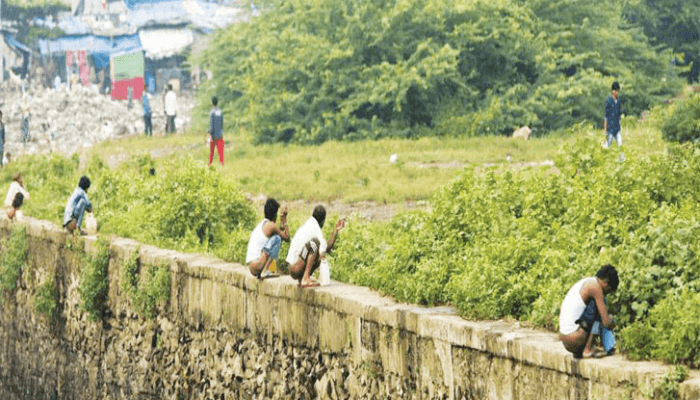
A few months ago, the people of Araromi Aperin, a small village on the edge of Oyo State, lived with a harsh reality, as many homes had no toilets, so open defecation was the only option.
People had to relieve themselves outdoors. The practice spread disease, made families sick, and carried a deep sense of shame, not by choice, but because there was no alternative.
Today, life has changed. Children walk to school without dodging human waste. Women no longer have to hide in the bushes or worry for their safety. Families are healthier, and the community talks openly about dignity, pride and cleanliness, things they once thought out of reach.
Across Nigeria, this transformation is slow but growing and it often begins in small, determined communities like Araromi Aperin.

A National Challenge Rooted in Everyday Realities
Nigeria’s open defecation crisis remains one of the country’s most stubborn public health challenges. According to the 2023 WASH National Outcome Routine Mapping (WASHNORM) report, over 46 million Nigerians still defecate in the open, placing the nation among the highest globally. Despite years of advocacy and investment, only two states, Jigawa and Katsina, have been certified open defecation free (ODF).
“If we have only two states that have been declared open defecation free out of our 36 plus the FCT, you can see how far we are. We are still very far. There are still states that have not even started the programme,” said Mr. Monday Johnson, the United Nations Children Fund, UNICEF’s WASH specialist.
Of Nigeria’s 774 local government areas, just about 140 LGAs have reached ODF status, a fraction of what is needed to meet the national target of ending open defecation by 2025 under the Clean Nigeria: Use the Toilet Campaign.
Yet the challenge is not confined to rural areas. Nigeria’s urban landscape is transforming at an astonishing speed. As of 2023, 54.3 percent of the population, about 123.7 million people, now live in cities, compared to 29.7 percent in 1990.

Unfortunately, sanitation systems have not kept pace. Only 25.4 percent of urban residents have access to safely managed sanitation, and more than 150 million Nigerians still lack basic sanitation services.
“Urban sanitation is our next big crisis. Rural areas are improving, but cities are falling behind,” Johnson warned.
Informal settlements in Lagos, Ibadan, Kano, Onitsha, Uyo, and Abuja present an especially daunting challenge. Overcrowding makes it nearly impossible to construct toilets or safely manage waste, resulting in contamination of water bodies, frequent cholera outbreaks, and a cycle of poverty fuelled by illness.
How Small Communities Are Leading the Way
Despite these systemic constraints, communities like Araromi Aperin show that dramatic change is possible. The catalyst in this case was leadership, the kind that listens, mobilises, and inspires action.
Under the guidance of its Royal Highness, Oba Mudasiru Obisesan Alararomi, the community embraced the call to end open defecation. When facilitators from UNICEF and the Oyo State WASH team first arrived, they expected scepticism or fatigue. Instead, they found a leader ready to champion change. The Oba hosted the visiting team, provided accommodation, and rallied his people.
“Before, our people didn’t understand why open defecation was dangerous. But now they know it brings sickness, and everyone is happy to have their own toilet,” said Mr. Jimoh Adetona,, deputy WASH coordinator for Ona Ara LGA.
Initially, only the palace had about 22 toilets. But once the Oba issued a royal directive mandating every household to build a toilet, the tide turned. To ease the financial burden, the community established a soft-loan scheme enabling households to pay an initial N17,000 for subsidised low-budget toilets costing about N65,000.
Neighbours volunteered to assist one another, digging pits, moulding blocks, and constructing slabs. Many families built what they once considered impossible, their own household toilets.
Today, Araromi Aperin stands as a community transformed. Nine out of eleven wards in Ona Ara LGA have already been certified Open Defecation-Free (ODF), with the remaining wards clustered in dense peri-urban pockets where sanitation challenges are more complex.
The impact on children has been especially profound. At Islamic Mission School, one of the community’s primary schools, teacher Omolara Oyelude said pupil attendance has doubled.
“Before now, children often fell ill or missed classes. But since we got toilets, that has changed. Our enrolment jumped from 40 to 80 pupils. The girls, especially, no longer stay home during their periods,” she said.
Still, challenges persist. The surge in enrolment has not been matched by an increase in teaching staff. “We need more teachers. But we are grateful our children are healthier and happier,” Oyelude admitted.
A Rigorous Path to Open-Defecation-Free Certification
UNICEF’s Johnson explains that becoming ODF is far from a symbolic declaration, it is a thorough, multi-tiered process.
“A community first claims to have stopped open defecation. The local government verifies this, then the State Task Group on Sanitation conducts further checks. Once all communities in the LGA are certified, a national team validates the entire LGA,” he said.
This layered approach ensures accountability but also demands coordination, training, and sustainable financing, conditions that are uneven across Nigerian states.
Urban Sanitation: The Next Frontier
With Nigeria urbanising at record speed, experts say sanitation strategies must evolve beyond rural-focused models. In Oyo State alone, 1.5 million households lack safely managed sanitation, and only three percent of excreta is safely disposed of.
To address this, UNICEF and partners are piloting Citywide Inclusive Sanitation (CWIS), a framework that integrates containment, emptying, transport, treatment, and reuse of waste across entire cities.
“Urban sanitation demands new thinking. We need systems that are affordable, resilient, and inclusive,” Johnson stated.
The Economic Case for Sanitation
Sanitation is not just a social investment; it is an economic opportunity. Analysts estimate a N75 billion sanitation economy in Oyo State alone if private-sector participation is scaled in faecal-sludge management and sanitation services.
But a gap remains as the average household can afford only N15,000 for safe services, far below the actual N50,000–N76,000 cost. Bridging this gap will require public-private partnerships, subsidies, and micro-credit schemes.
“The private sector must see sanitation as a viable market. With the right incentives, sanitation can be both sustainable and profitable,” Johnson said.
A Clean Future Built From the Ground Up
Nigeria’s battle against open defecation is far from over, but communities like Araromi Aperin offer a glimpse of what is possible. They show that a clean future does not start in high-level conference rooms or government offices, it begins in households, schools, and small communities determined to chart a different course.
“For us women, having a toilet at home means safety and pride. Our daughters no longer go into the bush. It has changed our lives,” said Mrs. Taiwo Adebisi, a mother of four,
For Nigeria, the path to a clean future may be long. But in its smallest communities, the journey has already begun.