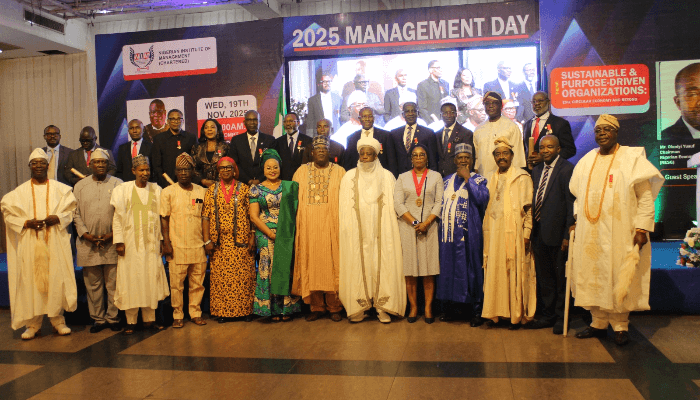
The Nigerian Institute of Management (Chartered) has reaffirmed its commitment to promoting world-class management practices in Nigeria.
NIM, at its 2025 Management Day Lecture in Lagos on November 19, held in honour of Peter Drucker, a global leader, showcased NIM’s leadership in driving excellence, sustainability and ethical governance across Nigeria’s public and private sectors.
With the theme “Sustainable and Purpose-Driven Organizations: ESG, Circular Economy and Beyond,” this year’s edition provided a dynamic platform for rethinking the future of organizational leadership in Nigeria.
Declaring the ceremony open, Abimbola Ayuba, president and chairman of the council of the Institute, described NIM as the nation’s symbol and custodian of management excellence. He called on the Federal Government to officially declare November 19 as a national day to celebrate the management profession, noting that strong management practices are indispensable to building resilient institutions and a prosperous nation.

Niyi Yusuf, managing director of Verraki Partners and Chairman of the Nigerian Economic Summit Group (NESG), explored the fast-rising global prominence of ESG principles and the circular economy. He noted that the global ESG investment market, currently valued at US$35.48 trillion, is projected to reach an extraordinary US$167.49 trillion by 2034, a signal that sustainability has become an essential driver of organizational relevance. Yusuf observed that Nigeria is making progress with existing governance codes but stressed the need for stronger enforcement and coordination.
He reiterated that ESG should be viewed not as a cost but as a long-term investment in organizational longevity. While acknowledging Africa’s climate-related vulnerabilities, he said the continent also stands before immense green investment opportunities if decisive action is taken. According to him, the task before Nigeria goes beyond economic development to nurturing a stronger moral foundation. “Profit sustains an organization, but purpose sustains a nation,” he concluded.
One of the major highlights of the day was the conferment of Fellowship on distinguished professionals who have met the Institute’s rigorous criteria. Drawn from diverse sectors of the economy, the new Fellows were urged to uphold the highest standards of professionalism and to remain worthy ambassadors of the Institute. In a historic moment, the Institute conferred its first-ever Honourary Fellowship on the Sultan of Sokoto and President of the Nigerian Supreme Council for Islamic Affairs, in recognition of his exceptional leadership and contributions to national development.
The Fellowship awarded to Lagos State Governor, Babajide Sanwo-Olu, was received on his behalf by the Secretary to the State Government, Abimbola Hundeyin. The ceremony drew notable traditional rulers, past presidents of the Institute, senior executives, captains of industry, and members of the diplomatic and policy communities.
The event also featured the presentation of long-service awards to staff who have dedicated a decade or more to the Institute’s growth and strategic influence. It was complemented by cultural performances and other attractions that added colour to the day’s proceedings.

At the close of the 2025 Management Day, the Nigerian Institute of Management reiterated its resolve to continue championing ethical leadership, sustainable development, and globally competitive management standards through its training programmes, advocacy initiatives, and thought leadership platforms. The Institute affirmed its commitment to remain at the forefront of shaping effective, purpose-driven and future-ready organizations in Nigeria.