…Calls for fairness, transparency and responsible media engagement
Governor Sheriff Oborevwori of Delta State has explained reasons why there should be fairness, transparency and responsible media engagement as Nigeria navigates key economic transitions, particularly tax restructuring and exchange rate unification reforms.
These reforms are not abstract policies but realities that influence commodity prices, wages, and the survival of small businesses, he said.
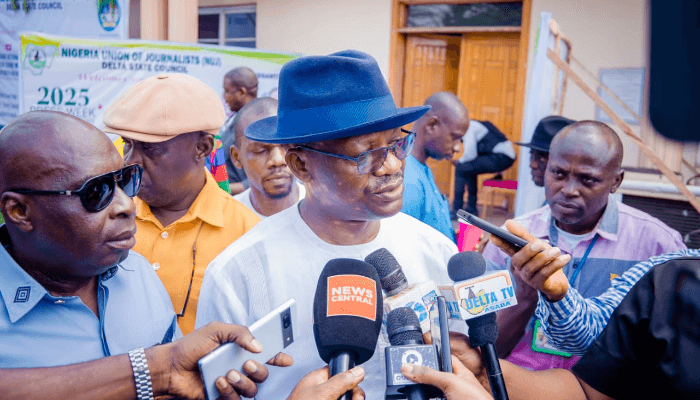
He explained this during the 2025 Press Week of the Nigeria Union of Journalists (NUJ), Delta State Council, held in Asaba, Thursday, with the theme, “Tax Regimes and Exchange Rate Unification: Economic Implications and the Media’s Strategic Role.” Oborevwori described taxation as the backbone of government revenue and a critical tool for national development.

Read also: Private Equity firms see Nigeria risking capital inflows on 30% Capital Gains Tax
“Without effective tax regimes, no government can sustainably provide infrastructure, healthcare, education, and security,” he said.
He stressed, however, that taxation must be fair, transparent, and growth-oriented, warning that complex and multiple tax structures discourage investment, while weak enforcement undermines development.
Oborevwori who was represented by Charles Aniagwu, Commissioner for Works (rural roads) and Public Information, reaffirmed his administration’s commitment to broadening the tax base, reducing leakages, and ensuring that every naira collected is judiciously invested in the welfare of citizens.
He described the exchange rate unification policy as a bold step aimed at stabilising the currency, attracting foreign investment, and eliminating distortions in the foreign exchange market.

While acknowledging short-term challenges, including inflationary pressures associated with the move, he insisted that the long-term gains remained substantial.
“These reforms will bring greater investor confidence, a level play field for businesses, and enhanced competitiveness for Nigerian goods and services,” he noted.
For states like Delta, with vibrant oil, gas, and agricultural sectors, stable exchange rates are “critical to unlocking export potential and driving economic diversification.”
He assured that the government was working to cushion their impact through targeted social interventions, infrastructure investment, and support for local industries.
He highlighted the crucial role of the media, noting that journalists remained central to shaping public understanding of economic reforms.
He cautioned that fake, misleading, or sensational news could inflame tensions, destabilise communities, and undermine confidence in national institutions.
He encouraged the NUJ and all media practitioners to approach their duties with courage, fairness, and patriotism.
even as he reaffirmed the state’s readiness to partner with the media by providing access to information and promoting transparency in governance.
Thus, he called for unity: “Together, we can build a Delta State and a Nigeria where reforms are embraced as stepping stones to greatness.”
In his keynote address, Joel-Onowakpo Thomas, the Senator representing Delta South at the National Assembly, noted that tax reforms and exchange rate unification were central pillars of a broader agenda of President Bola Tinubu’s administration to stabilise and grow the country’s economy.
Read also: Is the withholding tax on fixed-income a new law?
“These reforms are not abstract ideas; they are strategic actions that rebuild an economy that works for all”, the Senator, who was represented by Uzuazo Ikelegbe, said.
Earlier in his remarks, Churchill Oyowe, chairman of the State Council of the NUJ, said the theme of the event was deliberately chosen to provoke thought, inspire policy conversations and reaffirm the media’s role as both the watchdog and bridge between government and the governed.
He expressed gratitude to Governor Oborevwwori for his administration’s unwavering support for press freedom, infrastructure development and inclusive governance under the MORE agenda.