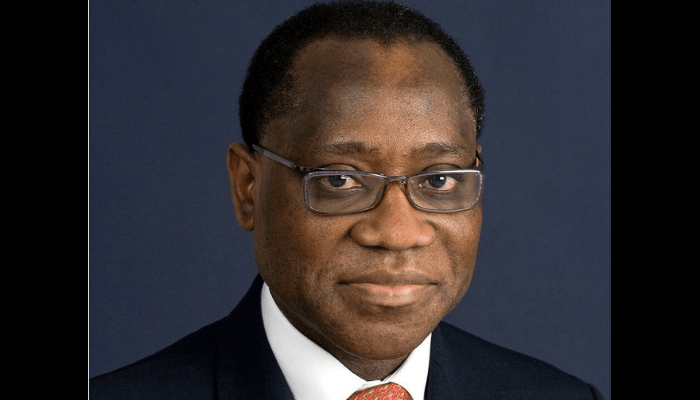
Nigeria’s vast economic potential remains trapped by weak political leadership, a collapsing value system, and a public service culture that rewards wealth over integrity, former Minister of Industry, Trade and Investment Olusegun Aganga said, warning that the country cannot achieve meaningful development until it confronts these foundational failures.
Speaking on Thursday at the book launch of “In the National Interest: The Road to Nigeria’s Political, Economic and Social Transformation,” written by Olu Fasan, a foremost columnist and policy analyst, Aganga said Nigeria’s inability to convert its human and natural resources into prosperity is not due to a shortage of talent but a political structure that shuts out the best and empowers the least prepared.
Read also: Improved economic activities drive lenders’ increased credit supply
“There is no shortage of competent leaders in Nigeria. What we lack is competent political leadership with national interest at heart,” he said. “Our political system is structured in a way that prevents the best talents from emerging.”

He blamed the monetisation of politics, godfatherism, and self-serving party structures for blocking credible leaders, while technocrats who do get appointed are often constrained by political interests that override economic reforms.
Aganga, who was also a former minister of finance, said these systemic weaknesses have produced a public service culture that treats government roles as money-making opportunities instead of a commitment to national progress.
“Public service must not be seen as a wealth-generating venture. Those seeking money should go into private enterprise,” he said. True public servants, he added, must be driven by contentment, honesty, and a sense of duty, traits increasingly rare in today’s governance ecosystem.
He warned that Nigeria’s value collapse has become a major economic risk. The country’s obsession with wealth, regardless of its source, has eroded accountability and allowed corruption to flourish across institutions. “We are a society that recognises only wealth and power, even when we do not know the source. That was not the generation I was born into,” he said.
According to Aganga, this distortion of values helps explain why Nigeria’s financial system is damaged, why institutions are weak, and why the country is unable to translate its demographic strength into economic gains.

With an average age of 18.6 years and poverty rising “by six people every minute,” he said, Nigeria’s population — its greatest asset — has become largely unproductive due to decades of neglect in education, health, and skills development.
“Nigeria’s large and growing population is simply not working for anyone. Our biggest asset is our people, not oil,” he said.
Aganga outlined solutions from his book, Reclaiming the Jewel of Africa, calling for a national values orientation programme embedded in the civil service, judiciary, National Assembly, private sector, and religious institutions.
National honours, he argued, should be tied strictly to integrity and withdrawn when recipients violate public trust, a standard common in advanced democracies but almost nonexistent in Nigeria.
He also urged the reintroduction of civic education at primary and secondary levels, alongside a penalty-and-reward system that promotes ethical behaviour and punishes misconduct.
Read also: Nigeria’s economic momentum at risk on rising insecurity
“These are simple reforms we can implement if we truly want to rebuild this country,” he said. “Until we fix leadership recruitment, repair our values, and strengthen institutions, Nigeria’s economic potential will remain locked up.”
In his remarks, the chairman of the book launch, Anya O. Anya, a professor and the former chairman Nigerian Economic Summit Group, said the government needs to revamp the country’s democracy to be more inclusive, rather than the exclusiveness being observed, noting that that could help redeem lost trust pervasive in the nation.
Frank Aigbogun, publisher of BusinessDay and the book reviewer, also described the 12-chapter-long piece as one that analyses Nigeria’s political, economic, and social challenges and offers profound ideas on the way forward, emphasising that the continued failure of Nigeria to recreate itself and evolve into a strong and united nation-state is both “unfortunate and unacceptable.”