|
Getting your Trinity Audio player ready...
|
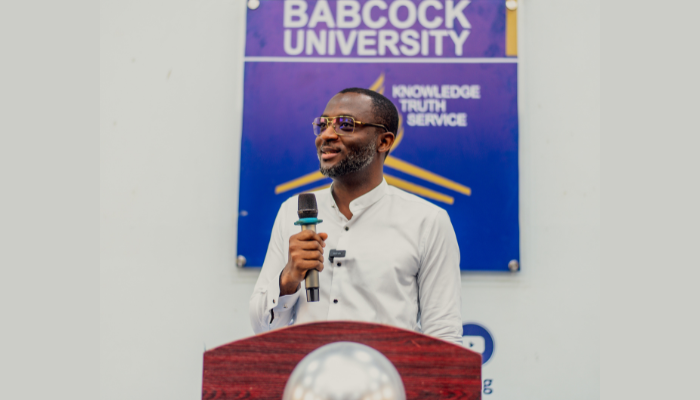
The School of Computing at Babcock University has marked its 25th anniversary with a keynote address by Mayowa Okegbenle, CEO of PressOne Africa, at the BUTH 600-Seater Auditorium in Ilishan-Remo, Ogun State. The anniversary event brought together faculty, students, and industry participants to reflect on the development of computing and the direction of artificial intelligence.
Okegbenle delivered a keynote titled “The Past, The Present, and The Future of Artificial Intelligence,” where he outlined the shifts that have shaped AI and its growing relevance in work and society. The Department of Computer Science invited him to share lessons from industry and to provide what the department described as “invaluable insights” for the academic community.
During his address, Okegbenle spoke about PressOne Africa’s work with AI and the company’s process of testing different approaches to customer operations. He recalled how the company began by relying on large groups of human customer service personnel but soon found the approach difficult to scale.
“We compared our early experiment and saw that only existing staff—people who had spent over 12 months with us, were able to deliver the results we wanted,” he said. “But we had already committed to annual targets. We couldn’t pause to train 100 new hires for months. We had to ask ourselves: Can AI do this work? Can AI talk to customers, onboard them, and deliver value at scale? And then we got to work.”

This effort led to the creation of Juliet, an AI-powered employee that now supports thousands of customer conversations across messaging platforms. Okegbenle explained that the tool has become central to PressOne Africa’s operations.
“Customers responded, they engaged, and they never realised they were talking to AI,” he said. “In the first week, humans still took over about 50% of conversations. Today, that number is less than 5%. Juliet now outperforms any human team we could have hired. For us, AI is not a cool trend, it is business.”
Okegbenle also spoke to students about the future of software engineering. He noted that job roles will change as AI advances, but he encouraged students to take advantage of new opportunities. He drew a link between the earliest stages of computing and the present moment.
“Computers existed before machines,” he said. “People were hired just to compute. But we eventually realised humans were too slow, and the first computing machines were built. The same shift is happening today with AI.”
As part of the ceremony, Okegbenle took part in the launch of the Babcock Compendium and the department’s new Artificial Intelligence Laboratory. The laboratory will support research and practical training in machine learning, robotics, and intelligent systems.