The percentage of women’s representation in Nigeria’s most valuable companies’ boardrooms has risen to the highest level this year since 2020 on the Nigerian Exchange (NGX).
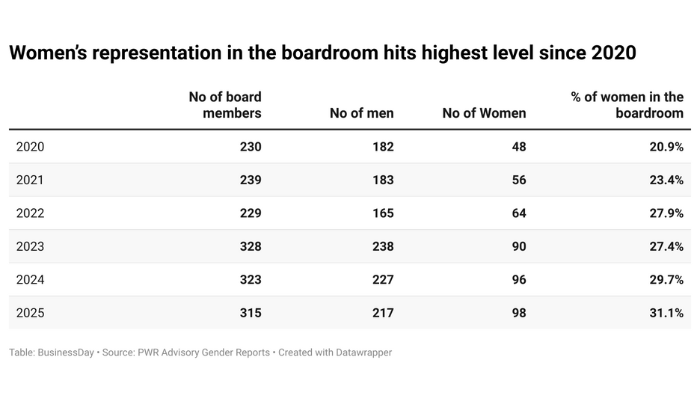
According to the NGX Top 30 Gender Diversity Scorecard by PWR Advisory, an inclusion and sustainability advisory firm in Africa, the percentage of women who secured seats at the boardroom tables of Nigeria’s most valuable companies has increased by 31.1 percent this year, up from 20.9 percent reported in 2020.
In 2020, when the scorecard was launched, the primary highlight of this scorecard centered on female representation on the board of the top 20 companies by market capitalisation on the NGX.
Read also: Leadway Assurance names Adebisi Lamikanra as first female board chairperson

The scorecard was developed with the support of Avivah Wittenberg-Cox, CEO of 20-First. The UK sourced current data from the company’s annual report, the company’s website, and the NSE website.
The 2020 gender report revealed that out of a total of 230 board seats, only 48 seats are held by women (20.9 percent), and 182 seats are held by men (79.1 percent).
However, according to the 2025 PWR Advisory report, women now occupy 98 out of 315 total board seats in NGX-30 companies as of July 31st.
“This edition of the scorecard gives us cause for optimism,” said Ivana I. Osagie, founder and CEO of PWR Advisory. “Women now hold 31.1 percent of board seats at Nigeria’s 30 largest listed companies, the highest since we began tracking the data.”
“For the first time, no company in our sample has an all-male board. Significantly too, there are five women CEOs, the highest since the scorecard’s inception, compared to four last year, and three companies have female board chairs, up from one in 2024,” she said.

The report underscores that 53.3 percent of the NGX-30 companies have achieved at least 30 percent female board representation, which aligns with what it describes as the Critical Mass Theory, the idea that 30 percent is the minimum representation level required for minorities to exert meaningful influence in decision-making.
When compared globally, the report places Nigeria’s progress in context. The PWR report cites the 2024 South Africa Spencer Stuart Board Index, which shows that 47 percent of board seats across the Johannesburg Stock Exchange (JSE) top 50 companies are held by women.
“Average female board representation for Africa is 23 percent based on the Sustainable Stock Exchanges’ 2023 report, while the MSCI Women on Boards and Beyond 2024 report puts the global average at 27.3 percent (large- and mid-cap companies),” it said.
Temi Popoola, the group managing director of NGX, represented by Olufemi Shobanjo, CEO of NGX Regulation Limited, during the launch of the report, commended PWR Advisory for launching the 2025 NGX30 Gender Diversity Scorecard, describing it as a vital instrument for fostering inclusivity in Nigeria’s corporate sector.
“Gatherings like this play a crucial role in fostering inclusivity and promoting gender diversity at the highest levels of corporate governance,” he noted.
He emphasised that gender-diverse boards are not just equitable but also yield measurable business advantages.
Gender-diverse boards lead to better decision-making. They reduce blind spots and deliver superior business outcomes,” he said. “It also leads to more resilience, innovation, and competitiveness on the global stage.”
Dahlia Khalifa, IFC regional director for Central Africa and Anglophone West Africa, said for Nigeria, Africa’s most populous country, ensuring that leadership reflects the diversity of its people is truly non-negotiable.
Read also: NGX records zero startup IPOs three years after launching tech board
According to the IFC’s 2023 gender data, women accounted for 25 percent of board seats in Nigeria, 8 percent of board chairs, and 8 percent of CEOs. These numbers show momentum but also expose persistent gaps.
“Increasing the participation of women as leaders, entrepreneurs, and employees is not only a moral imperative but also a smart business strategy,” she said. “Companies with more women in leadership have been shown to outperform their peers in profitability, innovation, and resilience.”
She added that closing the gender gap in Nigeria’s key sectors could yield an economic gain of up to $22 billion in GDP.
Describing IFC’s initiatives, she shared examples from the Nigeria2Equal Program developed with the NGX.
“We mobilised 18 leading companies to make measurable commitments. Together, they introduced 147 gender-smart policies, reaching 49,000 employees, enabling access to finance for over 2,000 women entrepreneurs, and supporting 70,000 women with skills and business support,” she stated.
Outlining steps to accelerate inclusion, she said, “We must scale what works, move beyond compliance, and invest in women at all levels, not just board seats. If we want women on boards tomorrow, today we must invest in them at every level.”
Here are five companies with a female CEO and their female board members
FCMB Group
Half of its 10 board members are women.
-Yemisi Edun – managing director and CEO.
– Oluwatoyin Olaiya – executive director, Risk Management and Compliance.
– Olufunmilayo Adedibu – Non-Executive Director.
-Felicia Obozuwa – Executive Director, Corporate Services and Service Management.
– Olayemi Keri – Non-Executive Director, Independent.
Fidelity Bank
5 out of 12 board members are women
– Nneka Onyeali-Ikpe – MD/CEO.
-Amaka Onwughalu is a managing partner at Blueshield Financial Services and also a non-executive director at Fidelity Bank.
-Morohunke Bammeke is a non-executive director, and she is currently the managing director of Cedar Capital Consult Limited.
– Obiaku Okam is a non-executive director and serves as the managing director and chief executive officer of Skycurve Nigeria Limited.
– Pamela Shodipo – Executive director.
Transnational Corporation
Three out of the nine board members are women
– Owen Omogiafo – president/group CEO.
– Foluke Abdulrazaq – Independent non-executive director.
– Toyin F Sann – Non-executive director and the founder/executive chairman at Emerging Africa Group.
Zenith Bank
5 out of 14 board members are women
– Adaora Umeoji – Group managing director/CEO of Zenith Bank Plc.
– Adobi Nwapa – Executive director.
– Omobola Ibidapo-Obe Ogunfowora – Non-executive director.
– Juliet Ehimuan is the founder of Beyond Limits Africa and a non-executive director of Zenith Bank.
– Pamela Mimi Yough – is a non-executive director of Zenith Bank.
Transcorp Hotels Plc
Four out of seven board members are women
– Uzoamaka Oshogwe – MD/CEO.
-Owen Omogiafo is a non-executive director and the president and group CEO of Transnational Corporation Plc.
– Adesimbo Bello-Ukiri is the pioneer managing director and CEO of Avon Healthcare Ltd. and a non-executive director at Trancorp Hotels.
– Bolanle Onagoruwa – Independent non-executive director at Trancorp Hotels.