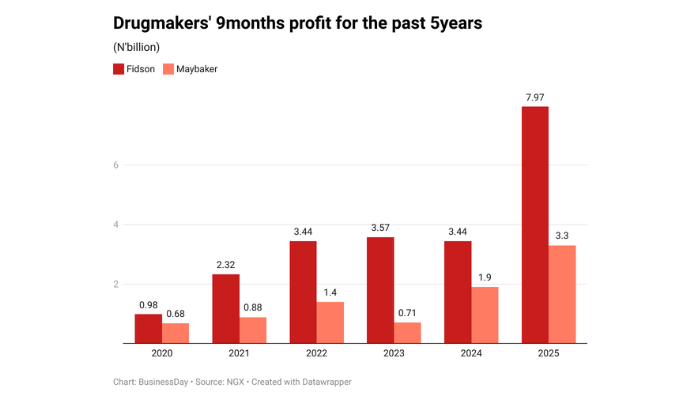
Nigeria’s top pharmaceutical companies have recorded their strongest profits in at least five years, driven by the exodus of multinationals, which has created room for local manufacturers to fill the widening supply gap in Africa’s biggest consumer market.
Fidson, MeCure, and May & Baker, the three listed players, saw their combined profit for the nine months to September 2025 grow to N15.77 billion, representing a 127.2 percent rise from the same period last year.
Analysts say the more-than-twofold surge in profits growth is likely driven by rising demand for medicines, fuelled by a growing population, and the exit of major players such as GlaxoSmithKline (GSK), which has handed local drugmakers a higher market share.
Samuel Oyekanmi, research and insights lead at Abuja-based consultancy Norreberger, said there are signs of rising demand for local drugs.

Read also: French food giant Danone bets big on Nigeria amid multinationals exit
“The exit of the likes of GSK pretty much presents an opportunity for both those local players to be able to maximise and improve their market share, and as much as possible, improve revenue,” Oyekanmi said. “When you have limited players in the market, the (drug) producers can dictate the market.”
Global giants such as GSK in 2023 and Sanofi-Aventis in 2024 scaled back their direct commercial operations, transferring most of their portfolios to third-party distributors. This was as Nigeria faced its biggest challenging moments due to the sharp removal of subsidy and floating of the naira.
The twin policies, which President Bola Tinubu began more than two years ago, saw inflation balloon to a multi-year high, while the naira plummeted by more than 70 percent before stabilising.
The weak naira was equally a blessing in disguise for the drugmakers. According to Oyekanmi, the weaker currency sharply raised the cost of imported medicines, giving local manufacturers unprecedented pricing power. This also affected the cost of foreign medical tourism, leaving consumers with local options. “Even if prices have gone up, it’s still the better alternative,” he said.

This is particularly evident for drugs treating acute illnesses, infections, and pain, where demands remain high despite price increases. All of Mecure’s N60 billion revenue was generated in Nigeria, with acute treatments’ earnings accounting for N33.6 billion.
For Aniekan Joseph, a Lagos-based public analyst with a keen interest in health system reforms, the profitability wave is structural rather than cyclical.
Read also: Jobless rate rises on multinationals’ exit, factory closures
“Beyond production efficiencies, the consumption environment is proving transformative. Hospitals—public and private—have increased procurement as patient volumes rise. As the purchases of local brands grow, retail pharmacies are expanding to meet surging urban demand. Health Maintenance Organisations (HMOs) now formalise purchases through insurance-backed channels, which provide recurrent revenue,” Joseph said.
“Outside the formal health ecosystem, self-paying consumers drive retail demand. A gradually expanding middle class and rising health awareness seem to have broadened access. The spread of digital pharmacies has also created a latent consumer base with long-term growth potential,” he added.
Fidson Healthcare Plc was the biggest gainer, posting a turnover of N93.1 billion in the reviewed period, up 56 percent from N59.7 billion in 2024, with profit more than doubling to N7.97 billion.
Mecure Industries nearly doubled revenue to N60 billion, with profit surging 181 percent to N4.5 billion, reflecting rapid expansion, contract manufacturing growth, and higher production utilization. May & Baker Nigeria Plc, on its part, delivered steady gains, with revenue rising 35 percent to N29.5 billion and profit jumping 74 percent to N3.3 billion.
These results reflect disciplined cost management, operational efficiency, and strategic scale expansion, suggesting that the sector’s strong performance is driven by structural shifts in the market rather than short-term currency fluctuations.
Still, analysts warned that sustaining growth will require regulatory consistency. Joseph said the National Agency for Food and Drug Administration and Control (NAFDAC) and the Pharmacists Council of Nigeria (PCN) must align local manufacturing standards with global benchmarks such as Good Manufacturing Practice (GMP) certification and World Health Organization (WHO) prequalification.
Read also: Multinationals exit Nigerian operations to limit FX exposure
The drug production industry points to a sector moving from import substitution toward local dominance, driven by a combination of FX-driven market consolidation, structural shifts, and rising domestic demand.
“Transparent post-market surveillance and stricter quality audits would protect consumers and enhance the export competitiveness of Nigerian-made drugs,” he said.
Oyekanmi added that while revenue momentum is likely to continue, growth may moderate. “We anticipate demand will keep revenue improving, but not as aggressively as we have seen so far in 2025,” he said.