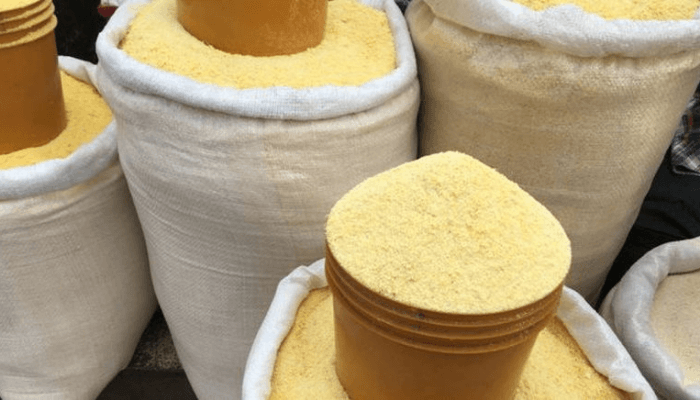
Cassava glut has forced down the price of garri by 51 percent year-on-year, as farmers grapple with oversupply.
The price of a small bucket known as ‘paint’– a popular measurement for selling the commodity across Lagos (yellow) – has declined by 51 percent from an average of N3,500 sold in 2024 to N1,700 in the same period of 2025, according to BusinessDay’s market analysis.
A 60kg of yellow garri currently sells for an average of N20,000 as against N42,000 sold in the same period of last year, indicating a 52 percent decline over the period. Also, a 60 kg of white garri now sells for an average of N18,000.
BusinessDay’s market survey shows that the price of the commodity is even lower in Abuja – the country’s capital. A ‘modu’– popular measurement in the northern region – now sells for N500 as against N900 sold in the same period last year.

Farmers have attributed the sharp drop in the price of the commodity to oversupply and low demand of the commodity, especially from processors.
Read also: A calmer December? Why prices may remain stable despite festive fears
Oversupply
Segun Adewunmi, a cassava farmer and former president of the Nigeria Cassava Growers Association, said that there is oversupply of the commodity from farmers across the country.
“There is currently a glut of cassava because people were inspired by high prices of the produce last year and lots of people went into it massively this year. Now, many of them have cassava, but there is no market for it,” he explained.
Adewunmi added that the cost of harvesting is more than the market value of cassava, but processors want to buy at the harvesting price, which, according to him, will lead to losses for farmers.

“Processors could not afford to buy cassava at the rate farmers wanted them to buy, so they imported instead, which happened to be cheaper. So, there was an excess of cassava that eventually had to be converted to food.”
Price slump persists
At the peak of the rainy season in 2024, a pickup truck of cassava tubers sold for an average of N300,000 in Oyo State. However, the same truck currently sells for N20,000, representing a 93 percent slump within a year.
The downward trend continues in the North-Central region, where prices of a pickup van have crashed by 86 percent to N50,000 from an average of N400,000 last year.
He noted that the country periodically experiences glut in cassava production. “This is not unusual,” Adewunmi said. “It always occurs every three years. This is because when cassava is scarce, farmers will run to the farm. This will eventually lead to an oversupply in the coming years.”
Cassava cheaper for processors
Nigeria is the largest producer of cassava globally. The country has seen a 10 percent rise in cassava output over the last five years—from 56.96 million tons in 2019 to 62.69 million tons in 2023, according to data from the Food and Agriculture Organisation (FAO).
Toyosi Olatayo, founder of Palmira Farm Trade, an agro firm involved in cassava business, told BusinessDay that while cassava glut led to a fall in garri prices, it was a different story for processors.
“It became cheaper for processors to import ethanol and starch than buy from local farmers because farmers’ price rate was so high,” she said.
Ethanol and starch are two by-products of cassava used by pharmaceuticals, cosmetics and consumable companies.
Read also: Food price drop offers rare relief for families
Pinning the cheap import to the free import window allowed by the federal government between July and December 2024, she noted that, “cassava prices began crashing when processors discovered that it was cheaper to import ethanol and the likes than buy from local suppliers.”
Nigeria has a supply and demand gap in cassava processing. This leaves processors scrambling for cassava with a consumer population that makes up more than 70 percent of the market chain.
Cassava glut cycle
Cassava glut has been a usual occurrence in the value chain for many decades. Commonly referred to as the boom-bust cycle, it occurs every three years, alternating between periods of abundance and scarcity.
“When there’s cassava glut, there is usually a higher supply than demand, but the issue now becomes pricing, especially for industry players,” said Austin Maduka, public relations officer of Cassava Growers Association of Nigeria, Abuja chapter.
“Garri becomes cheaper for consumers, but cassava prices become high for processors.”