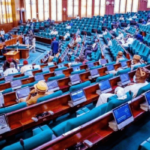
A storm of political speculation swept through the National Assembly last week when reports emerged alleging a covert plot to unseat the President of the Senate, Godswill Akpabio.
The rumour fueled by unnamed insiders and amplified by the media suggested that forces within the Red Chamber were quietly mobilising to challenge the Senate President’s leadership.
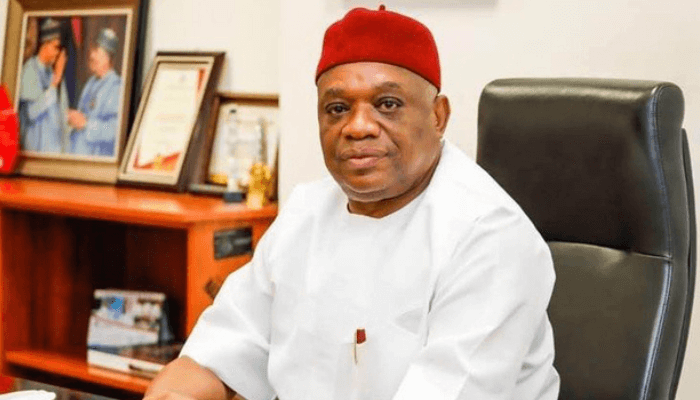
Kalu, the Senator representing Abia North and a former Governor of Abia State, seized the moment to address journalists in the Senate, firmly refuting claims of an internal rebellion.
Read also: Senate leader denies move to oust Akpabio

However, in doing so, he inadvertently became the centre of political interpretation and speculation, especially as the race toward the 2027 Senate Presidency slowly gains shape behind the scenes.
For many in the National Assembly, Kalu’s sudden visibility is more than a coincidence.
It is part of a wider, carefully choreographed effort to reposition himself for the Senate’s top job when the curtain falls on the current tenure.
On Tuesday, as chatter about the alleged impeachment plot dominated political conversations, Kalu invited journalists for what appeared to be a clarifying engagement.
In his speech, he sought to cast the Senate as stable, united, and unwavering in its support for Akpabio.

“Well, whatever the problem is, the Senate is more interested in making laws that will help President Ahmed Tinubu overcome the economic challenges our people are going through,” he said.
“We are more interested in the people. You can see that the legislation we are bringing are pro-people, and we are focused on redeeming the Nigerian people to ensure that they eat three times a day.”
In emphasising unity, Kalu moved further to deny any institutional chaos, insisting the Senate was not only stable but resilient against internal sabotage.
“Though there were attempts, we didn’t allow that to happen. That is why I say we are one big family, and it is not going to happen,” he asserted, responding sharply to a journalist who pressed him on the rumoured plot.
“Were you there? Even if there were attempts, we will never allow that to happen.”
The tone was firm and defensive, yet political watchers noticed a layered undertone.
While Kalu reaffirmed loyalty to Akpabio, he simultaneously cast himself as a protector of Senate unity, a senior statesman rising above petty squabbles.
For a man widely believed to be nursing a renewed ambition for the Senate Presidency in 2027, the optics were unmistakable.
Barely 24 hours after Kalu’s media engagement, Opeyemi Bamidele (Ekiti Central), the Senate Leader, took the floor during plenary to offer what many considered a more authoritative rebuttal to the rumour.
Read also: Drama in Senate over Trump’s threat as Akpabio, Barau differ on response
Bamidele dismissed the reports in strong terms, calling them “false, misleading, and intended to sow confusion within the National Assembly.”
“There was no attempt by any of our colleagues, nor any discussion around the possibility or otherwise of the removal of the Senate President from office,” he declared.
He reiterated that the Senate was united under Akpabio’s leadership and focused on national priorities, not political distractions.
“We are totally united and have developed a zero-tolerance attitude toward distractions,” he said.
“Reports like that are calculated to create confusion.”
His intervention seemed designed not only to calm the chamber but also to shut down interpretations arising from Kalu’s earlier remarks, particularly those suggesting that the Abia North Senator had confirmed, rather than denied, an attempted coup.
Kalu, displeased with the mischaracterisation of his comments by the media, doubled down on his earlier stance.
“The Senate remains one big family,” he insisted.
“There is no crisis. What you are hearing is nothing more than a family misunderstanding.”
He clarified that at no point did he affirm the existence of a plot to remove Akpabio.
Instead, he argued, he was stressing the internal strength of the Senate, that even if troublemakers existed, the Senate had the maturity to neutralise them.
Yet, the damage was done.
The misinterpretation of his remarks had set tongues wagging within the National Assembly. Some lawmakers whispered that Kalu’s statement had been ambiguous, perhaps intentionally so.
Others argued that the episode was blown out of proportion by political actors eager to shape the 2027 succession race.
To understand the subtext, one must revisit the events of 2023.
When the 10th Senate was inaugurated, Orji Uzor Kalu was one of the earliest and most vocal aspirants for the Senate Presidency.
Seen by many as experienced, influential, and well-connected within the APC, Kalu initially had a strong case.
But the party leadership quickly settled on Akpabio, leaving Kalu sidelined.
He responded with visible disappointment but played along with the party’s decision, at least on the surface.
Since then, Kalu has not hidden his aspiration for another attempt in 2027.
He has intensified media engagement, strengthened political alliances, and amplified his public presence.
Observers note that he has also adopted a more statesmanlike tone, always positioning himself as a defender of Senate unity and a champion of national interest.
It is against this backdrop that his intervention in the impeachment rumours must be understood.
Kalu’s comments could be interpreted in two ways:
Read also: Natasha, Akpabio and the “Not-an-Olive-Branch” Letter
A defence of Akpabio, suggesting that he is committed to preserving institutional stability and supporting the President of the Senate.
A strategic move to portray himself as indispensable, a man who stands above crisis and could be trusted with leadership in the next Senate.
Senator Bamidele’s strong counter-statement was therefore not just a clarification, it was a subtle rebalancing of the political narrative.
Where Kalu’s remarks appeared open to interpretation, Bamidele’s response was crisp, institutional, and final.
Some insiders believe Bamidele was cautioning Kalu, reminding him that parliamentary leadership narratives must be shaped from the floor of the chamber, not from impromptu interviews.
For now, both Kalu and Bamidele insist the Senate is united under Akpabio. But beneath the surface, the political currents are clearly shifting.
Kalu has already begun the early dance for 2027.
His words, actions, and visibility increasingly reflect a man preparing for high-stakes political negotiation.
The alleged impeachment plot may have been a rumour, but it provided the perfect stage for Kalu to remind the political class that he remains a force in the Red Chamber, and that the battle for the Senate Presidency in 2027 is already underway.