…Showcases seven master artists in first exhibition
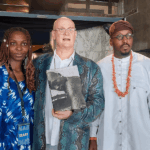
For Babatunde Olufon and his partner, Ope Sangosanya, founders of Ini Gallery, Lagos, there is no place like home. Both Nigerians are based in the United States of America, but there is no losing touch with the land of their birth this art season. They have arrived to rev up the Nigerian arts scene with revolutionary concepts.
November 8, 2025, was like a homecoming for them as LasGidi, their first major exhibition, hit the ground running at Ini Gallery, Lekki Phase 1, Lagos, a dream come true for the duo. Before now, they had organised so many exhibitions outside Nigeria.
Happening a week after the recent Lagos Fashion Week, the exhibition was looking at “an intersection between art and fashion. “That is what LasGidi is all about. That is what is supposed to put LasGidi on the map,” said Olufon at the opening ceremony.

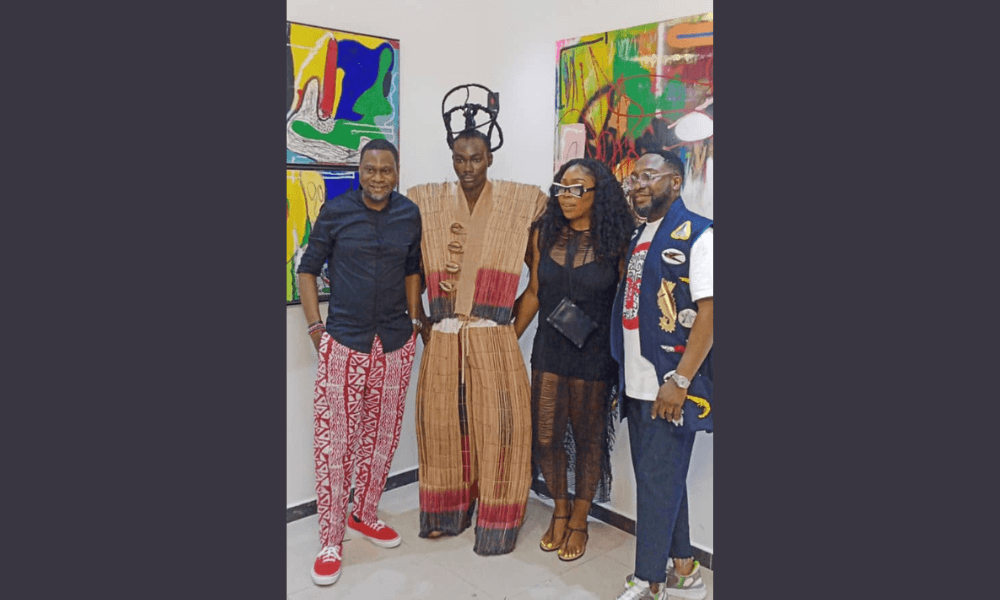
The exhibition featured seven artists, including; Tola Wewe, Victor Ekpuk, Anthony Nsofor, Jamilla Okubo, Fola David, Anjoreen Couture, and Idera Oyeneyin, whose collective creativity showcases African creativity across paintings, traditional wearable art, and sensory experiences. It was a rare artistic mesh in Nigerian art exhibition trends. The exhibition witnessed a splash of colours, sounds, magic and abundant laughter.
According to Ope Sangosanya, co-founder of the gallery, the aim was to establish a connection between the diaspora and the African continent. “As a gallery, we are a nomadic gallery in the sense that we don’t want to be fixated in one place. We believe we need to spread our wings. That is why we decided to have this exhibition. It is the first of the many we shall be holding in Nigeria. Obviously, being nomadic, it is something we shall be doing across the continent. In a few years, we shall be in Ghana, Cameroon, among other countries,” he said.
Tola Wewe exhibited the elegance and functionality of the Yoruba wears. His works portray how functional and comfortable the Nigerian wears are, evident in the Buba and iron fitting, made with unique material mixed with traditional Yoruba Aso Oke fabric.
“People want to identify with their culture,” said the artist. “As Nigerians and Africans, we have things that are unique to us that are comparable, if not better than what we have in other parts of the world. So, we need to introduce, wear, and exhibit it in our art,” Wewe said.
His inspiration comes from the day-to-day activities, parties, church outfits, reminiscent of one of the exhibited works depicting a lady going to church in a fashionable manner. “We are writing history,” he echoed.

On his part, Anthony Nsofor, a painter and vice president, Artist Association in Torpedo Factory, USA, brought a novel concept to the LasGidi exhibition. His were perfumes, made in collaboration with a perfumer who prepared exclusive performers, limited edition perfumes with a body of work he had been known with since 2008. The perfume is called Citizens of Nowhere. The painting is inspired by that identity of an international nationalism that does not just identity with a small village or country that cuts across borders and has the ambition of being ambassadorial. It connects people from different spaces.
“The perfumer got notes that were inspired by the vibrancy of my work, and he wanted to give that spiciness, exploration of adventure we always talk about when you talk about travel – the restlessness of the voyager, almost like the poem ‘’Ulysses’. Inside those conversations, he created 48 bottles, and the picture on the bottle is from my series,” Nsofor said.
Idara Oyeneyin exhibited three works, which have an element of religion, identity and sexuality. One of them is entitled WTF (Waterfall), and very sexual. It has a play of both female reproduction and sexuality in it. You also see it ejaculation. “It is very sexual,” said the artist.
Another one is entitled “Uncharted Territory”. The artist explained: “It is talking about you being a destination, just trying to find your way and navigating what life throws at you. The third work is entitled “27”, a reference to Psalm 27. “There is a cross on it and there is a man. It depicts that, though you face challenges in life, you still stay focused,” she said. She is a fashion designer, who, with her work, “does a lot of storytelling.”
Anjorin Babatunde exhibited four unique clothes at LasGidi. “I believe in nature. We live by nature. Nature is the power behind my creativity,” he declared. “You can get inspiration from nature and transform it to an afrocentric design.”
The materials he used for the wears take you back to the slavery era and the homemade clothes some Africans were wearing then. Lest we forget, “Fashion can never expire. ‘Eru di Oba’ (the slave Becomes the King) series is derived from rafia sack material combined with traditional Yoruba Aso Oke fabric.
Sangosanya said that the EVVDEE Art Academy was not a one-dimensional galley. In the future, it might be infusing art and music, art and drama, and art and performance art. “We intend to cover the entire spectrum of the arts,” he noted.
Olufon added that the gallery was out to make a difference in Nigerian art. “It is a great thing that we are having too many galleries in Nigeria. Art has to be brought to the people – art is for the people – and the more we have this gallery, the better. Like what you have seen in LasGidi, we have brought somebody from the United States to showcase his work, and we also do the same vice versa, That in itself is building bridges. We are amplifying the culture using art, fashion, music and drama.”