…Stakeholders map out plans for self-survival
A cargo airline may soon begin operations out of Port Harcourt International Airport. This is to be floated by export operations managers and exporters operating in the Port Harcourt zone who said they are tired of complaining about high and discriminatory freight rates against the Niger Delta region and south-east states.
Thus, the stakeholders concluded a one-day summit in Port Harcourt with anger against endless costs and high airfreight charges which they say make goods from the Port Harcourt International Airport to be over priced.
The summit attended by key stakeholders including government, the private sector, academia, small businesses, and export-supporting institutions in the export value chain agreed that goods out of Port Harcourt are over charged.

The reasons range from risk charges, aviation fuel being brought in from Lagos, the status of PH as a transient but not a destination port, etc.
Agencies of the federal government denied culpability, saying their charges were not responsible for the freight disparity.
A big ovation hoever erupted when one panelist, Omanake Mathew Clever, said to be the CEO of Klever Handling Global Resources, an Airfreight consulting company, showed the stakeholders what could be done to bring down the costs in Port harcourt instead of continuous lamentations.
Claver suggested forming a group from the exporters to meet every government agency involved in export value chain, and negotiate from a point of strength. The expert also said they could go get their own airline, agree on regular volume, and all of them would fly their containers out of Nigeria.
In an interview on the side of the summit, Claver said his firm was just leveraging on over two decades experience on the air freight industry. “We are also into airline consulting for startups and we are doing a whole lot currently. Going by what I said there the truth is that the state of variation and operator variation, the state has not been able to focus on trying to help straight freight forwarders. But I thank God for what they are doing at the moment, but for operator variations, airlines can’t just bring in equipment and begin to do business without focusing on certain factors and they are factors that actually contribute to the freight rate.

“For instance, if I am an operator and I want to bring a flight here, I will start asking few questions; do I have the required tonnage that will help me break even within a certain period of time?
Read also: Low demand keeps cargo planes away from Nigeria 2 years after airlines’ trapped funds ‘palaver’
Why the freight rate is higher here is because most of the time, once they take a freight from a custormer, they will need to go to where there transit is, so they build-in that expense into the rate and that is operator variation. Now Port Harcourt has been designated and recognized as a red zone, so anybody coming in here knows that he needs to prepare very well in case of any eventuality. So, all these are factors that contribute and many more others that contribute to why air freighting seems to be very difficult for the agencies in PH. The agencies also have a role to play, because they must have to come together and sit down and discuss how they can protect the interest first of all of the people doing business, the local agents. Most of the local agents don’t want to be known or regongnized because they don’t want these bottlenecks or some of them are not knowledgeable or are not certified enough.
“So, one of the ways we should be able to make this place viable is to have collection centres where we have to aggregate cargos and then when we know that weekly we can boast of certain amount of tonnages weekly, we can now say okay, we meet a consultant, because that’s what we do. We can take an aircraft.”
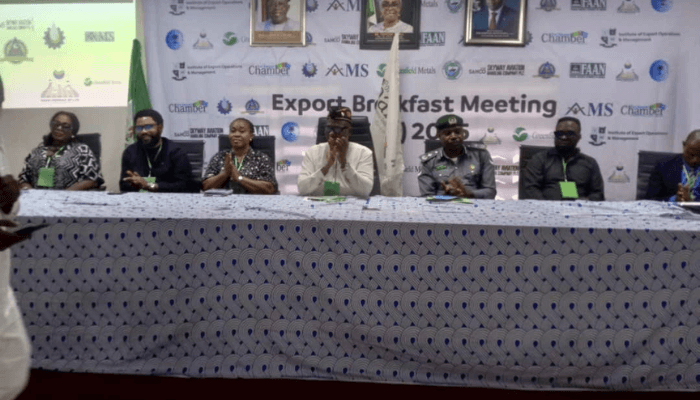
The resolution to fight the situation emerged at the first ever ‘Export Breakfast Meeting’ held Thursday, at the auditorium of the Port Harcourt City Chamber presided over by Chinyere Nwoga.
Nwoga said in her opening remarks that trade groups were the engine room of the City Chamber who treat issues before presenting them to the main body for attention and onward presentation to the appropriate bodies. She regretted that the PH International Airport is not fully maximized.
In his technical lecture, Mac-Kingsley Ikegwuru, the Acting Head of Department, Logistics and Supply Chain Management of the Rivers State University, explained why the PH International Airport is expensive and gave tips on what can be done.
Other experts also gave their suggestions and an agreement was reached to act, now.
In his welcome speech, Ofon Udofia, convener and chairman of the Export Trade Group of the Port Harcourt Chamber of Commerce, Mines, and Agriculture (PHCCIMA), who is also the Executive secretary of the Institute of Export Operations and Management, said time has come for action, not talk or complaining.
Udofia, who holds a doctorate degree in international trade, said the problem of the Niger Delta must be solved by Niger Deltans, saying discriminatory charges against the region must stop.
A resolution by the stakeholders at the ‘Export Breakfast Meeting (EBM) 2025’ examined the barriers to non-oil exports from the Niger Delta and chart a shared pathway for growth.
Discussions were said to be frank, engaging, and solutions-driven. At the end, they looked at infrastructure and logistics, thus resolving to establish a state-backed cargo airline. The communique said “Stakeholders emphasized the urgent need for the Rivers State Government to float or partner with a dedicated cargo airline to ensure direct, efficient, and predictable export flights from Port Harcourt.”
They also resolved to develop strategic export warehouses across the state to support aggregation, processing, and packaging of goods closer to production clusters.
They agreed to create professional training for consolidators who can aggregate products from numerous SMEs, enhance shipment volumes, and reduce individual freight costs.
They called for financial incentives and pricing toward a unified freight rate comparable with other international airports across Nigeria. There was talk about cost reduction measures whereby the MDAs and cargo service providers at Port Harcourt International Airport were to implement a 50$ reduction in freight charges for non-commercial exports, in order to encourage broader participation among small-scale exporters.
Other measures and calls were for Government Policy and Regulatory Interventions, removal of the “Red Flag” security classification, land regulation and green belt development, capacity building and education, curriculum integration by universities, mandatory certification for forwarding agents, university-government collaboration , and SME development and data collaboration scheme.