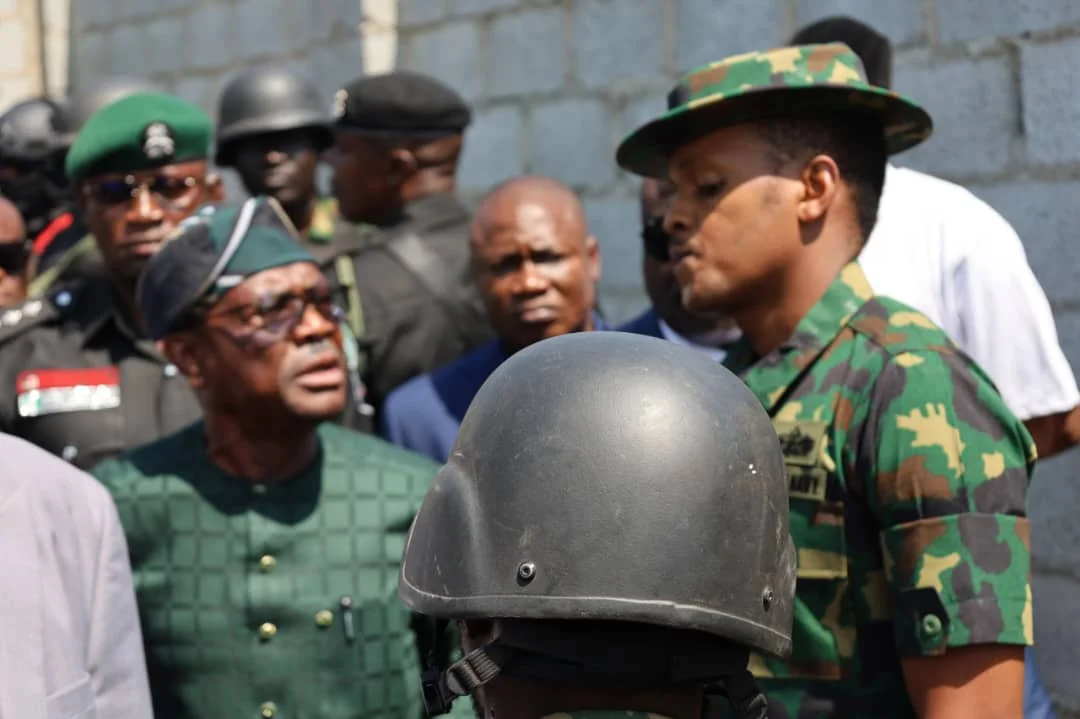
The tense exchange between the Federal Capital Territory (FCT) Minister, Nyesom Wike and Naval Officer, Lieutenant A. Yerima on a disputed plot of land in Abuja has reignited an old but unresolved question in Nigeria’s civil–military relations: where does lawful obedience end, and where does unconstitutional authority begin?
What looked like a routine enforcement dispute has now evolved into a national debate over illegal orders, military discipline, and the boundaries of civilian power.
What began as a standoff over land allegedly held for former chief of naval staff, Vice Admiral Zubairu Gambo (retd.), has morphed into a national conversation about the limits of obedience within the armed forces, the nature of civilian oversight, and whether uniformed personnel may lawfully operate as private guards for former or serving superiors.
Read also: When two authorities squabble: Breaking down the legality of the Wike–Yerima clash

The legal question: When must an officer disobey?
Sabastine Hon, a senior advocate of Nigeria and law professor, offered one of the sharpest rebukes of Yerima’s conduct, grounding his argument in constitutional and judicial precedent. In a statement titled ‘My Brief Opinion on the Faceoff Between Nyesom Wike and the Young Naval Officer, A.M. Yerima’, he called the conduct “totally condemnable” and warned that obedience to superior orders is not absolute.
Hon drew on the Supreme Court’s decision in Onunze vs. State (2023) 8 NWLR (Pt. 1885) 61, where Justice Helen Ogunwumiju reaffirmed that military personnel are not required, or permitted, to comply with “palpably illegal or manifestly unjust” orders. Nigeria’s military oath, he reminds, is to the Constitution first, not to individual commanders.
He further invoked Nigeria Air Force vs. James (2002) 18 NWLR (Pt. 798) 295, where the Supreme Court held that military personnel remain subject to civil law and cannot hide under unlawful commands.
For Hon, the principle is clear: no service regulation authorises an officer to mount guard over the private construction site of a superior. Therefore, Yerima’s deployment constituted “an aberration and a serious breach of service discipline.”

The SAN also emphasised that under sections 297(2) and 302 of the 1999 Constitution, the FCT minister exercises the president’s powers regarding land administration. Preventing Wike’s entry, therefore, amounted to obstructing the president’s representative, an act Hon considers both unconstitutional and punishable under section 114 of the Armed Forces Act, which addresses military liability for civil offences.
In Hon’s framing, the episode is less about land and more about the constitutional boundaries of obedience: the duty to disobey illegal orders and uphold civilian authority.
Was Yerima on official duty, or acting as private guard?
One of the most contentious questions is whether the Naval officer’s presence was a legitimate official deployment or an improper assignment rooted in private interests.
Hon and many others in the civil society and legal community, argue that there is no provision in military law authorising the posting of officers to guard private property belonging to a retired service chief. If true, Yerima’s deployment would constitute misuse of military resources and a violation of the Armed Forces Act. However, this legal interpretation is not unanimous.
Read also: Meet Yerima, Navy officer who clashed with Wike
The case for Yerima: ‘He acted professionally’
Several commentators insist Yerima neither violated military rules nor exceeded his mandate.
Sam Amadi, director of the Abuja School of Social and Political Thought, criticised Wike, arguing that the minister approached the matter wrongly by directly engaging armed personnel.
“I think it was needless for the FCT Minister to go there with people to get the officers out,” he said on Arise News. “The officer acted in accordance with standard military procedure… the minister cannot override the instruction given to the soldier.”
Amadi suggests that even if the officer’s deployment were questionable, accountability should follow the chain of command, not public confrontation.
This view was echoed more forcefully by General Lucky Irabor (rtd.), former chief of defence staff, who shifted the debate from legality to symbolism and military ethos. For him, the uniform represents state authority, not personal identity.
“The uniform is not about who is wearing it. The uniform represents the authority of the state,” he said.
Irabor criticised Wike’s rhetoric, arguing that disparaging a commissioned officer, who holds a presidential commission, amounts to disparaging the Commander-in-Chief himself. He framed Wike’s words as an affront to the oath and dignity of Nigeria’s armed forces.
“When you make such disparaging comments, you have desecrated the oath… It is an offence against the state,” the retired general said.
Irabor also challenged what he described as simplistic legal interpretations, reminding analysts that proving illegality requires examining actus reus (action) and mens rea (intent). If the officer believed he was executing a lawful order, his culpability may be limited.
The Defence Ministry backs the officer
In a twist that further complicates the debate, Bello Matawalle, minister of state for Defence, publicly defended Yerima, describing his conduct as “professional,” “disciplined,” and fully compliant with military expectations.
In an interview with DCL Hausa, Matawalle said: “Yerima acted strictly on instructions; he maintained respect and discipline, he committed no military offence and that Wike should have addressed concerns through the officer’s superiors.”
“He merely obeyed a lawful order and followed due process… He did not commit any offence under military regulations,” the minister affirmed.
He went further to assert that disrespecting a uniformed officer is akin to disrespecting the President as Commander-in-Chief.
Matawalle’s position effectively pits the Defence Ministry’s interpretation against the constitutional lens offered by legal scholars like Hon.
The ethical question: Does a culture of obedience threaten civil authority?
Nigeria’s military is steeped in a culture of rigid obedience, rooted in hierarchy and discipline. But the Constitution makes civilian authority supreme. The tension between the two has historically produced conflict, from coups in earlier decades to more subtle clashes today. The Wike–Yerima incident reopens a long-standing dilemma.
Does blind loyalty undermine constitutional supremacy?
Hon and others argue yes, emphatically.
If officers follow illegal orders from superiors, especially for private gain, it erodes rule of law and emboldens abuse of state power.
Yet military veterans counter that without strong obedience, discipline collapses. Irabor insists that the issue is not about who is right on land ownership but about respecting the chain of command. In this worldview, Yerima’s loyalty is a virtue, not a breach.
The incident exposes enduring ambiguities: Who determines whether an order is lawful, the officer on ground or the superior issuing it? Can military personnel be deployed to non-military, private locations? What are the limits of ministerial authority when confronting armed officers? Should civilian enforcement involve police alone, as Amadi insists? Do public altercations with uniformed personnel erode respect for the state?
These questions reveal a structural gap: Nigeria lacks clear, publicly articulated enforcement protocols for situations where civilian authorities encounter armed military personnel acting on dubious assignments. The result is confusion, tension, and potential escalation.
A teachable moment for civil–military relations
The Wike–Yerima confrontation has become a national case study in: the limits of obedience, the supremacy of the Constitution, proper civil–military channels, the perils of personalised command structures, and the need for unambiguous guidelines on deployment of armed personnel.
If handled poorly, such incidents risk normalising the use of military personnel in private disputes, undermining civilian oversight and eroding constitutional order. If handled well, they could catalyse reforms reinforcing legality, transparency, and proper chain-of-command processes.
Nigeria’s democracy depends on clarity. Military officers must know when to obey, when to refuse, and whom they ultimately serve, the Constitution, not personalities.