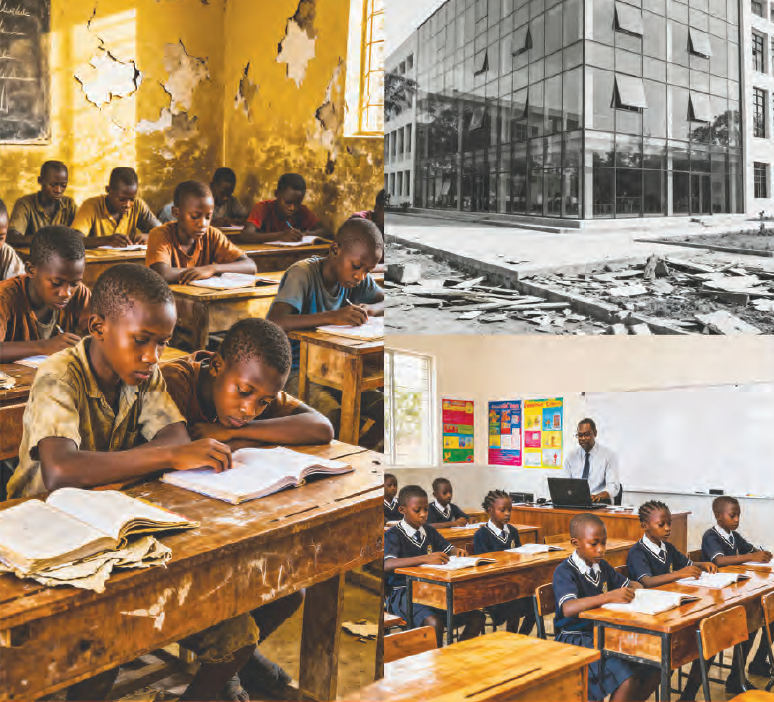
Nigeria’s private education sector – from crèches and primary schools to tertiary institutions – has grown rapidly in recent years, becoming one of the country’s most dynamic industries. What began in the late 1980s as a response to government neglect and economic austerity during the Structural Adjustment Programme (SAP), has since expanded into a multi-billion-Naira enterprise. However, beneath this expansion lies a troubling reality: declining standards, weak regulation, and poor oversight. Despite government efforts to establish benchmarks for quality, irregularities persist, exposing millions of young learners to substandard education.
At the lower levels, the situation is particularly alarming. Many childcare centres and nursery schools – especially in rural areas – operate in converted residential buildings, often without safety features, play areas, or learning facilities. Most lack basic infrastructure such as classrooms, toilets, water supply, and administrative offices. Others function without qualified teachers or compliance with health and safety regulations. When children’s first experience of learning begins in such an environment, what kind of foundation is being laid for their future?
Overcrowding is another crisis. In several urban centres, as many as 40 pupils are squeezed into classrooms built for 15, creating an impossible teacher–learner ratio. According to the Universal Basic Education Commission (UBEC), Nigeria falls far short of the UNESCO-recommended 25:1 pupil–teacher ratio at the primary level. The consequences are visible: overstretched teachers, disengaged pupils, and dismal learning outcomes.
Even more concerning is the sheer number of unapproved private schools operating across the country. Recent data shows that between 70% and 74% of private schools in Nigeria operate without full government approval or accreditation. In Lagos State alone, of the estimated 15,000 private schools, only about 4,573 are registered and approved – leaving over 10,000, or roughly 69.5%, operating illegally. These figures reflect a nationwide pattern in which many proprietors, unable or unwilling to meet regulatory standards, open schools that prioritise profit over quality.

A major driver of this decline is the widespread employment of unqualified teachers. Studies suggest that up to 70% of private school teachers in Southwest part of Nigeria are not certified by the Teachers Registration Council of Nigeria (TRCN). Many are secondary school graduates, National Diploma holders, or poor bachelor’s degree holders with no professional training in education. In rural areas, the shortage of qualified teachers is even more acute. Initiatives such as Teach for Nigeria and NYSC postings to schools have attempted to fill this gap, but they remain insufficient to ensure consistent quality.
This crisis is not confined to primary or secondary education. Many private tertiary institutions also struggle with inadequate staffing, poor infrastructure, and outdated curricula. The National Bureau of Statistics (NBS) estimates that more than 60% of private schools at all levels operate without full accreditation, while the National Universities Commission (NUC) continues to shut down illegal universities each year – evidence that the sector’s growth has outpaced its regulation.
Meanwhile, the government continues to grant approvals for new universities, both public and private, without first ensuring that existing ones meet minimum standards. Instead of strengthening institutions, Nigeria risks multiplying mediocrity – creating more schools but producing fewer truly educated citizens.
What this reveals is not simply a failure of enforcement but a deeper national malaise: the commodification of education. Learning has been reduced to a business transaction rather than a public good. Parents are customers, students are products, and schools are profit centres. The outcome is a generation of learners lacking critical thinking, creativity, and employable skills – a reality that threatens not only the individual’s future but Nigeria’s collective development.
Other nations have faced similar crises and responded decisively. Ghana enforces strict accreditation procedures for private schools, ensuring compliance with national standards. Kenya’s Ministry of Education conducts annual audits to verify teacher qualifications and child safety compliance. India’s Right to Education Act mandates specific pupil–teacher ratios and infrastructure standards. Nigeria can learn from these examples by institutionalising stronger accountability systems.
The way forward lies in both regulation and reform. First, the federal and state governments must conduct a comprehensive audit of all private schools and close those that fail to meet minimum standards. A National Private School Registry could be established to track ownership, teacher qualifications, and compliance records. Second, schools that meet or exceed required standards should be incentivised through grants, training programmes, and partnerships. Third, teacher certification must be strictly enforced — no one should teach without TRCN registration. Finally, curricula at all levels must be revised to prioritise practical skills, digital literacy, and civic responsibility.

Ultimately, education should be redefined as a shared responsibility between government, parents, and private stakeholders. Parents must demand accountability rather than settle for convenience; teachers must see their role as a national calling, not merely a job; and regulators must enforce standards without fear or favour.
A compromised education system does not just produce unemployable graduates – it produces disillusioned citizens. If left unchecked, Nigeria risks raising a generation unprepared for the demands of a knowledge-driven world. To reverse this trend, the private education sector must be reimagined – not as a business venture but as a civic duty. Quality education should not be a privilege bought by the few, but a right guaranteed for all.