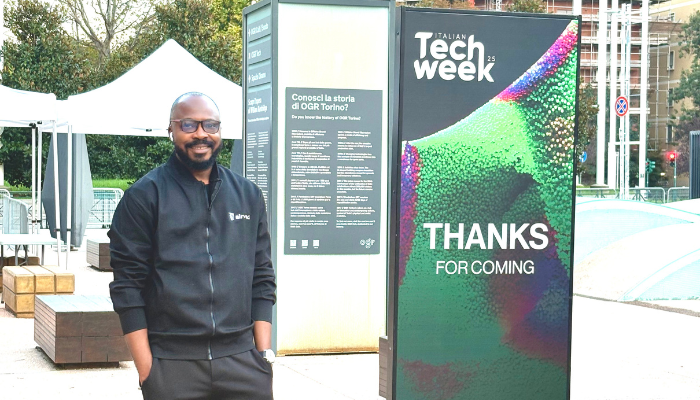
Italian Tech Week 2025 in Turin gathered over 200 world-class speakers and 70 sessions exploring “The Wave Ahead” — how innovators move before the signal, not after it. The event celebrated pioneers who build what’s missing, from early-stage founders to global leaders like Jeff Bezos, John Elkann, and European Commission President Ursula von der Leyen.
Ursula von der Leyen, President of the European Commission, in her keynote address, delivered a hopeful message on building a Europe worthy of its talent, while Amazon founder Jeff Bezos and John Elkann, CEO of Exor and Chairman of Stellantis and Ferrari, shared powerful insights on vision, risk, and long-term thinking during their fireside chat.
The conference highlighted Italy’s ambition to become a global technology hub. It also reinforced the importance of aligning policy, capital, and innovation to build independent tech ecosystems.
Among the guests was Precious Ekezie, CEO of Nigerian fintech company Airvend Payments, who shared his view about how African technology leaders can draw lessons from Europe’s approach to self-reliance.

“Europe’s journey toward tech independence shows what happens when innovation is driven by purpose, policy alignment and reflects your own priorities,” Ekezie said. “For Africa, that means deepening collaboration, investing in infrastructure, realistic policies and scaling our homegrown ideas with the confidence that we can define our own future. We must build technology that reflects our realities, control our data, and strengthen intra-African collaboration to scale sustainably.”
Ekezie explained that Europe’s example reinforces the importance of building local capacity rather than depending on external systems. “At Airvend, we see this as a call to action: to invest in our own digital infrastructure and empower local talent to create tools that work for African economies. Europe’s example proves that ecosystems flourish when they trust their capacity to build, not just consume, innovation. Africa has that same potential and perhaps an even greater urgency to act.”
Ekezie described how African startups can position themselves to compete and collaborate globally in the era of artificial intelligence (AI) in financial services
“Fintech in Africa is moving from enabling transactions to enabling intelligence, and that’s where AI comes in,” he said. “Startups that combine fintech with AI are not just improving efficiency; they’re redefining how trust, credit, and access are built across informal economies.”
He noted that Africa’s greatest advantage lies in its ability to innovate within constraints. “Africa’s edge lies in solving complex problems with limited infrastructure. That forces creativity. As AI becomes central to digital infrastructure, our startups can lead with context, building solutions that global players may overlook because they’re rooted in real-world constraints. Collaboration will be vital, but the goal is to engage the world on our terms as innovators, not imitators.”

Ekezie added: “Fintech used to be about transactions; now it’s about intelligence. AI gives us new ways to understand and serve people, and Africa’s creative edge comes from innovating under constraint. That’s our global advantage.”
He also reflected on how Airvend embodies the spirit of “The Wave Ahead.” “Italian Tech Week celebrates people who don’t wait for the signal; they are the signal. That’s how Airvend was built. We saw the wave of digital inclusion before it arrived and built for it.”
“When we started, digital agent networks in Nigeria were still an idea most people thought couldn’t scale,” he said. “But we saw the wave forming—the need for small merchants to become the backbone of financial access. We built for that future before it arrived.”
Today, Airvend connects thousands of agents and retailers across Nigeria, providing digital payment services that enable small businesses and individuals to transact more efficiently. The company also powers airlines, banks, and SMEs with APIs designed for seamless integration, while continuing to offer simple and reliable tools for everyday users.
Ekezie said Airvend’s success stems from anticipating market needs and building for what is missing. “Our approach has always been to anticipate where the market is going, not react to where it is. That’s how we stay ahead: by building for what’s missing, not just for what’s visible.”