|
Getting your Trinity Audio player ready...
|
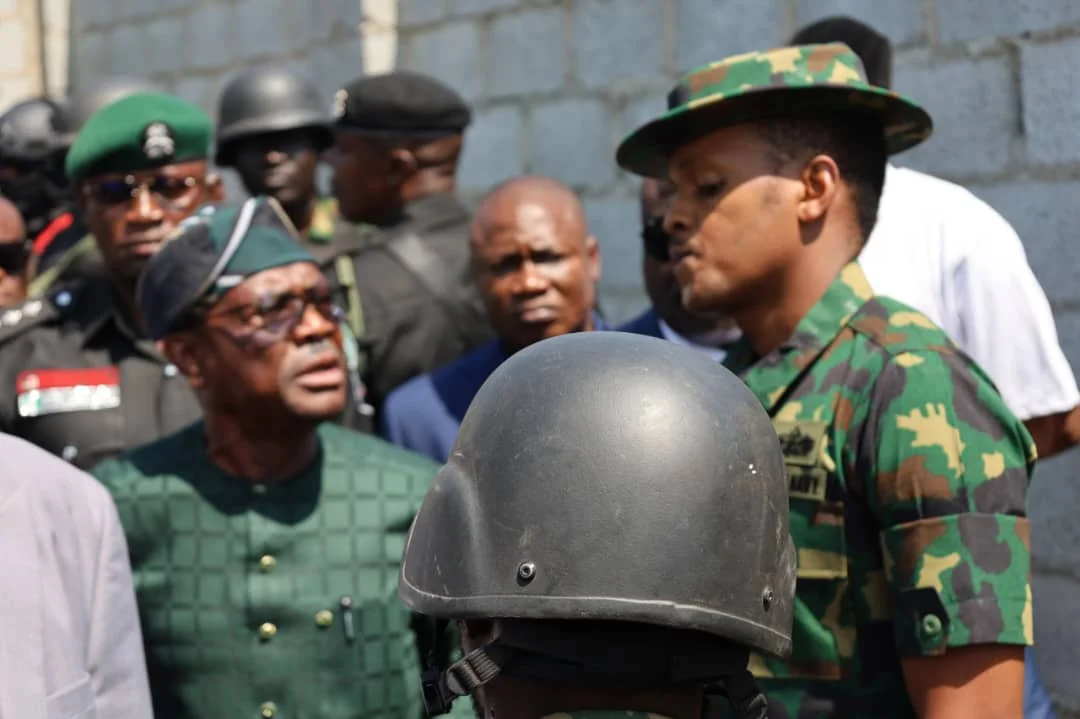
Sebastine Tarhenger Hon, a Senior Advocate of Nigeria (SAN) and Professor of Law, has faulted the actions of a naval officer, A.M. Yerima, who reportedly prevented Nyesom Wike, minister of the Federal Capital Territory (FCT), from accessing a parcel of land in Abuja under the pretext of obeying superior orders.
In a statement on Wednesday, Hon described the officer’s action as “palpably illegal,” arguing that military obedience does not extend to unlawful instructions.
Citing the Supreme Court decision in Onunze vs State (2023) 8 NWLR (Pt.1885) 61, he noted that “the obligation to obey the orders of a superior does not include orders that are manifestly illegal or unjust.”
The SAN explained that military and police officers swear an oath not to obey all orders but to “preserve, protect and defend the Constitution of the Federal Republic of Nigeria.” He added that any officer who enforces illegal commands becomes personally liable and risks court martial or other disciplinary action.

Read also: Land dispute: Wike in heated argument with soldiers in Abuja
Hon also referenced the apex court’s ruling in Nigeria Air Force vs James (2002) 18 NWLR (Pt.798) 295, which reaffirmed that soldiers remain subject to civil authority and cannot claim protection for obeying illegal orders. “It is monstrous to suppose that a soldier could be protected when the order is grossly and manifestly illegal,” the court held.
According to him, no service regulation permits a serving officer to guard the private construction site of a superior officer. If there were security concerns, he said, the proper step would have been to contact the civil police.
The law professor further explained that under Section 297(2) of the 1999 Constitution (as amended), all lands in the FCT belong to the Federal Government, while Section 302 empowers the President to delegate land administration authority to the FCT Minister.
“By constitutional interpretation, the Minister acts on behalf of the President and Commander-in-Chief with respect to FCT land administration,” Hon said. “Obstructing him amounts to obstructing the President’s authority.”

He stressed that Section 114 of the Armed Forces Act makes military personnel criminally liable for civil offences, including obstruction of a public officer performing lawful duties.
Hon described the incident as an affront to civil authority and warned that glorifying such conduct could encourage impunity among security personnel.
“Celebrating the humiliation of the FCT Minister because of personal sentiments misses the real issue,” he said. “If such conduct goes unpunished, it could embolden others to undermine civil authority. That is not the Nigeria we aspire to build.”