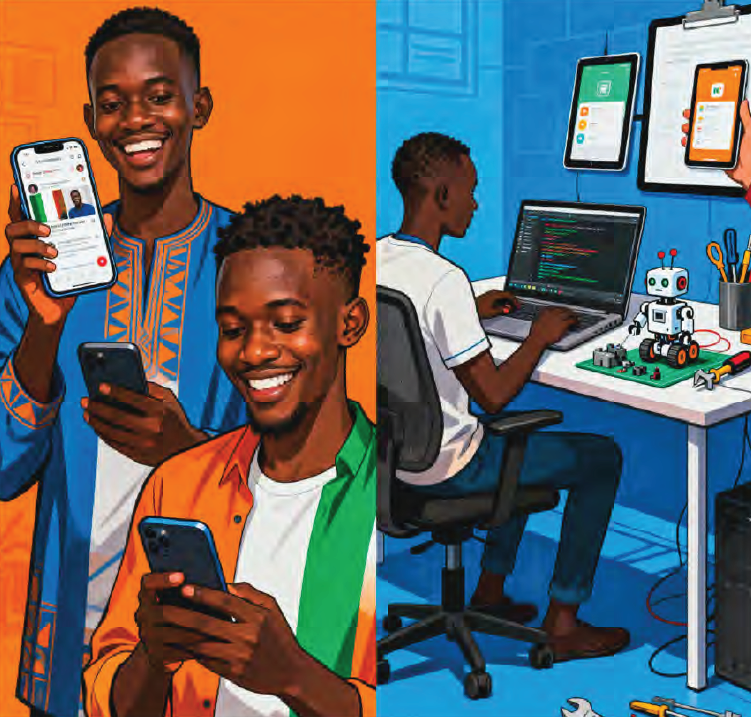
The 21st century has been defined by an unprecedented acceleration in technology – a revolution that has transformed economies, redefined power structures, and redrawn the boundaries of human potential. Nations that once relied on the export of raw materials now compete on the strength of ideas, data, and innovation. In this emerging order, the ability to create – not merely consume – digital technology determines influence and prosperity.
Nigeria, Africa’s most populous nation, stands at the threshold of this new reality. For years, its participation in the global digital economy has been largely as a consumer – a vast market for imported software, hardware, and services. Yet beneath the surface lies an evolving story: one of ambition, innovation, and a growing recognition that true economic sovereignty in the digital age depends on the capacity to create.
Recent data highlight both the promise and the paradox. Nigeria’s digital economy contributed approximately ₦7 trillion, or 14 percent of GDP, in the first quarter of 2025, according to figures presented at GITEX Nigeria. The Information Technology and Innovation Foundation (ITIF) ranked Nigeria eighth among 40 countries in its global specialisation index for IT and information services – a strength 27 percent above the global average. Venture capital tells a similar story. In 2024, Nigerian startups attracted over 35 percent of Africa’s total tech funding. Moniepoint raised more than US$110 million in growth capital; Flutterwave surpassed a US$3 billion valuation; and Paystack continued expanding its footprint across Africa after its landmark US$200 million acquisition by Stripe.
These achievements show that Nigeria is no longer a peripheral player in Africa’s digital economy. The challenge, however, lies in transforming digital participation into digital production. While hubs in Lagos, Abuja, and Port Harcourt host some of the continent’s most promising startups, the ecosystem still leans heavily toward service adoption rather than product creation. Much of Nigeria’s hardware remains imported, cloud infrastructure is hosted abroad, and software ecosystems are largely foreign-owned. This imbalance reflects a broader developmental question – how to move from the consumption of technology to its creation, export, and ownership.

Structural barriers remain formidable. Unreliable power supply, limited broadband penetration, and expensive internet access continue to constrain innovation outside major cities. Talent is abundant but unevenly distributed, with universities still struggling to align curricula with the needs of a global digital economy. Even where innovation thrives, inconsistent regulation and limited access to local venture funding often impede scalability. The result is a dual economy, one vibrant with entrepreneurial energy yet tethered to external dependency.
Reversing this trend demands a deliberate recalibration of national priorities. Building a creator-based economy requires targeted investment in digital infrastructure, expanded support for research and development, and stronger intellectual property frameworks to protect homegrown innovation. Financial institutions must move beyond conservative lending models and design instruments suited to the high-growth, high-risk nature of technology ventures.
To the government’s credit, initiatives such as the Nigeria Startup Act (2022), the National Digital Economy Policy and Strategy (2020–2030), and the Renewed Hope Digital Agenda (2024) signal a shift toward coordinated action. These frameworks aim to nurture innovation hubs, provide tax incentives, and train over three million young Nigerians in digital skills by 2027. Yet implementation remains slow and fragmented. Policies alone will not suffice; they must be matched by institutional continuity and measurable outcomes.
Human capital development will remain the cornerstone of this transformation. Nigeria produces thousands of computer science and engineering graduates annually, yet the gap between academic preparation and industry readiness remains wide. Strategic partnerships between universities, technology firms, and innovation clusters can bridge this divide. Structured apprenticeship programmes, digital-skills accelerators, and research-linked funding can convert latent potential into productive innovation capacity.
Globally, countries that have moved from consumers to creators offer useful lessons. India achieved global competitiveness in software exports through consistent investment in education, digital infrastructure, and R&D incentives. South Korea’s Digital New Deal (2020) invested over $58 billion to digitise industries and nurture domestic hardware manufacturing. Both nations developed ecosystems anchored on policy consistency, public-private partnerships, and local capacity building, not short-term initiatives.

Nigeria’s domestic ICT market, projected to reach US$32.8 billion by 2025, can serve as a launchpad for export-oriented growth if guided by a coherent strategy. The goal should not merely be to attract global platforms but to produce them. Building indigenous cloud services, semiconductor assembly lines, and data analytics hubs are not beyond reach; they require vision, coordination, and courage.
Ultimately, the redefinition of Nigeria’s place in the global tech economy is not a question of capability but of commitment. The resources exist – a youthful population, entrepreneurial drive, and a fast-growing digital market. What remains is strategic alignment across infrastructure, education, and governance.
A nation that builds the tools it uses commands a different kind of power, the kind that shapes its own narrative in the world. If Nigeria embraces this transition with focus and discipline, the next decade could mark a new identity: not as Africa’s largest consumer market, but as one of its leading creators of technology, ideas, and innovation. The journey from consumption to creation is neither quick nor easy, but it is essential for a nation seeking not just to participate in the digital age but to define it.