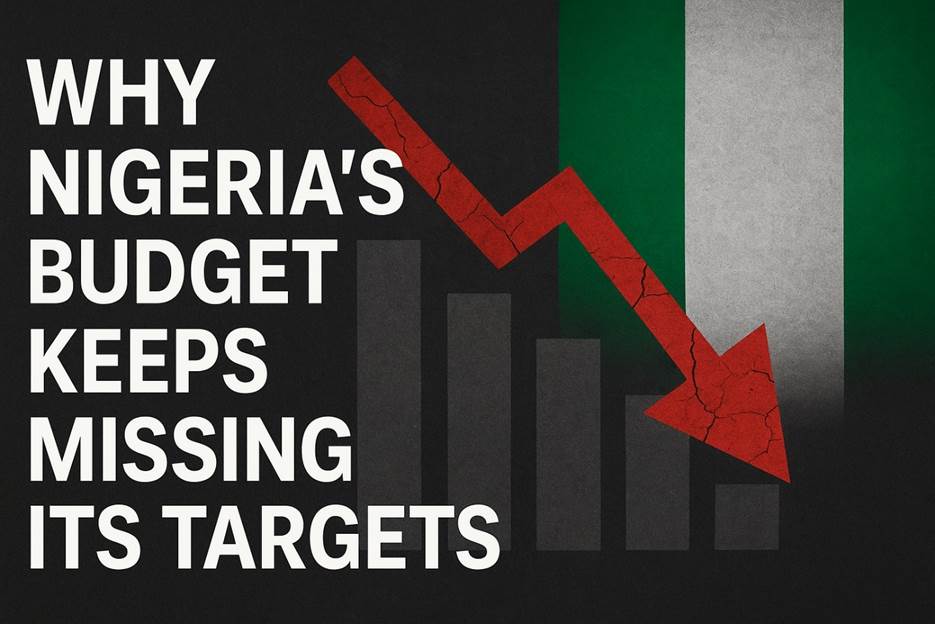
For four straight years, Nigeria’s budget has promised growth that never arrived. Fresh data shows assumptions on GDP, inflation, exchange rates, and oil production repeatedly diverged from reality, revealing not just forecasting errors but structural weaknesses in the economy.
Figures from the November Lagos Business School Breakfast Session illustrate the mismatch. In 2023, the government projected GDP growth of 3.75 percent. Actual growth barely reached 2.45 percent, weighed down by sluggish oil output and weak consumer spending. Inflation, targeted at 16.98 percent, surged to 27.33 percent. The naira was expected to trade at N435 to the dollar but ended the year at N1,158.
The International Monetary Fund (IMF) flagged the challenge in blunt terms: “Achieving the government’s 2025 budget targets will require additional measures, largely reflecting the drop in oil prices compared to when the budget was approved… the key challenge now is to tackle high poverty and food insecurity.”
Oil production continues to underperform

Oil, Nigeria’s fiscal backbone, has repeatedly fallen short. In 2022, production was 1.21 million barrels per day against a 1.88 million target. In 2023, output reached 1.32 million barrels per day, missing a 1.69 million target. Even in 2025, projections of 1.39 million barrels per day are expected to fall short.
Security challenges, sabotage, ageing infrastructure, and labour disruptions explain part of the shortfall. Yet even as rig counts rise and exploration resumes, gains have not translated into meaningful increases in output, a reminder that structural problems cannot be resolved with investment alone.
Global shocks, domestic fragility
Nigeria’s woes are compounded by volatility in global markets. Oil price swings, shifts in U.S. interest rates, trade tensions, and sudden policy changes have repeatedly disrupted economic forecasts. Analysts note that even JP Morgan, Goldman Sachs, and the IMF have struggled to maintain accuracy as external pressures intensified.
But external shocks only magnify domestic weaknesses. Overly optimistic assumptions on revenue, oil output, and exchange rates have widened fiscal deficits and strained budget execution. The naira has drifted steadily from projections, hitting N1,460–1,480 in 2025 against a budgeted N1,500, while parallel market pressures continued to influence sentiment.

Wale Edun, Minister of Finance acknowledged the difficulty: “The shortfall to those estimates is glaring for all to see… That means we have a task of prioritisation to ensure that critical payments are made and key areas are still funded.”
Structural inflation and fiscal pressures
Inflation has become a structural challenge rather than a symptom of demand pressures. Analysis shows a negative correlation between money velocity and prices, suggesting that rising costs are driven by FX volatility, logistics bottlenecks, higher input costs, and weak productivity growth. Earlier assumptions on price movements have become obsolete, complicating budget planning.
Revenue streams remain vulnerable. Crude prices slid toward year-end, and FAAC disbursements were expected to fall in October. Tax collection improvements can plug some gaps but cannot offset broader fiscal risks.
From projection to hard truths
The repeated failure to hit budget targets is more than a numbers problem, it is a window into Nigeria’s economic architecture. Policymakers are relying on models that assume stability in an inherently volatile economy. When assumptions fail, the cracks appear: fiscal gaps widen, payments are delayed, and critical infrastructure and social spending are put at risk.
Yet there are glimmers of progress. Analysts argue that 2026 assumptions are increasingly aligned with domestic and global realities. Gradual reforms, higher oil output, and improving macroeconomic conditions could provide a more stable foundation.
The lesson for Nigeria and other commodity-dependent economies is stark: optimism alone cannot make budgets work. Fiscal planning must embrace volatility, incorporate flexible assumptions, and anticipate structural constraints. Judgment-driven budgeting, rather than number-chasing, is no longer optional, it is essential.
In a world shaped by unpredictable shocks, data alone will not save the budget. What matters is how policymakers interpret it, adapt it, and use it to make decisions that withstand reality, not just projections.