…Why Nigerian economists should stop pretending they know what’s next
In today’s hyper-connected global economy, data streams never sleep, models proliferate, and pundits proclaim certainty with algorithmic confidence. Yet recent years have mocked forecasters with merciless irony. Few predicted the pandemic’s economic fallout. Fewer foresaw the inflation surge that followed. And almost no one anticipated that artificial intelligence—not oil—would become the defining geopolitical lever of 2025.
As Bismarck Rewane reminded participants at the recent Lagos Business School Breakfast Session, “macroeconomics is about judgment, not prediction.” Forecasts are necessary; clairvoyance is not. The economist John Kenneth Galbraith once quipped that “the only function of economic forecasting is to make astrology look respectable.” In Nigeria, where budget assumptions routinely collide with reality, this wisdom feels painfully apt.


The limits of models
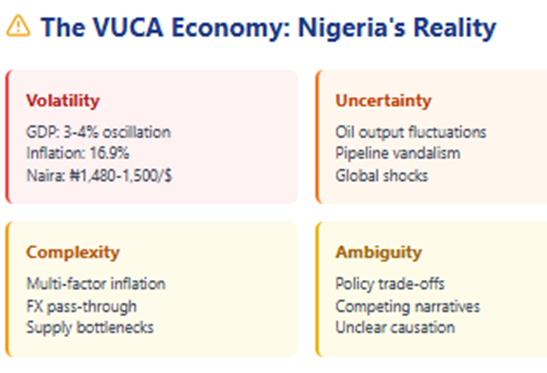
From Washington to Abuja, the global policy community still clings to numerical models as if accuracy were a moral virtue. Yet the last decade has shown that volatility, uncertainty, complexity and ambiguity—VUCA—have colonised economic life. Data can capture what has been; it rarely anticipates the sudden tremor that changes everything. Consider Nigeria’s recent macro scorecard.
GDP growth has oscillated between 3 and 4 per cent through 2025, respectable but unremarkable. Inflation, though moderating to 16.9 per cent by September, remains structurally stubborn—a reflection of cost-push pressures, exchange rate pass-through, and supply-side bottlenecks that resist monetary tightening alone.
Meanwhile, budget assumptions on oil output, exchange rates and fiscal revenues have repeatedly missed their marks, sometimes spectacularly. In such an environment, the economist’s job is less prophecy than probability—assigning sensible weights to uncertain outcomes, mapping plausible scenarios, and cultivating judgment about what truly matters. Models are tools, not oracles.
They illuminate paths but cannot choose which one to walk.
Judgment as an economic asset
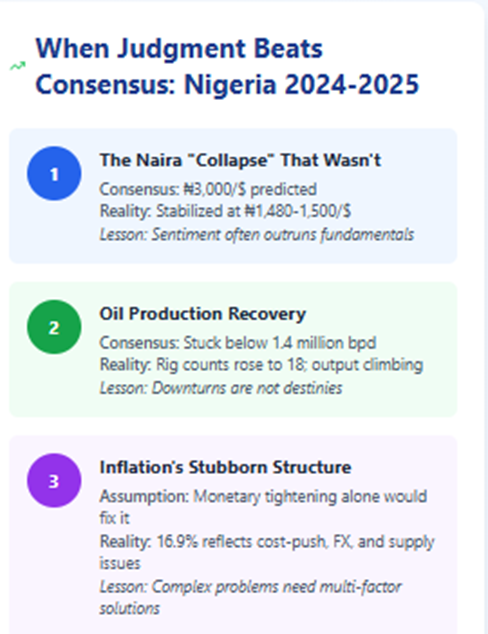
Judgment means discriminating signal from noise. It requires humility before data, scepticism toward consensus, and courage to act despite incomplete information. When analysts predicted the naira would collapse to ₦3,000 per dollar by 2025, prudence—not pessimism—was called for. The currency stabilised nearer ₦1,480–₦1,500, reminding investors that sentiment often outruns fundamentals and that central bank interventions, however imperfect, matter. The same lesson holds for oil.

Few believed Nigeria could restore output above 1.4 million barrels per day amid pipeline vandalism, sabotage and industrial unrest. Yet rig counts rose to 18 by September 2025, production inched upward, and the sector showed signs of renewed investor interest.
Judgment recognises the cyclical heartbeat of economies: downturns are not destinies. Structural weaknesses can coexist with tactical recoveries. Good judgment also knows what not to focus on. The proliferation of real-time indicators—purchasing managers’ indices, Twitter sentiment scores, Google search trends—creates an illusion of control. But more data does not necessarily mean more insight. Distinguishing durable trends from ephemeral noise is the economist’s comparative advantage in an era drowning in information.
The new discipline of uncertainty
Globally, uncertainty is no longer episodic; it is systemic. Trade wars morph into tech wars. Disinformation distorts markets. Climate shocks—floods in Maiduguri, droughts in the Sahel—defy historical baselines and render past patterns unreliable. The economist’s craft must therefore evolve from predicting to preparing: stress-testing policies, diversifying assumptions, rehearsing the improbable.
For Nigeria, this means embedding flexibility into fiscal design—building buffers rather than banking on best-case oil prices. It means reforming data governance so that policymakers work with credible, timely statistics rather than outdated projections. And it means embracing “nowcasting”—using high-frequency indicators to monitor the economy in near-real time—rather than relying solely on annual forecasts that age like milk.
It also means nurturing a generation of policymakers trained to think probabilistically, not ideologically. Too often, Nigerian economic debates descend into binary camps: devalue or defend, tighten or ease, reform or protect. Reality is messier. Good policy balances competing risks and acknowledges trade-offs without pretending they do not exist.
The human element
Economics, ultimately, is a social science. Algorithms can calculate correlations but cannot judge causation. Machine learning can spot patterns but cannot interpret meaning. Leadership—whether in central banking, corporate boardrooms or presidential councils—depends on temperament as much as on models. Judgment is forged in uncertainty, not erased by it.
As Rewane concluded, “nobody controls volatility, but leaders can choose what to focus on.” The question is not whether the next shock will come—it will—but whether institutions are resilient enough, and policymakers wise enough, to navigate it without capsizing the ship. The world will always surprise us. Markets will overshoot. Black swans will land unannounced.
The task is not to eliminate uncertainty but to learn to think clearly within it—to distinguish the controllable from the inevitable, to act decisively where it matters, and to accept humbly what lies beyond mortal ken. In an age of imponderables, judgment is the economist’s most valuable asset. Models are merely footnotes.