From proxy rivalries to sweeping political shockwaves, Africa’s largest economy in early November 2025 was once again in the eye of a shocking geopolitical crosshairs when President Donald Trump threatened military action against the country and threatened to suspend aid, which totaled $1 billion as of 2023 when complete data was last available, unless “widespread violence against Christians” was addressed.
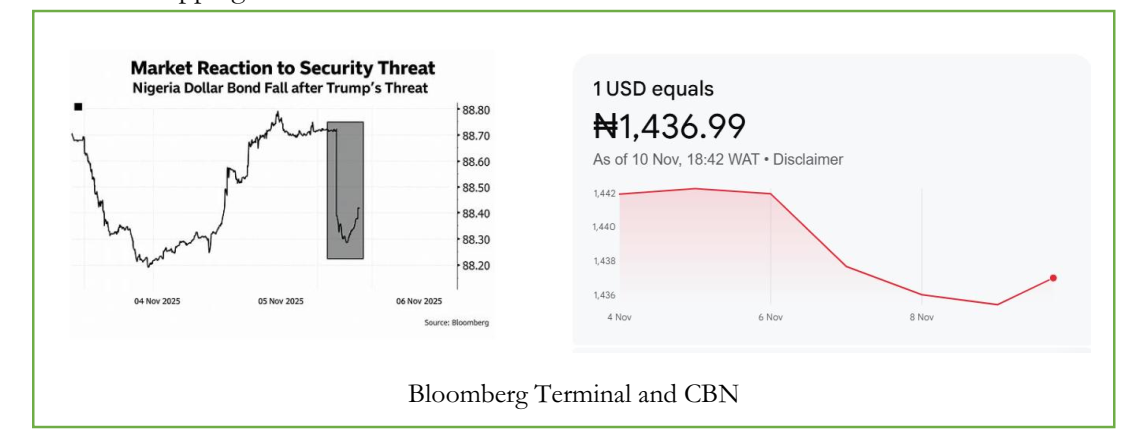
In a move that shocked diplomats and markets alike, the fallout was immediate: Nigerian sovereign bonds experienced the sharpest decline among emerging markets, with the 2051 eurobond dropping approximately 0.5 cents before recovering some losses to trade just below 92 cents per dollar by the end of the week. Other market indicators also declined: the Naira fell 1.2% to 1,442.80 against the dollar, the most significant intraday drop since June before eventually picking up before the end of the week. The stock market also suffered a significant downturn, with investors losing a total of N2.8 trillion at the NGX.
This is the modern landscape of power. Foreign policy now travels through markets as quickly as through military deployment. Trump’s confrontational, public-pressure style turns statements into economic events. For a country like Nigeria, where foreign capital supports the budget, eurobond pricing influences debt costs, and investor perception underpins currency stability, these shocks have consequences that persist long after the headlines fade.

And beneath the surface lies a deeper contest over how Nigeria is perceived: a fragile state in need of rescue, or a sovereign nation navigating complex internal challenges, forcing us to ask whether another nation’s narrative can shake Nigeria’s stability, and how secure is its economic independence?
The shockwave moment
In Lagos, traders track exchange rates the way sailors read the tide because in Nigeria, stability can shift in minutes. Then came a message from Washington: Donald Trump warned of potential military action over alleged religious persecution. There was no briefing, no formal directive; just a public remark.
Markets reacted before diplomats did. According to Bloomberg, Nigerian assets immediately tumbled. Sovereign dollar bonds declined from about 88.7 cents to nearly 88.1, as global investors quickly moved to reduce exposure. The naira weakened on the parallel market, and trading desks reported a brief halt in foreign inflows. One analyst called it “a reflexive flight to safety, not fundamentals, just fear.”
Reports from Ecofin Agency noted that while the sell-off was short-lived, the reaction revealed something deeper: Nigeria’s financial system is susceptible to geopolitical tone, not only policy substance. The stock market reflected the same anxiety: losing over ₦1.3 trillion in value within days, as uncertainty outpaced information.

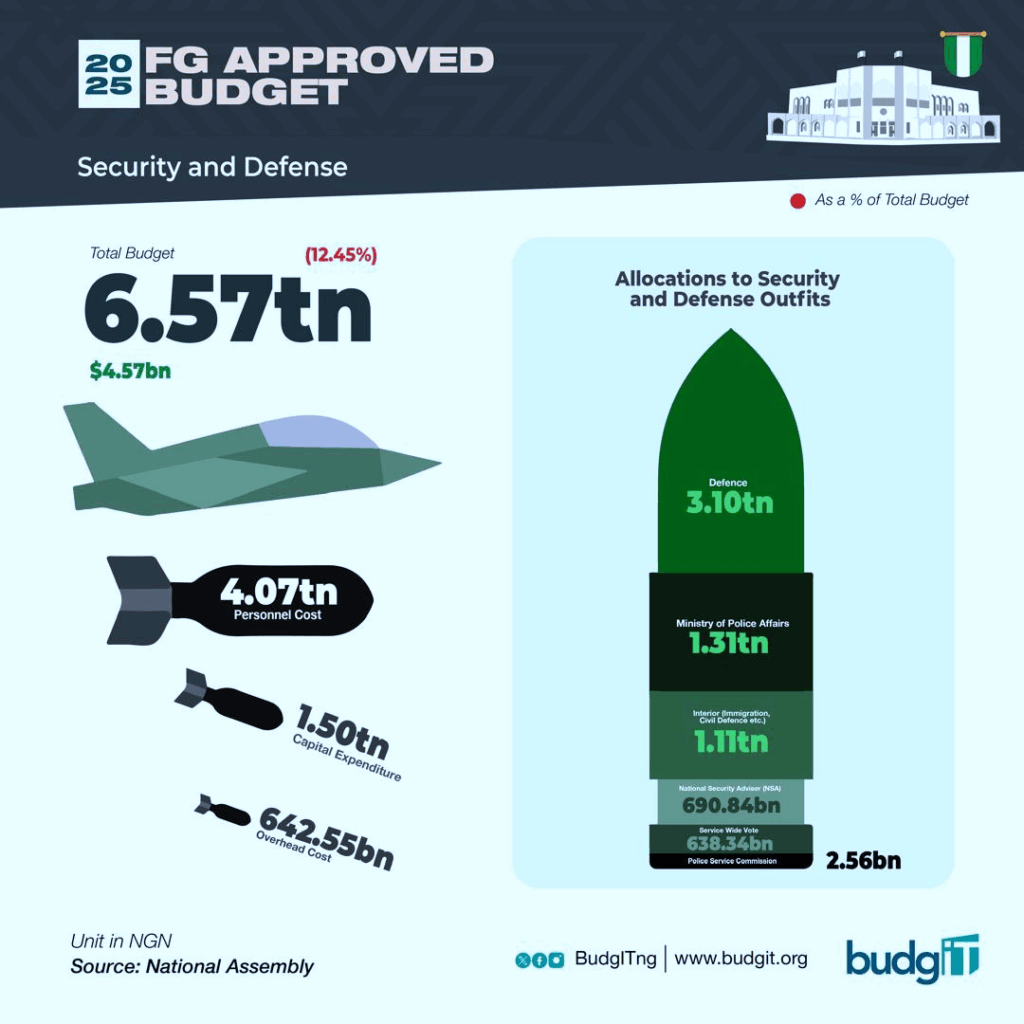
However, the episode highlights a deeper structural reality. Nigeria is highly vulnerable to global perceptions, mainly due to its security and fiscal situation. The 2025 budget allocates ₦6.57 trillion to security and defense, with personnel costs making up most of the budget, indicating both the extent of Nigeria’s internal security issues and its dependence on external support and funding.
In such a landscape, a shift in diplomatic tone alone can impact markets, even before policy changes are implemented.
The fragile economic balancing act
Nigeria’s economy sits on a delicate balancing point where perception can be as powerful as policy. The country relies heavily on foreign capital markets, particularly Eurobonds, to finance budget gaps and stabilise external reserves.
But the nation ignored the noise, raising $2.35 billion through eurobond issuance last week that attracted a record demand of $13 billion, according to the Debt Management Office (DMO). However, on the back of this, investor sentiment was already cautious; any sign of geopolitical instability increases, making borrowing more expensive. In this environment, even the suggestion of sanctions or military pressure triggers immediate market reactions, not because fundamentals collapsed overnight, but because confidence has eroded.
Foreign reserves are equally sensitive. Nigeria depends on dollar inflows from oil earnings, foreign investment, and multilateral security cooperation. When diplomatic strain surfaces, investors hesitate, reserve buffers thin, and the naira weakens, increasing the cost of imports and external debt servicing.
Foreign exchange stability and debt pricing react first to signals or statements, posture, tone, and only later to measurable events. The sharper the perceived risk, the higher the yields Nigeria must pay to borrow, and the quicker capital outflows accelerate.
Confidence Over Chaos
Despite the shock, analysts say the market reaction remains contained. The initial bond decline has already partially corrected, according to the Ecofin Agency, and the regions referenced in Trump’s remarks lie far from Nigeria’s core economic centers, including the commercial hub of Lagos and the oil-producing South.
Investor sentiment had strengthened in recent months, supported by President Bola Tinubu’s reforms, including the removal of fuel subsidies and exchange-rate liberalization. These measures helped restore credibility and drew investors back into Nigerian assets. The stock market has gained nearly 60-65% this year, against the dollar, making it one of Africa’s strongest performers.
“We expected a knee-jerk reaction, but we remain comfortable with Nigeria’s creditworthiness,” said Anders Faergemann, portfolio manager at PineBridge Investments. “We expect markets will calm.”
Nigeria’s sovereign dollar bond spreads have also narrowed significantly, from nearly 1,000 basis points in 2023 to around 400 basis points, moving the country further away from debt distress territory.
Diplomacy as economic strategy
To stabilise both markets and Nigeria’s international standing, Nigeria must approach diplomacy as an economic tool rather than just ceremonial protocol. The first step is to move from reactive rebuttals to thoughtful and proactive engagement with Washington and other key partners. Nigeria needs to communicate clearly that its security challenges are non-sectarian, rooted in governance issues, resource competition, and the legacy of armed groups, not a religious war. Correcting this narrative is not merely about reputation; it influences the policy choices that foreign governments decide to implement.
Second, Nigeria should strengthen counterterrorism and intelligence cooperation with allies, while maintaining a non-alignment posture that protects sovereignty without isolating the country. This entails broadening security partnerships beyond a single global power and enhancing regional coordination through the ECOWAS and AU frameworks.
Finally, Nigeria must integrate economic risk protection into foreign policy planning: communicate policy continuity to investors, anchor Eurobond messaging in stability, and shield FX strategy from geopolitical shocks.
When diplomacy is strategic, it lowers borrowing costs, stabilises the currency, and reinforces investor confidence.