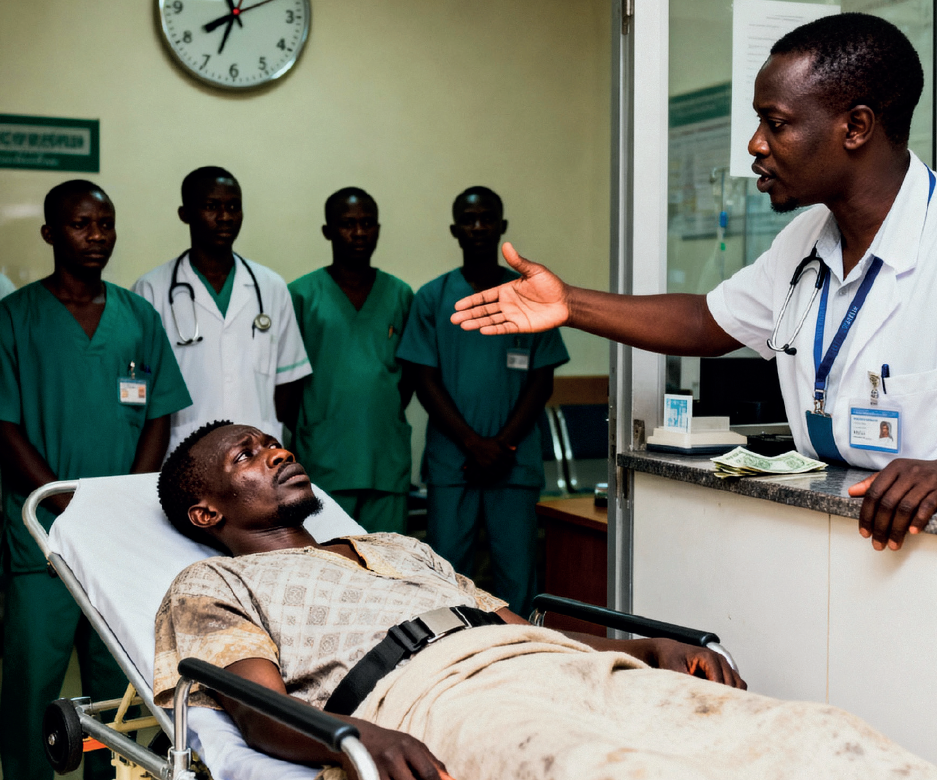
Martins, a young medical doctor, counted himself lucky to have received a job offer in a top private hospital as soon as he finished with his youth service. As far as he was concerned, this was not just an employment – it was a dream come true. It had been his wish, and that of his mates, to work in top private medical facilities to boost their CVs and meet the top brass in society.
His new employer indeed had top brass as patients – movers and shakers who could one day help him set up his own clinic. Martins was truly happy with his new job. The hospital rooms, corridors, and surroundings felt rich and smooth, and the place smelt good. He sometimes wondered how easily these rich patients were billed, but he left that to the administration and the big Ogas to worry about.
Then came the day his first high-society client was referred to him – a big politician who was always in the news. Martins examined him and prescribed some drugs, and the big man left. An hour later, the hospital’s medical director asked how the consultation went. “It went very well, Doctor. I prescribed some drugs for him, and he has gone home,” said Martins.
“Gone home?” she nearly exploded. “Whatever they come here for, you admit them. If he refuses, get the nurse to call his wife; she will convince him. Why do you think those private rooms with TVs and internet are that cosy? So that they enjoy their stay here and do not complain about paying for it.”

The story of Martins captures one side of the ethical issues in Nigeria’s medical practice. Another is the “cash and carry” system, where patients must deposit money before treatment. Then there is the question of doctors going on strike and whether that should happen when it involves life and death.
Old practitioners will tell you that, in most medical schools across the globe, the Hippocratic Oath has long served as a moral compass for physicians. Written in ancient Greece around the 5th century BC, it binds doctors to uphold ethical standards, give first place to patient welfare, and promise “to do no harm.” But as the world grapples with changing economic fortunes, technological disruption, and healthcare disparities, one must ask: Is the Hippocratic Oath still adequate for modern practice, particularly in Nigeria?
Across continents, the Oath has undergone several adaptations. In the United States, most medical schools now use the Declaration of Geneva, adopted by the World Medical Association in 1948, which emphasises human rights, patient autonomy, and social responsibility. In India, the revised oath honours teachers and lifelong learning. South Africa’s version incorporates cultural sensitivity and post-apartheid realities. In the UK, the General Medical Council’s Good Medical Practice provides an ethical structure rooted in modern realities. These changes reflect a broader truth: medicine does not exist in a vacuum. Doctors now work in systems shaped by policy, insurance, and finance.
In Nigeria, graduating medical students still take the classical Hippocratic Oath, yet the realities of practice, especially in emergency care, are far from that ideal. Hospitals often turn away patients unable to pay upfront, even in critical cases, leading to tragic delays and preventable deaths.
This practice raises serious ethical and legal questions. Section 20 of the National Health Act (2014) stipulates that no person shall be denied emergency medical treatment. Yet enforcement remains weak, and many hospitals – especially private ones – cite financial survival as a reason for demanding payment before care.

The tension between economic survival and ethical duty is palpable. Doctors, caught between hospital policies and personal conscience, often face a moral dilemma: should they treat without payment and risk sanction, or obey directives and betray their oath? In other words, who will pay the bill?
The challenges call for a contextual adaptation of the Hippocratic Oath – one that reflects local realities while retaining its ethical core. It should include a commitment to provide emergency care regardless of financial status, acknowledge economic constraints, and promote sustainable health financing.
An adapted oath would serve not only as a guide to personal conduct but also as a rallying point for institutional reform. It could be endorsed by the Nigerian Medical Association, integrated into medical curricula, and used to foster dialogue between healthcare providers, policymakers, and civil society.
Ethical reform, however, must go hand in hand with structural change. Nigeria’s health system remains chronically underfunded, with less than 5% of the national budget allotted to health in recent years. The country relies heavily on out-of-pocket payments, which account for more than 70% of healthcare spending. Strengthening health insurance coverage, particularly through expanding the National Health Insurance Authority (NHIA) to include emergency care, would reduce the ethical stress faced by doctors and save countless lives.
Although the Hippocratic Oath is ancient, it remains a symbol of integrity among physicians. Yet symbols alone cannot mend broken systems. In Nigeria, where the economy often dictates the outcome of treatments, the oath must go beyond ceremonial recitation to become a living document that inspires real action.
As we reimagine the Hippocratic Oath for Nigeria, we must preserve its timeless essence – to serve humanity with compassion, courage, and conscience. In doing so, we honour not just tradition but a future in which medicine truly heals.