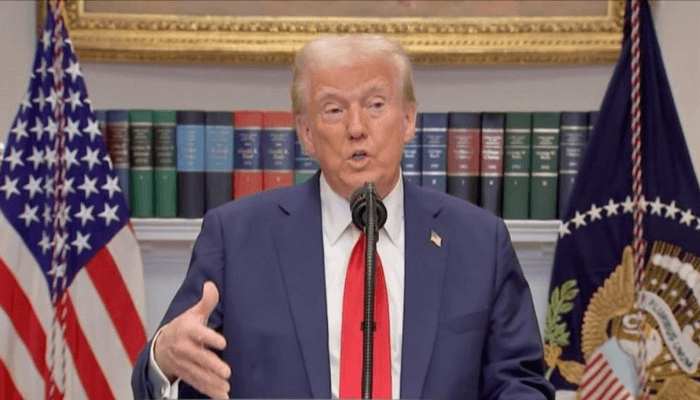
Last week was full of activity, particularly in the corridors of power in Abuja. The powers that be were seen making frantic efforts to poohpooh some threats by President Donald Trump of America. It was a measured response, however, from the Nigerian seat of power.
The dust raised by the threats is yet to settle. Reactions have been legion.
Recall that the United States President Trump
had threatened a possible military action against Nigeria over alleged persecution of Christians.
Trump’s outburst has sparked a storm of international criticism and local reactions, with global powers reaffirming support for Nigeria’s sovereignty and leaders at home calling for calm and unity.

In a post on his Twitter page penultimate Saturday, Trump had accused the Nigerian government of failing to protect Christians and warned that Washington could cut off all aids and “go in guns blazing” to “wipe out Islamic terrorists.”
“If the Nigerian government continues to allow the killing of Christians, the U.S.A. will immediately stop all aid and may very well go into that now disgraced country, guns-a-blazing,” Trump declared.
Speaking later aboard Air Force One, Trump doubled down when asked if his words implied possible troop deployment or air strikes.
“They’re killing Christians in large numbers. We’re not going to allow that,” he told reporters.
His remarks came shortly after the U.S. State Department redesignated Nigeria as a “Country of Particular Concern” for alleged religious persecution — a move that has already strained diplomatic relations between both countries.

Read also: Trump’s threat: FixPolitics condemns violence, tasks FG
EU, China reject Trump’s comments
The European Union and China were among the first to respond, both rejecting Trump’s rhetoric and pledging support for Nigeria’s sovereignty and internal efforts to maintain peace.
EU Ambassador to Nigeria and ECOWAS, Gautier Mignot, said the bloc’s position remained one of solidarity with the Nigerian people and government.
“We respect Nigeria’s sovereignty and constitutional commitment to religious neutrality,” Mignot said.
“Our position is one of solidarity — with the victims of violence, the authorities protecting citizens, and the people striving for peaceful coexistence beyond ethnic and religious divides.”
He added that the EU would continue to support peacebuilding, deradicalisation, and interfaith initiatives in the North-East, where insurgency has disrupted lives for over a decade.
In Beijing, China’s Foreign Ministry spokesperson Mao Ning warned against what she described as “foreign interference under the pretext of religion and human rights.”
“China firmly opposes the use of religion or human rights as excuses to threaten sovereign nations with sanctions or force,” she said.
“Nigeria has the right to choose its development path in line with its national conditions, and we will continue to support the Tinubu administration in maintaining stability and pursuing development.”
U.S. lawmakers push for sanctions
Meanwhile, Trump’s comments have spurred fresh legislative efforts in Washington. Senator Ted Cruz has introduced the Nigeria Religious Freedom Accountability Act of 2025, which seeks sanctions against Nigerian officials allegedly complicit in religious persecution.
The bill mandates the U.S. Secretary of State to identify governors, judges, and religious figures accused of promoting or tolerating violence under blasphemy laws. If passed, the measure could trigger asset freezes and visa bans, further straining Nigeria-U.S. relations.
Tinubu, religious leaders seek unity
In Abuja, President Bola Ahmed Tinubu last Tuesday met with the Catholic Archbishop of Abuja Diocese, Ignatius Kaigama, at the Presidential Villa. While details of the meeting were not made public, sources said discussions focused on promoting religious harmony and reinforcing Nigeria’s image amid global scrutiny.
At the same time, local civil society groups and interfaith organisations called for restraint, urging Nigerians not to allow external statements to inflame religious tensions at home.
Military reaffirms Nigeria’s strength
Meanwhile, the Nigerian Army announced new counter-terrorism gains, confirming that troops rescued two kidnapped victims and recovered ₦3.8 million ransom in Kogi State. In Borno State, soldiers repelled a Boko Haram attack in Mallam Fatori, killing six insurgents and seizing weapons.
Military authorities described the operations as proof that Nigeria is capable of managing its own security without foreign intervention.
As reactions continue to unfold, analysts say Trump’s comments have reignited global debate on religious freedom, sovereignty, and the limits of foreign influence in African affairs.