|
Getting your Trinity Audio player ready...
|
On October 3, 2025, more than thirty top-level executive leaders from firms including BCG, Duke Energy, Wells Fargo, IBM, Schneider Electric and the Environmental Defense Fund joined MBA students at the University of North Carolina’s Kenan-Flagler Business School for the Careers with Impact Forum (CWIF 2025).
For a full day, classrooms became laboratories of ideas. Executives debated how purpose and profit can co-exist, while students explored how business tools can drive inclusion, innovation and sustainability in a rapidly changing world.
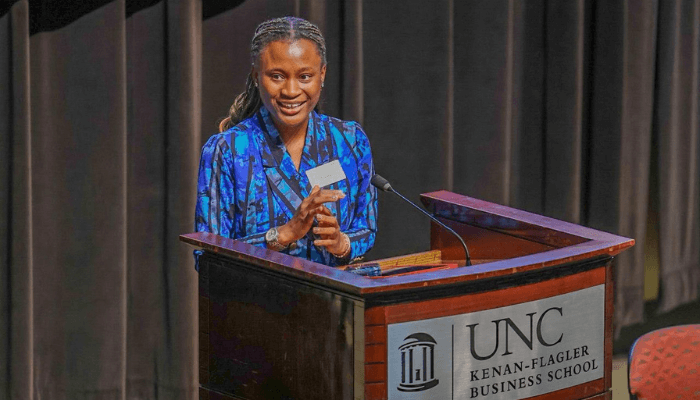
At the center of it all, I helped coordinate the 25th annual forum as a second-year MBA student and President of UNC Kenan-Flagler’s Net Impact Club, drawing on my experience as Founder of the Revamp Rave Network, a youth-led nonprofit focused on climate resilience and environmental education. Standing between the worlds of climate advocacy and business, I witnessed how quickly the language of impact is evolving.
As I said during my remarks, “Impact careers are not a niche; they are the future of business. Every young advocate or environmentalist now needs not only the heart of change but the tools of business to scale it.”

Reflecting on the event, I noted that the forum revealed a global shift: sustainability has moved from compliance to competitiveness.
From Compliance to Competitiveness
The Forum underscored how companies are redefining success beyond quarterly earnings, measuring instead the long-term value they create for society and the environment. ESG integration, circular-economy models and impact measurement have become pillars of corporate strategy rather than optional responsibilities.
Employers today seek professionals who can link climate risk to financial risk, embed sustainability into supply chains and translate purpose into profit.
Conversations across CWIF panels, from consulting and energy to finance, healthcare, technology and entrepreneurship, showed that the most resilient organizations are those that align growth with stewardship.

In a world defined by uncertainty, I observed that the ability to manage impact has become a measure of leadership itself.
My Journey: From Lagos to Chapel Hill
Before business school, I worked as an independent consultant across Africa and the Middle East, advising multilateral organizations on climate and governance. I consulted for the United Nations Office on Drugs and Crime (UNODC) on environmental protection and governance, served as Youth Advisor on the Digital and Green Economy to the EU Delegation to Nigeria and ECOWAS, and drafted the Climate Action Plan for an Oxfam-funded climate governance project across two governorates in Iraq.
While consulting for the United Nations Office on Drugs and Crime, I coordinated Nigeria’s first National Encyclopaedia of Threatened, Vulnerable and Endangered Species, a landmark reference designed to guide conservation policy and enforcement agencies. I also supported the national stakeholder mapping on wildlife and forest crime, identifying gaps in coordination, metrics and institutional leadership that limit policy implementation.
These experiences taught me that policy ambition often fails when institutions lack the tools of business such as strategy, data and accountability. The challenge was not commitment but coordination, the absence of systems and incentives that make sustainability operational.
Now working at the intersection of climate, governance and business sustainability, my MBA training is reshaping how I connect these worlds. I am learning how market analysis, design thinking and impact measurement can make social-change models scalable and financially viable. As I plan the next phase of Revamp Rave Network, I envision bridging youth advocacy with business innovation, linking the empathy of activism with the efficiency of enterprise.
Standing on stage at CWIF 2025, I realized that my personal evolution from advocacy to business strategy mirrors the transformation the Global South must embrace.
Lessons from CWIF 2025
Across seven panels, CWIF 2025 explored how industries are embedding purpose into performance.
• Consulting for Good: Experts from Implement Consulting Group and ScottMadden showed how consultants turn ESG frameworks into operational roadmaps.
• Finance and Impact Investing: Leaders from Wells Fargo, Self-Help Credit Union and the Founder Readiness Institute demonstrated how capital is redefining returns through blended finance and social value.
• Technology for Good: Executives from IBM and Lotacomm highlighted how AI and data can scale sustainability as a measurable growth driver.
• Entrepreneurship for Impact: Founders and investors shared how mission-led startups can attract capital without compromising values.
• Power with Purpose: Energy leaders from Duke Energy, RTI International and Strata Clean Energy showed how innovation, policy and leadership intersect in the energy transition.
• Impact at Scale – Healthcare: Health executives discussed how localized innovation can make health systems more equitable, data-driven and sustainable.
Each discussion converged on one insight: business has become the most powerful vehicle for social transformation when led by people who align purpose with performance.
Why Nigeria Should Care
Nigeria, Africa’s largest economy and one of its youngest nations, stands at a crossroads. Youth unemployment among 15–24-year-olds reached 8.6 percent in Q3 2023, while the informal employment rate stood at 92.3 percent, showing that even many “employed” young people work in low-productivity and unstable roles (NBS, 2023).
At the same time, Nigeria must invest massively to adapt to climate risk and deliver a low-carbon transition. The Climate Policy Initiative (2025) estimates that the country needs USD 3 trillion in infrastructure investment by 2050 and USD 1.9 trillion for its Energy Transition Plan to 2060 (CPI). Although Nigeria has mobilized about USD 2.5 billion for adaptation and USD 2.09 billion for mitigation, the financing gap remains vast (Connected Development, 2025).
With global investment flowing toward renewable energy, green finance and inclusive technology, Nigeria’s human-capital systems must evolve in tandem. These sectors demand professionals fluent in both sustainability and business strategy. As I emphasized during the Forum, “If every business leader viewed climate risk as business risk, and every graduate understood that profit and purpose are intertwined, Nigeria’s transition to a green and equitable economy would accelerate.”
Policy and Institutional Recommendations
• Build stronger partnerships: Building a sustainable economy will require more than corporate commitments; it demands collaboration between business, academia and government. Universities and professional institutes must integrate ESG strategy, innovation and sustainability analytics into their curricula, aligning education with Nigeria’s most pressing challenges such as energy access, waste management and local job creation.
• Develop Impact Career Accelerators: The Ministry of Labour and private-sector groups such as the Nigerian Economic Summit Group can help bridge this gap by creating Impact Career Accelerators, placing young professionals in sustainability projects and rewarding companies that mentor such talent.
• Reform corporate reporting: Corporate reporting must also evolve. Beyond tracking emissions, Nigerian firms should disclose the number of green or social-impact jobs they create and the skills they are developing for a digital and climate-resilient economy.
• Prepare for a gradual transition: Africa’s path to sustainability will not be powered overnight by renewable energy alone. The real opportunity lies in reforming existing energy systems, improving governance and building technical and business capacity to prepare for a gradual, inclusive transition. Investing in infrastructure, innovation and green skills now will create the foundation that makes renewables viable and equitable in the future.
Sustainability is not a Western luxury; it is an economic necessity. Research from the International Finance Corporation shows that companies with strong ESG performance enjoy lower capital costs and higher employee retention. Nigerian firms such as Access Holdings, Dangote Cement and others are already embedding sustainability to attract investors and manage long-term risk.
In today’s economy, purpose is a performance metric. Competitive advantage now depends not only on innovation but also on trust, the way companies earn legitimacy with communities, regulators and markets.
A Call to Re-imagine Work
CWIF 2025 affirmed that impact is infrastructure, the foundation that helps organizations and businesses withstand shocks and remain relevant. The future of work will belong to those who can balance analytical rigor with human purpose, combining technological innovation and AI with empathy and social awareness.
Nigeria’s next generation of leaders should not have to choose between doing well and doing good. With the right partnerships between academia, business and policy, they can do both, and in doing so, redefine what success in business truly means.
As someone who began advocacy in environmental justice, ocean governance and local adaptation, I believe the lesson is clear: to build resilient economies, we must build purposeful careers to promote sustainability from the ground up.
About the Author
Abimbola Abikoye is President of the Net Impact Club at UNC Kenan-Flagler Business School and Founder of the Revamp Rave Network, a youth-led initiative advancing climate resilience, ocean governance, and sustainability education. She works at the intersection of climate policy and justice, ocean governance, and rural adaptation.