A journey that began centuries ago
The story of Miyetti Allah cannot be told without tracing the history of Fulani herders who dominate its ranks. In a research published by Ifeanyichukwu Charles Nweke, on Self surveillance as securitisation: conceptualising Miyetti Allah’s membership surveillance as internalised securitisation, the author held that historical evidence place the arrival of nomadic Fulanis in northern Nigeria between the fourteenth and sixteenth centuries. For centuries, they remained largely in the north, fearing tsetse fly–borne diseases that affected their cattle.
Two events changed that trajectory the 1804 Jihad led by Usman Danfodio and the later arrival of British colonialists. The Jihad allowed many Fulanis to settle and blend into urban life, while colonial disease control measures made migration southward easier. Over time, the herders moved in search of pasture, bringing with them both cultural ties and new tensions with farming communities.
Read also: Why Miyetti Allah is trending and what it means for Nigeria’s agric sector
The birth of Miyetti Allah
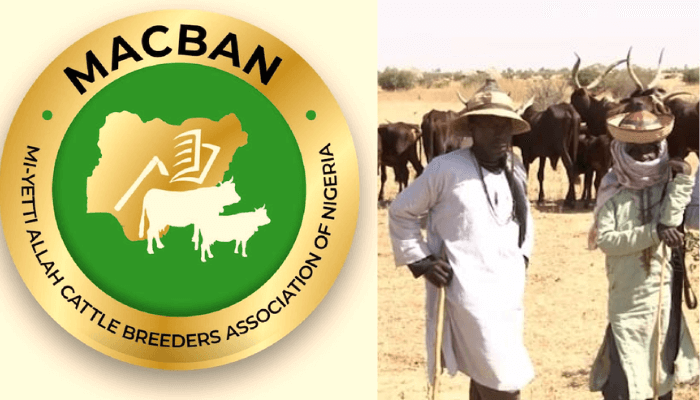
It was against this backdrop that the Miyetti Allah Cattle Breeders Association of Nigeria (MACBAN) was founded in 1979, with headquarters in Kaduna. The name Miyetti Allah means “I thank God” in Fulfulde. Initially, it was a loose welfare group promoting self-help among settled Fulanis in Kaduna and Plateau states.

Over the years, Miyetti Allah grew into an influential national organisation representing about 100,000 semi-nomads and nomads. Its focus included advocating for nomadic education, access to grazing reserves, and peaceful coexistence with farming communities.
The association’s structure mirrors Nigeria’s federal system, with national, state, and local executives. The Sultan of Sokoto chairs its board of trustees, while the national chairman is elected every four years. According to the group, funding comes from membership dues and donations.
Read also: New U.S. bill seeks visa bans, asset freezes for Nigerian Miyetti Allah, Fulani militias
A divided house
Miyetti Allah today exists in two main factions: the Miyetti Allah Cattle Breeders Association of Nigeria (MACBAN) led by Baba Othman Ngelzarma, and the Miyetti Allah Kautal Hore faction led by Bello Badejo. Both claim to represent the interests of Fulani pastoralists, but their approaches sometimes differ.
The late Muhammad Adamu, chairman of MACBAN in Barkin Ladi, Plateau State, was recently killed by unknown gunmen. State chairman Ibrahim Yusuf Babayo confirmed that Adamu was attacked at home after breaking his fast. His death once again highlights the risks associated with the insecurity that has engulfed pastoralist communities.

Accused, misunderstood, and adapting
Conflicts between farmers and herders, many of whom are Miyetti Allah members have become more frequent since the 1970s. Thousands have died, and both sides blame each other. Farmers accuse herders of destroying crops, while herders say they are victims of political exclusion and profiling.
Miyetti Allah leaders insist they are not violent. In 2018, Muhammadu Sanusi, the emir of Kano, told The Punch that the group’s patrons including the Sultan of Sokoto, Emir of Katsina, Emir of Zazzau, and Lamido of Adamawa have always stood for peace.
“To the best of my knowledge, Miyetti Allah has never been involved in acts of violence and has always condemned violence,” Sanusi said. “It is committed to protecting the fundamental rights of herdsmen as Nigerians.”
Still, the association’s name is often linked to rural banditry, cattle rustling, and communal clashes. In response, Miyetti Allah has tried to reshape its image, particularly in southern Nigeria.
In the Southwest, the group began compulsory registration for herders to enable authorities to identify genuine members and monitor criminal activities. “Every herder must have an identity card,” one state chairman explained, saying it helps police confirm their legitimacy. Nweke’s study notes that such internal documentation aligns with the group’s long-term shift toward self-regulation in response to rising public scrutiny.
Amotekun, the regional security outfit, described the registration as a tool to prevent crimes and ensure accountability. “If anything goes wrong, we will know who is responsible,” an Amotekun commander said.
Internal reforms and local cooperation
To reinforce its credibility, Miyetti Allah tightened membership screening. New members must be introduced by existing ones, and the association verifies their identities through their home state branches, Nweke’s work points out that this layered verification system has become one of the association’s most important tools for preventing bad actors from accessing its membership.
Read also: US lawmakers seek sanctions on Miyetti Allah, others over alleged religious-freedom violations
“We do not want bad people joining us,” one official said. “That will allow them to claim they are our members when engaging in criminality.”
The association has also set up vigilante units in pastoral communities across Ogun, Oyo, and Ondo states. These units assist the police and Amotekun in identifying criminals who disguise themselves as herders. “If the suspect is Fulani, the vigilante will arrest and hand him over to the police,” the study noted.
Changing attitudes and policy engagement
In Benue, Miyetti Allah recently declared that open grazing is no longer sustainable. Benue State secretary Ibrahim Galma said the group now supports more modern practices.
“We now know quite well that open grazing is not sustainable, not only in Benue state but in Nigeria in general,” Galma said. “If we can stop open grazing in good condition and understanding, I believe there would be no clashes between farmers and herders.”
Miyetti Allah Kautal Hore association has also condemned what it calls “genocidal massacres” of Fulani pastoralists by non-state vigilante groups. It urged Inspector-General of Police Kayode Egbetokun to investigate and prosecute those responsible.
“The continuous profiling of Fulani pastoralists by some sections of the media must stop,” the group said, calling for fairness in reporting the farmers-herders conflict.
The association has also commended some state governments for peaceful interventions and has worked with security agencies to prevent further violence.
Read also: FCT Police, Miyetti Allah leaders move to end communal clashes, cattle roaming in Abuja city centre
The U.S. sanctions controversy
In a new twist, Miyetti Allah has come under international scrutiny. The United States House of Representatives recently passed a resolution urging the Departments of State and Treasury to impose targeted sanctions including visa bans and asset freezes on individuals and organisations accused of religious-freedom violations in Nigeria.
Among those named were the Miyetti Allah Cattle Breeders Association and its affiliate, Miyetti Allah Kautal Hore. The resolution also called for Fulani ethnic militias in Benue and Plateau States to be listed under the Entities of Particular Concern category.
In response, Abdul Danbature, President of the Arewa Youth Assembly for Good Leadership, said that Trump’s decision to sanction Miyetti Allah suggested a lack of proper knowledge about the group’s composition and purpose.
“Miyetti Allah is a group of Fulanis. In this group of Fulanis, we have professors, students, herdsmen, doctors, and governors. We also have terrorists, or let me say bandits, inside. If America or Trump said they have sanctioned Miyetti Allah, does that mean they sanctioned the entire Fulani or what? That is why we are not clear, because it is just a group of people that came together,” he said
If implemented, the sanctions could have far-reaching implications: disrupting cattle supply chains, increasing Nigeria’s risk profile internationally, and affecting investor confidence in agriculture and logistics sectors.
Caught between perception and survival
Miyetti Allah stands today as both an advocate and a symbol defending Fulani pastoralists’ rights while struggling to shed its association with violence. For some, it remains an important voice for marginalised herders; for others, it represents the face of rural insecurity.
What is clear is that Miyetti Allah’s future and that of Nigeria’s fragile coexistence between farmers and herders depends on how effectively both government and communities confront the deep issues of land, identity, and justice that underpin the conflict.