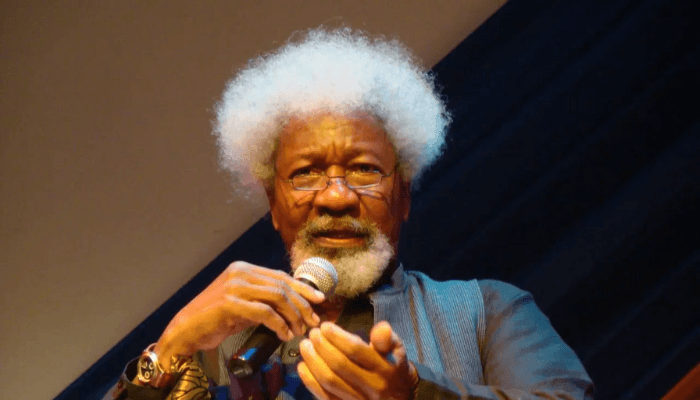
Wole Soyinka has framed his long-running clash with Donald Trump as a symbolic struggle against rising authoritarianism, arguing that personal dignity must be defended when democracy comes under threat.
Speaking in a recent BBC interview, the 91-year-old playwright said his actions since Trump’s ascent to power, including voluntarily discarding his US green card, were driven by a refusal to “wait to be humiliated” by policies he believed targeted Black people and other minorities living in America.
Soyinka reiterated his early warnings in 2016 that Trump’s presidency would foster discrimination and state-backed hostility toward vulnerable populations. He said those fears were soon validated by what he described as a spike in hate-driven rhetoric and extrajudicial police killings.
“We saw that dark side of the American psyche,” he said. “There were more extrajudicial killings by the police of Black people, of minorities, during the campaign and on account of hate rhetoric.”

The revered writer, who spent decades lecturing in top American universities, said he foresaw a political climate in which immigrants, even legal residents, would be treated as disposable. “When that man comes to power, the first thing he will do is cancel even the green cards,” Soyinka recalled predicting. “This is a petty-minded dictator.”
He explained that destroying his green card in 2016 was a preemptive declaration of autonomy. The gesture, he said, was misinterpreted by many who did not understand the importance of self-respect in the face of rising intolerance.
Read also: Edo APC boss vows ‘uncontrolled’ loyalty to governor Okpebholo, says 2027 Tinubu votes ‘settled’
“I don’t like to be kicked out. I like to kick myself out; it’s more dignified.”
According to Soyinka, his concerns gained even greater resonance following Trump’s re-election in November 2024. Shortly afterwards, he received an unexpected letter from the US Internal Revenue Service (IRS) demanding he report for a tax audit covering five years of his filings, a coincidence he found “very impressive”.

Soyinka said he immediately alerted the US Embassy, noting that his invalidated residency status could have been maliciously used to portray him as a tax fugitive.
“I don’t want to be advertised as a tax dodger owing the United States money and being chased all over the world with letters and police,” he said.
He attended the audit, insisting on clarifying his financial status to avoid what he feared might become a weaponised legal case.
His strained experience with US authorities culminated last month when his visa request was denied and his non-immigrant visa revoked, a move that many have interpreted as the latest episode in his turbulent relationship with the US immigration system during the Trump era.
Soyinka’s account underscores a broader warning about democratic backsliding in global powers like the United States. While he acknowledges that some may view the incidents as coincidental, he insists the pattern reflects a deeper reality: intolerance thrives when citizens fail to take principled stands.
For Soyinka, that stand was personally a defiant defense of dignity over silence. “People failed to accept it,” he said of his early protest. “But I knew what I was doing.”