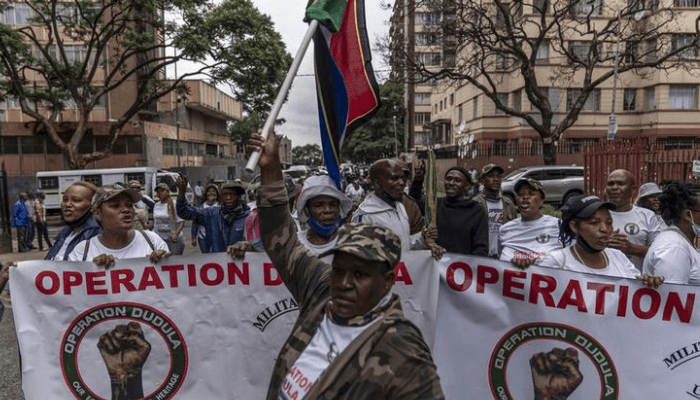
Across Africa today, a disturbing wave of populist nationalism is re-emerging: a phenomenon marked by the scapegoating of immigrants, the stoking of xenophobic passions, and the cynical manipulation of public fears for short-term political gain. From the streets of Johannesburg, where Operation Dudulla militants have hounded African migrants, to political podiums in Accra, where Hassan Ayariga, the leader of Ghana’s All People’s Congress (APC), recently initiated online and offline campaigns against Nigerians as well as also making inflammatory comments about the country and its citizens, the continent seems to be sliding toward a dangerous crossroads.
At the heart of this worrying trend lies an ugly truth: some African politicians, running out of genuine ideas, resort to exploiting nationalist and anti-immigrant sentiments as a desperate strategy to resuscitate their waning political fortunes. This tactic may yield fleeting applause, but it threatens the very soul of African integration and the vision of a unified, prosperous continent.
Operation Dudulla, a symptom of political decay
Operation Dudulla began as a vigilante movement in South Africa, ostensibly to protest illegal immigration and unemployment. But what started as an expression of ‘economic frustration’ quickly mutated into a xenophobic crusade targeting mostly fellow Africans from Zimbabwe, Nigeria, Malawi, Mozambique, and elsewhere.

The group’s rallies and raids, often violent, have been accompanied by rhetoric eerily reminiscent of colonial and apartheid-era segregation: the framing of African brothers and sisters as ‘foreigners’ and ‘thieves of local jobs.’
What is worse, some South African politicians have courted or echoed the group’s message, calculating that aligning with popular anger could boost their standing among the poor and disenchanted. But such politics of division is a short-sighted gamble. By vilifying migrants, they fuel hatred, fracture communities, and undo decades of progress toward continental solidarity.
Hassan Ayariga and Populism at its pettiest
In Ghana, Hassan Ayariga, a fringe and serial presidential aspirant whose academic qualification has been questioned by the relevant state agency responsible for vetting academic titles by public figures in Ghana, recently joined the populist bandwagon by making inflammatory remarks against Nigerian migrants blaming them for crime, economic hardship, and social disorder. His comments, couched as being in the ‘national interest,’ were in fact a calculated attempt to tap into latent public frustration for political relevance.
It is not the first time Ayariga has tried to ride the wave of sensationalism. But this time, he struck a dangerous chord that resonates far beyond Ghana’s borders. By attacking Nigerians, a people with deep historical, cultural, and economic ties to Ghana, Ayariga undermined not only bilateral goodwill but also the broader ECOWAS dream of regional integration and free movement.

The ECOWAS Protocol on the Free Movement of Persons, ratified in 1979, guarantees citizens of member states the right to enter, reside, and establish in one another’s countries without visa restrictions. It was a visionary pact, built on the belief that the economic destiny of West Africa is shared. Politicians like Ayariga, in stoking anti-immigrant sentiment, betray this vision and risk reigniting the toxic rivalries of the past including memories of the 1969 Aliens Compliance Order which had expelled immigrants, mostly Nigerians, from Ghana, and the 1983 ‘Ghana Must Go’ expulsions that still haunt regional relations today.
Read also: Nigerians raise alarm as over Xenophobic threats in South Africa
The broader African context as populism’s new frontier
Across the continent, populist nationalism is becoming a convenient refuge for struggling politicians. In Kenya, South Africa, Ghana, and parts of North Africa, the ‘foreigner’ is being framed as the cause of local unemployment, crime, and poverty. Yet, these problems are primarily rooted in corruption, poor governance, and weak economic planning; not immigration.
By shifting blame to immigrants, opportunistic politicians escape accountability. They find easy enemies instead of hard solutions. And in doing so, they plant seeds of hatred that can outlive their fleeting careers and outgrow their control.
If left unchecked, this politics of exclusion could metastasize into a continental crisis, tearing apart regional blocs like ECOWAS, SADC, and COMESA, and reversing the modest gains of the African Continental Free Trade Area (AfCFTA), the very framework designed to unite Africa’s markets, peoples, and resources.
Danger to African Integration
African integration is not merely an economic aspiration; it is a survival imperative. With over 1.4 billion people and a combined GDP exceeding $3 trillion, the continent’s strength lies in its unity and interconnectedness. Xenophobia, nationalism, and ethnic populism threaten to destroy this foundation from within.
When a Ghanaian politician vilifies Nigerians, or a South African mob attacks Zimbabweans, they are not merely attacking individuals, but they are attacking the idea of Africa itself. They erode trust, discourage mobility, and sabotage regional cooperation.
Integration thrives on mutual respect, cultural exchange, and shared opportunity. Once suspicion replaces solidarity, the African dream becomes a mirage.
History and the False Promise of Xenophobia
History is replete with warnings. Europe’s descent into fascism in the early 20th century began with populists demonizing minorities and immigrants. The result was decades of conflict and collapse before the continent painfully rebuilt through cooperation.
Africa cannot afford to repeat that mistake. Its leaders must recognize that anti-immigrant populism is not a path to progress; it is, rather, a path to paralysis. It weakens economies, invites retaliation, and isolates nations in a globalized world.
Already, anti-Nigerian sentiments in parts of Africa have begun to provoke reciprocal hostility, endangering citizens abroad and straining diplomatic relations. When one African’s presence becomes another African’s ‘problem,’ the very spirit of Pan-Africanism, for which our forebears fought, begins to die.
Saving Africa from the politics of desperation
The rise of anti-immigrant populism in Africa, as embodied by Operation Dudulla of South Africa and echoed by politicians like Hassan Ayariga of Ghana, is a symptom of desperation, not leadership. It reflects a moral bankruptcy that prefers division to dialogue, blame to vision, and regression rather than progress.
True leadership in Africa today must reject the easy path of populism and embrace the harder road of integration, cooperation, and shared growth.
Way forward through leadership and continental responsibility
Africa’s leaders and regional organizations must take firm steps to curb this dangerous trend. The African Union, ECOWAS, SADC and all other regional economic blocs across the continent must not remain silent. There must be political consequences for leaders and movements that incite xenophobia or promote discriminatory policies.
Media institutions, civil society, and thought leaders must also play their part by calling out divisive rhetoric, promoting public education on migration’s economic benefits, and reasserting the shared destiny of African peoples.
Migration, when managed with fairness and foresight, is not a burden but a blessing. It drives trade, innovation, and cultural enrichment. African cities from Lagos to Johannesburg to Accra thrive because of cross-border energy and diversity, not despite it. The future of Africa depends not on those who divide it for political convenience, but on those who unite it for collective prosperity.
History will remember the difference.
Martin-Luther C. King is an international journalist, media entrepreneur, and regional integration advocate.