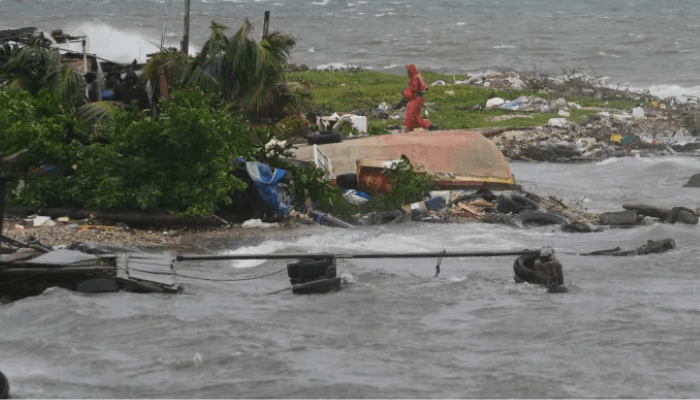
Jamaica woke up on Wednesday to a country almost unrecognisable. Electricity is out for most people. Roads are under water. Homes lie in ruins. Life on the island has been brought to a sudden stop after Hurricane Melissa tore through with frightening force.
Andrew Holness, the Prime minister said Jamaica has been “ravaged” and has now been declared a disaster area. He warned that the storm caused “devastating impact” to hospitals, homes and major roads. “It is clear that where the eye of the hurricane hit, there would be devastating impact,” he said on United States news channel CNN. “We are expecting some loss of life.”
Read also:Nigeria finds new LNG bride in Jamaica as export rises
Melissa struck the island on Tuesday as a Category 5 storm. It ripped off roofs, smashed power lines and uprooted trees as it took hours to grind its way across the country. Almost three quarters of Jamaica is without power. The government says help will begin to reach people as quickly as possible, but communications are badly damaged and many areas remain cut off.

Desmond McKenzie, local government minister, said the storm hit “almost every parish” and left the main farming region of St Elizabeth “under water”. He added that roads are blocked and communities are surrounded by floodwater.
Read also: Caribbean venture capital fund invests in Jamaican delivery service, Doorstep
The fear and shock felt by Jamaicans is now turning into worry about what comes next. In Kingston, 30 year old communications specialist Lisa Sangster is trying to deal with the loss of her home. “Parts of our roof were blown off and the entire house was flooded,” she said. “Everything outside was destroyed.”
Others count themselves fortunate but are deeply concerned for people in the west. “My heart goes out to the folks living on the western end of the island,” said 31 year old Mathue Tapper. “We in Kingston were lucky.”
For many in rural communities, the night felt endless. “Powerful wind. A lot of things flying all over the place. Trees uprooted. No electricity,” said Tamisha Lee, president of the Jamaica Network of Rural Women Producers. “I am feeling anxious and tense. The damage will be enormous.”

Journalist Kimone Francis, reporting for The Jamaica Gleaner, described scenes “like an apocalypse movie”. She said the heavy rain and wind through the night were “stressful” and “intense”. In some areas, water rose to the roofs of two storey homes.
Read also: FG commences BASA review with Jamaica, receives ambassador
Montego Bay, the heart of the island tourism industry, has been torn apart. Mayor Richard Vernon said the city was split in two by floodwater. “One side is now cut off from the other. My immediate concern is simple. Check if everybody is alive,” he told the BBC.
Meteorologists say Melissa strengthened at a rare speed, driven by unusually warm waters in the Caribbean. Experts warn this kind of rapid growth is becoming more common as the climate heats up.
Jamaica is only beginning to understand the full scale of the disaster. Even before the storm hit the island, Melissa had already killed seven people in the region. Now, millions face a long road back as they try to rebuild a country shaken by its strongest storm in modern history.