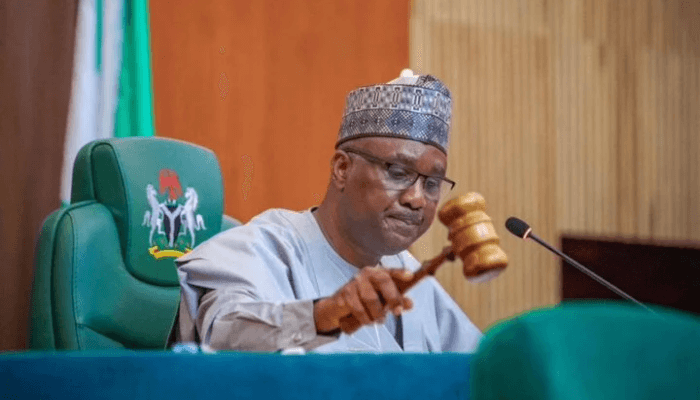
The National Assembly has intensified efforts to grant Nigerians living abroad the right to vote in national elections, as the Federal Government deepens its engagement with the diaspora community.
This renewed drive was highlighted at the Nigerian Stakeholders Engagement on Diaspora Governance (NiSEDiG 2025) in Abuja, where lawmakers reaffirmed their commitment to inclusivity and unveiled new digital platforms aimed at strengthening ties with citizens abroad.
Tajudeen Abbas, Speaker of the House of Representatives, announced the development on Monday while launching the Nigerians in Diaspora Response (NiDRes) Application and Website and declaring the NiSEDiG 2025 open in Abuja.

Represented by Patrick Umoh, member representing Ikot Ekpene/Essien Udim/Obot Akara Federal Constituency, Abbas described the bill as a bold step toward strengthening democratic participation and ensuring that every Nigerian, regardless of location, contributes to nation-building.
“The 10th House of Representatives regards diaspora engagement as a national priority consistent with its legislative agenda of inclusion, accountability, and economic reforms”, he added.
Speaking earlier, Tochukwu Chinedu Okere, Chairman of the House Committee on Diaspora, said the NiSEDiG 2025 initiative was conceived to create a coordinated policy framework that integrates institutions, legislation, and technology to improve diaspora governance.
“The newly launched NiDRes App and Website were designed to make it easier for Nigerians abroad to access government services, communicate with embassies and missions worldwide, and respond to national issues in real time”, he noted.
Delivering the keynote address, Abike Dabiri-Erewa, Chairman and Chief Executive Officer of the Nigerians in Diaspora Commission (NiDCOM), highlighted the remarkable progress made in diaspora engagement since the Commission’s establishment six years ago.

She explained that the Nigeria–Diaspora relationship has recorded groundbreaking achievements in sectors such as health, education, agriculture, ICT, transportation, and volunteerism. According to her, the country has now entered a new phase of consolidating diaspora engagement to strengthen national development.
Read also: Bill for diaspora voting passes second reading in House of Reps
Dabiri-Erewa recalled that the National Diaspora Policy, approved by the Federal Executive Council on April 28, 2021, provides the guiding framework for integrating diaspora participation into national planning and development.
She also referenced the Diaspora Data Mapping Portal, launched in June 2021, which supports data collection and informed decision-making on issues concerning Nigerians abroad.
The NiDCOM chief noted that diaspora remittances remain Nigeria’s most significant source of foreign exchange, amounting to US$23.81 billion in 2019, representing about six percent of the nation’s GDP.
She cited several NiDCOM-led initiatives that have deepened diaspora participation, including the National Diaspora Day celebrated annually on July 25, the Nigeria Diaspora Investment Summit (NDIS) which connects investors abroad with local opportunities, the National Town Hall Meetings that enable direct interactions between the President and Nigerians abroad, and the National Diaspora Merit Awards which recognise outstanding achievements by Nigerians in the diaspora.
She also mentioned the Diaspora Quarterly Lecture Series that addresses issues affecting Nigerians overseas, alongside NiDCOM’s collaborations with the Ministries of Foreign Affairs and Humanitarian Affairs to assist in the repatriation of distressed citizens.
Dabiri-Erewa identified persistent challenges such as limited funding, inadequate office accommodation, and the urgent need to amend the NiDCOM Act to ensure a sustainable financing mechanism through diaspora remittance levies.
Read also: Coalition calls for immediate passage of legislation on diaspora voting
“Addressing these challenges is critical to maintaining the progress already achieved and to enabling NiDCOM to serve as a stronger bridge between the government and Nigerians abroad”, she stressed.
The NiSEDiG 2025 engagement and NiDRes App launch, she said, symbolise Nigeria’s renewed commitment to building a more structured, inclusive, and technology-driven diaspora engagement system.
The event drew participation from Nigerians in Diaspora Organisations (NIDO), members of the academia, students and youth groups, the Nigerian Immigration Service, various ministries, departments, and agencies of government, as well as state diaspora focal point officers.