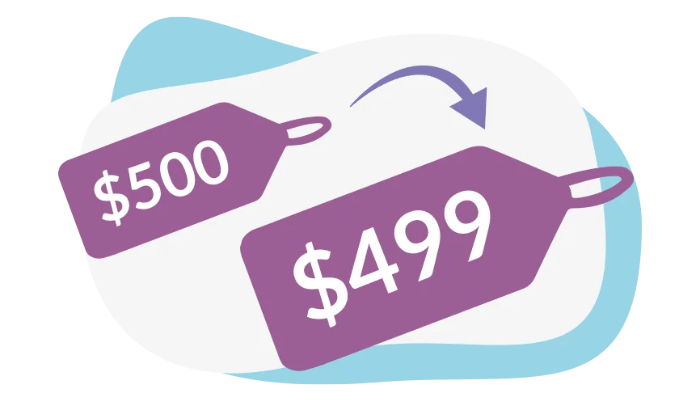
The Round Figure Illusion is the psychological weight Nigerians attach to rounded prices. Round figures evoke different emotional reactions from different shoppers. Since we make our purchase decisions emotionally and then just with logic, the effects of ‘Round Figures’ on commerce require a thorough examination.
Numbers With Personality
Nigerians respond to prices like radio signals. Round figures such as N500, N1,000, or N10,000 feel clean and decisive. They mark boundaries of affordability. Odd numbers such as N499 or N9,950, though mathematically similar, evoke different emotions.
Behavioural economics calls this left-digit bias. It is the tendency to anchor decisions on the first number seen. A study by Thomas and Morwitz (2005) found that consumers perceive prices ending in “9” as significantly lower than rounded ones, even when the difference is minute (Journal of Consumer Research). The difference of one naira can shift perception dramatically.
In Nigeria, this bias meets a strong cultural preference for completeness. A CBN study on cash handling habits found that over 60% of cash-based transactions in open markets are conducted in round amounts like N500 or N1,000, even when change is possible (Central Bank of Nigeria, 2022). The round figure feels “settled.”

The Psychology of Closure
Nigerians treat round figures as closure points. To “make it N1,000” signals finality. In Yoruba, one might say “Ki o to san daadaa” (“pay it properly”). The number feels complete, respectful, and less awkward than decimals.
This is why market women often quote in clean thousands, and buyers mirror the same rhythm. The simplicity of round figures reduces cognitive strain. You don’t have to calculate change, remember decimals, or split notes. The transaction ends neatly.
In psychology, this is linked to the principle of cognitive fluency. People prefer what is easier to process. Prices that are simple to read or say feel more honest and trustworthy. A 2013 study by Wadhwa and Zhang found that fluently processed prices increase perceived value and reduce price resistance (Journal of Marketing Research).
Negotiation and Round Pride
Rounding up or down also has social meaning. In Nigerian bargaining culture, buyers use round figures to assert control or generosity. A buyer may say, “Take N3,000 and close it,” implying fairness and authority. Sellers reciprocate, saying, “Add small and make it N3,500,” invoking closure.
This ritual transforms numbers into performance. Rounding becomes a gesture of completion, dignity, and or goodwill. It mirrors broader social norms where closure matters more than precision.

Interestingly, digital payments are slowly disrupting this habit. Mobile apps now encourage exact transfers (N9,855 instead of N10,000). Yet, even here, round figures persist. Many users prefer sending “complete” numbers to friends or relatives because it “looks better.” The emotional symmetry of roundness endures.
When Roundness Backfires
For businesses, round pricing can simplify operations but sometimes hurts perception. In formal retail, consumers often associate rounded prices with institutional inflexibility or hidden mark-ups. A study of Nigerian supermarkets by Ogunbajo et al. (2021) found that odd-number pricing (N499, N999) improved perceived affordability and purchase frequency by nearly 18% compared to round pricing (Journal of Economics and Sustainable Development).
This is why many large retailers and online platforms adopt psychological pricing even in cash-heavy environments. It nudges consumers toward feeling they are spending less. Yet in open markets, the opposite holds true, rounded prices build trust because they align with cultural expectations of “complete” payment.
The Nigerian Duality
The Round Figure Illusion captures a unique duality. In formal retail, Nigerians prefer prices that look slightly less than the next round number. In informal settings, they prefer rounded totals that feel settled. The environment determines which illusion dominates.
This explains why N499 sachets of milk work in supermarkets, while open market retailers stick to N500. Both cater to the same psychology from opposite ends. Precision feels smart in one context, completeness feels safe in another.
Business Implications
1. Context matters. Round pricing performs better in cash markets; odd pricing works better in digital and modern trade channels.
2. Round closures signal trust. Sellers in informal sectors should use round prices to communicate honesty and confidence.
3. Odd pricing signals value-seeking. Retailers targeting middle-class or online buyers should adopt precise figures that create a perception of savings.
4. Combine round and odd strategically. Use round figures for brand communication (“from N5,000 packages”) and odd figures at checkout (N4,950) to balance clarity with psychological reward.
Conclusion
The Round Figure Illusion shows that Nigerians feel it when they count money. The way a price looks, sounds, or ends shapes whether it feels fair or inflated. In Nigeria, trust and perception drive commerce as much as arithmetic, and pricing must be a deliberate design acknowledging your trade channel and consumer expectations.
For businesses, this means every zero and every nine is emotional currency. The difference between N999 and N1,000 is not one naira; it’s a feeling.