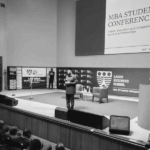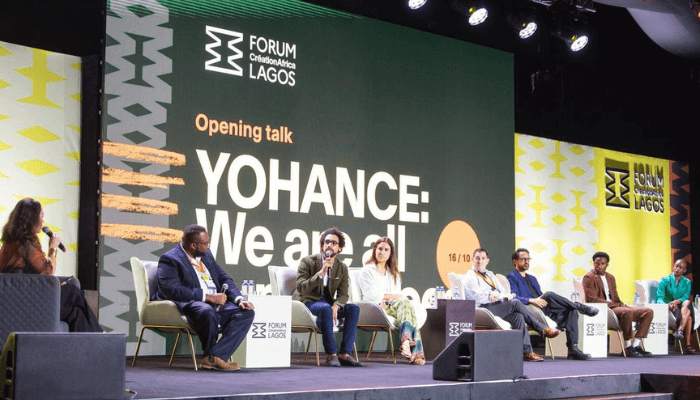
At the heart of Lagos Island, the Federal Palace Hotel transformed into a vibrant hub of creativity as Africa’s most talented creatives converged for Forum Création Africa Lagos.
The air was electric with anticipation as TV series producers, musicians, animators, game developers, visual effects artists, comic book enthusiasts, and digital visionaries gathered to showcase their work, share their stories and foster knowledge sharing.
This dynamic forum was more than just a meeting of minds – it was a celebration of African creativity, a reawakening of hope, and a testament to the continent’s boundless potential. As creatives from across the continent came together to share their perspectives and showcase their talents, the atmosphere pulsed with energy and excitement.
With Africa’s stories told in a fresh, innovative light, Forum Création Africa Lagos was a beacon of inspiration, shining brightly for all to see.

Emmanuel Macron, President of France who spoke virtually on this year’s event said choosing Lagos to host the first African edition was an obvious decision as Lagos is not only a creative powerhouse in Africa, but also a global reference for cultural innovation.
“You have gathered in this vibrant city to explore new perspectives, foster collaboration and spark creative energy. You are exploring exciting new frontiers in all areas, such as music, TV series, animation, video games, visual effects, comics, digital vision, etc. But Creation Africa is more than just a forum.
“It’s a powerful opportunity to bring people together across borders, across languages, and to strengthen the ties that unite our creative industries. Through this, you are not only reinforcing cultural ties between Africa and France, you are shaping the stories of today and tomorrow; stories in all languages, speaking to all cultures, stories that reflect our ever-evolving societies,” Macron said.
The France President said the Creation Africa is a unique opportunity, guided by MansA-Maison des Mondes Africains, which has just opened its doors in Paris.
He noted that MansA is a major new cultural institution built to spotlight the vibrancy of contemporary African creativity and the connection between Africa and France.

“Today marks an important milestone in this journey. I’m counting on each of you to help open new horizons, create new spaces, and spark new hopes for our youth and our societies. I’m extremely happy that you will gather all the creators, all the artists from the whole continent in Lagos,” Macron said.
In her welcome address, Elizabeth Liz Gomiz, director, MansA Maison des Mondes Africains said together Africa is not waiting to be seen but already setting the rhythm.
From fashion to film, from gaming to sound design, from VR to AI, Liz Gomiz said the creative energy of this continent is rewriting the code of global culture, adding that while the rest of the world looks for trends, France and Africa are collaborating to build frameworks for imagination.
“That is Creation Africa, a space where innovation doesn’t erase tradition; it extends it; where the creative economy isn’t an afterthought, but the engine of transformation. We see creation as a lever for global innovation, and culture as a tool for research and development,” Liz Gomiz said.
She said culture produces meaning, and meaning produces power; power to shape perception, to influence behaviour, and to move markets. Creation Africa is not just a forum; it’s a rehearsal for the future; a place where new ideas, new alliances, and new systems of value are born.
“So today, let’s keep that light burning in Lagos, Nairobi, Gaborone, Cotonou, Cairo, Dakar, and of course in Paris, where MensA Maison des Mondes Africains, the new cultural institution dedicated to contemporary African creation, which I have the privilege to lead.”
According to Liz Gomiz, two years ago, it was all a dream, today, it’s more than an institution, it is a bridge between creation and entrepreneurship, between memory and technology, because the next revolution won’t be televised.
“It will be designed, coded, filmed, composed, and deeply felt. It will be African, and it will belong to all of us,” she added.
One of the exhibitors at the event, Zara Odu, Roundabout Community, a resource-kit and digital gathering space focused on circularity, sustainability, and innovation in Africa said Heritage in Motion is their first exhibition with the goal of highlighting the indigenous craft processes across Africa and to position them as innovative.
“The idea is that we’re looking at digital innovation, but the value is by going back to our roots, looking at what is innate to us and saying the simple indigenous ways that we create are actually innovative in themselves.
“So looking at looking at the way things are hand woven, how paper is made through recycled textiles, all those things are indigenous to us as Africans and we want to use them as opportunities to show the work that we are doing, but also to show that they are also innovative and can then be a stepping stone to building for the future. So looking at craft as not just nostalgia and as a relic, but as something that’s future proofing, Odu said.
She further explained that Heritage in Motion considers how inherited techniques, often passed down informally, quietly, and by hand, are being reactivated with new perspectives. In doing so, it reframes heritage as a site of experimentation, adaptability, and cultural authorship.
“African craft has always been innovative, not through machinery or scale, but through process, adaptability, and deep material intelligence. In reality, it can be found in small, intentional acts: the way materials are sourced, the rhythm of handwork, the logic embedded in techniques refined over generations.
These processes are not just traditions, they are dynamic systems of making that respond to context, community, and need. At its core, Heritage in Motion examines how old craft processes like weaving, dyeing, beading, stitching, molding, can be re-seen, reworked, and reinterpreted through contemporary eyes,” Odu stated.