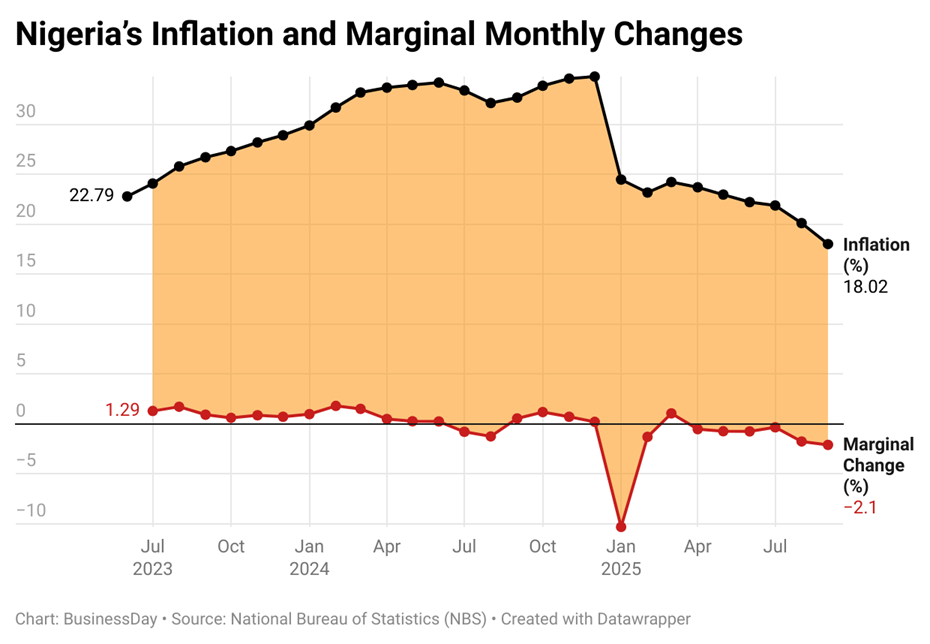
Nigeria’s Central Bank (CBN) is edging closer to its medium-term inflation target as prices continue to decline steadily, signaling a gradual return to economic stability.
According to the National Bureau of Statistics (NBS), headline inflation eased to 18.02 percent in September from 20.12 percent in August, marking the sixth consecutive monthly decline and the largest drop this year, a fall of 2.10 percentage points. With the Medium-Term Expenditure Framework (MTEF) target set at 15.75 percent, the CBN is now 2.27 percentage points closer to its goal.
The sustained decline suggests the economy is moving away from the price volatility that followed the 2023 reform shocks.
Disinflation boosts confidence

The recent figures have strengthened analysts’ confidence that inflation is trending downward. Bismarck Rewane, an economist who had projected inflation would ease to 19 percent by November, said the trend “confirms that Nigeria’s economic recovery is real.” He noted that the connection between inflation and growth is becoming more apparent, with easing prices supporting GDP growth, a dynamic consistent with classical economic theory.
Olayemi Cardoso, the CBN Governor, has echoed this optimism, stating that the bank remains committed to “anchoring expectations through sound monetary management and coordination with fiscal authorities” and emphasized that price stability “is the foundation of sustainable growth.”
The CBN’s recent 50-basis-point cut in September, its first since 2020, further reflects confidence that inflation will continue to decline. The benchmark rate now stands at 27 percent as the central bank balances supporting growth while managing price expectations.
Econometric projection supports continued easing
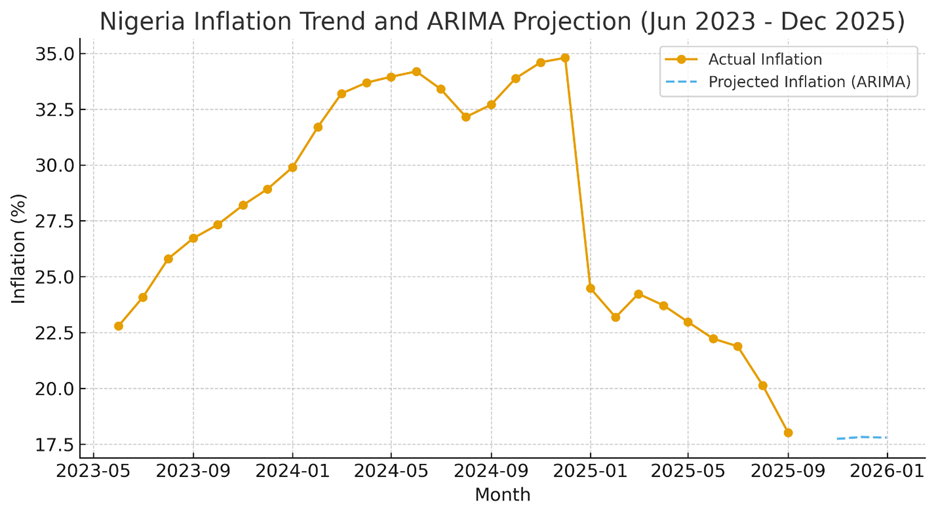

BusinessDay economists projected that if the current disinflation trend persists, Nigeria’s inflation rate could fall below 17 percent by the end of 2025, moving closer to the MTEF target.
Using the ARIMA (Autoregressive Integrated Moving Average) model, a statistical tool that identifies patterns in past data to forecast short-term trends, with 28 monthly observations from June 2023 to September 2025 and projecting three additional months to December 2025, the analysis points to a continued path toward price stability, supported by monetary easing, improved agricultural output, and exchange rate stability.
Food and core inflation show relief
The moderation in inflation has been broad-based. Food inflation, the primary driver of headline prices, fell to 16.87 percent from 21.87 percent in August, reflecting improved harvests, better logistics, and lower energy costs.
Core inflation, which excludes food and energy, has also begun to slow, indicating that the decline is structural rather than seasonal.
Still, the CBN’s ultimate goal of single-digit inflation remains distant. Achieving it will require continued policy discipline, exchange rate stability, and fiscal coordination.
Growth gains momentum
The decline in inflation coincides with an upturn in real growth. Nigeria’s GDP expanded 4.23 percent year-on-year in the second quarter of 2025, up from 3.48 percent a year earlier, driven by non-oil sectors such as agriculture, manufacturing, and services.
This balance between growth and disinflation is delicate. Excessive monetary tightening could slow growth while too little could reignite inflation. For now, Nigeria appears to be maintaining a steady course.
Risks on the horizon
Despite progress, risks remain. Global food and energy prices, exchange rate volatility, and potential fiscal slippages could reverse gains.
Analysts caution that inflation could rise again if reforms stall or spending pressures increase, particularly during year-end consumption spikes, pre-fiscal-year budget disbursements, and elevated public spending often associated with election cycles.
Historical GDP data show that fourth-quarter growth often exceeds that of the first quarter of the following year, reflecting these seasonal spending surges.
The CBN’s success will depend on sustaining credibility, strengthening coordination with fiscal authorities, and maintaining consistent policy. As inflation continues its gradual decline, the challenge will be to maintain momentum toward achieving the lower single-digit range.