|
Getting your Trinity Audio player ready...
|
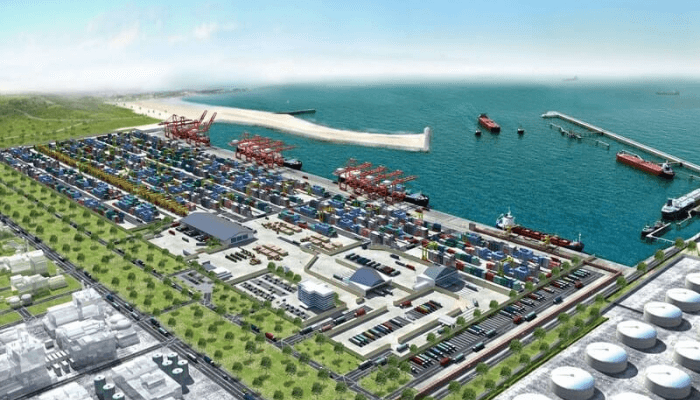
The Federal House of Representatives has urged Ministries, Departments and Agencies (MDAs) to collaborate with Akwa Ibom State and ensure the establishment and completion of Ibom Deep Seaport.
These are Federal Ministry of Marine and Blue Economy, Nigerian Ports Authority (NPA), Nigerian Maritime Administration and Safety Agency (NIMASA), and other relevant agencies.
The directive followed a motion presented on Tuesday on the floor of the House by Unyime Idem, Member Representing Ukanafun/Oruk Anam Federal Constituency and Leader, Akwa Ibom House of Representatives Caucus and co-sponsored by nine other members of the Caucus.
Idem noted that the global economy is increasingly shaped by marine trade and the blue economy, which encompasses the sustainable use of ocean resources for economic growth, improved livelihoods, and job creation.

Read also: Eno’s progressive movement and the plea for Ibom deep seaport realisation
He emphasised that “these resources remain largely untapped in Akwa Ibom State, leading to the loss of potential foreign direct investment (FDI) and reduced economic opportunities that could significantly improve the standard of living in the State and across the country.”
He disclosed that the Nigerian Ports Authority (NPA) projected that the Ibom Deep Seaport could attract investments worth over $5.6 billion, and decried that the project has remained stalled, thus hindering the development of intermodal transport systems, limiting Nigeria’s full participation in the blue economy, and weakening its export and logistics competitiveness.
He said that when realised, the Ibom Deep Seaport would directly stimulate local economies, create thousands of direct and indirect jobs, catalyse industrial growth, strengthen maritime value chains, and facilitate the full implementation of Export Processing Zones (EPZ) blueprints.
“Nigeria’s vast coastline and Akwa Ibom State’s strategic location on the Atlantic Ocean offer immense potential for export-driven economic expansion through the establishment of the Ibom Deep Seaport. The State produces several exportable commodities such as cocoa (a major non-oil export), palm oil, palm kernel, cassava, maize, timber, rubber, fish, and seafood.

‘‘It is also proximate to abundant natural resources and solid minerals, including crude oil, natural gas, kaolin, and limestone, key materials for manufacturing, pharmaceuticals, petrochemicals, and construction.
Read also: Experts laud Eno’s commitment towards Ibom deep seaport project
“The blue economy currently contributes about 2% to Nigeria’s GDP, and with the President’s strategic proposal to raise this to between 5% and 10%, the realisation of the Ibom Deep Seaport would be a major driver in achieving this goal.”
He expressed hope that the establishment and realisation of the Ibom Deep Seaport will lead to the expansion of haulage networks, boost export capacity, attract foreign direct investments, and contribute significantly to Nigeria’s Gross Domestic Product.
Consequently, the House mandated its Committees on National Planning and Economic Development, Ports and Harbours, Finance, and Shipping Services to pay an oversight visit to the proposed project site, and, based on their findings, make appropriate recommendations to support its realisation.