



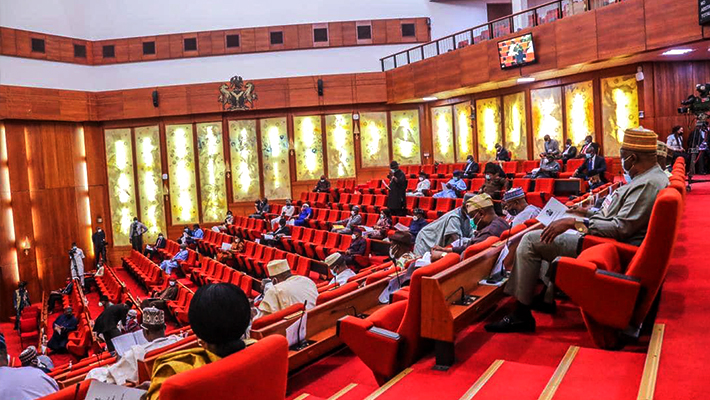
The 10th Senate of Nigeria has often been like a high-limit credit card holder for the Presidency: whenever there’s a borrowing request, the Senate repeatedly swipes “approve.”
Since the start of this Assembly (2023), several major loan/borrowing and securitisation requests have sailed through the Senate, sometimes swiftly, sometimes amid murmurs, but almost always with endorsement.
Here’s a narrative of what’s been approved, and what it might mean.
In December 2023, President Bola Tinubu asked for the Senate’s approval to borrow US$7.8 billion plus €100 million, as part of the government’s 2022-2024 borrowing plan.

Read also: Worrisome loans and high cost of debt servicing in Nigeria
The aim was to bridge budget gaps and ease economic pressures on ordinary Nigerians.
The Senate said yes.
At around the same time, still December 2023, came the securitisation of “Ways and Means” advances: a ₦7.3 trillion outstanding balance, which had piled up in the Central Bank’s books (Credits, advances to the government to cover short-term revenue shortfalls or meet obligations).
The Senate approved turning that debt into a securitised instrument. (Think: converting something fuzzy and temporary into something more formal and permanent, with repayment schedules etc.)

Fast forward to July 2025: that was the biggest swipe yet.
The Senate approved a borrowing package of over US$21 billion in external loans for 2025-2026.
To break that down: US$21.19 billion in foreign loans, plus €4 billion, ¥15 billion, and a US$65 million grant.
In addition, there was approval for domestic borrowing, namely government bonds of about ₦757 billion, and even a plan to raise up to US$2 billion through instruments denominated in foreign currency but in the domestic market.
So, let’s put the numbers together, because the scale matters:
External plus domestic borrowings in 2025 of over US$21bn + €4bn + ¥15bn + ₦757bn in bonds, plus etc.
These aren’t mere pocket change. They represent a substantial increase in Nigeria’s external and domestic obligations.
Why does this matter (and why some people breathe a little nervous sigh when they hear “Senate approves loan”)?
Loans are fine—if what you borrow produces returns or at least delivers essential services that make life better. If not, you end up spending more on interest and repayment, leaving less for health, education, and infrastructure.
When you securitise past advances (as with that ₦7.3tn), you’re committing to paying back over long periods with lagging costs.
Read also: Tinubu seeks NASS approval for $2.35bn loan, $500m Sukuk to fund budget deficit, infrastructure
Some Senators have raised questions: how exactly will this money be used? Which projects? What timeline? Which states or ministries get what? Who monitors? Because big numbers + vague wording = ripe ground for mismanagement or delays.
Even if intentions are good, lack of detailed breakdown can leave citizens in the dark. In the 2025 borrowing approval, there was talk that most of the items were already in the Medium-Term Expenditure Framework and the 2025 Budget, which suggests prior planning but also means scrutiny should already have happened.
If the loans are long-term and concessional (i.e. favorable terms), that helps.
Some of the 2025 package loans have repayment tenors of 20-35 years. But even concessional loans accumulate, especially if currency risks or inflation/depreciation of the naira make repayments more expensive in local currency.
Also, long repayment schedules mean that governments not yet in power might be saddled with obligations.
Citizens often hear “loan approved” and imagine big foreign sums being spent somewhere else while their roads are bad, power is shaky, or health facilities are under-resourced. If the Senate keeps approving large loan requests, people expect visible results.
If results lag, the trust gap widens. And some Senators seem aware of this, pressing for details in the plenary.
If Nigeria’s 10th Senate has a motto, one might jokingly suggest it is: “If the President writes asking to borrow, count on a ‘yes’”, but of course reality is more complicated. It’s not always blind consent; there are technical committee reports, legal frameworks like the Fiscal Responsibility Act and the Debt Management Act, budget frameworks etc.
However, the frequency and scale of approvals show that the Senate plays a major role in enabling government financing, for better or worse.
Read also: FG loans based on structured plans – Adedeji
At the end of the day, borrowing isn’t evil. Every government needs money to build and run things.
The question is: Do we see value for what is borrowed?
Do citizens know what will be done with it? Will future Nigerians repay smoothly without being crushed by interest or debt burdens?
If the Senate demands those answers and insists on rigorous oversight, then approving loans can be a tool for national development.
If not, it’s just adding to a pile of IOUs.





