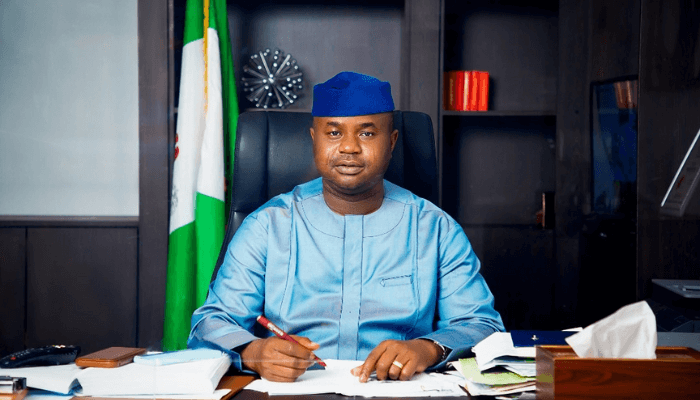
The Niger Delta Development Commission (NDDC) says it has many tools of development to execute its mandate to transform the Niger Delta region and make a difference.
One of the schemes is said to be the Postgraduate Scholarship Project through which the Commission embarks on human capital development.
One of the star candidates that put the commission’s efforts on the global map is named Idara Bassey.
She is a beneficiary of the postgraduate scholarship scheme of the NDDC who is said to be making waves as the 263rd Certified Global Tech Hero. According to a document by Ifeatu Agbu of the communications unit of the NDDC, Bassey was named a recipient of the prestigious Connected Awards in recognition of her pioneering work at the intersection of law, technology, and ethics.

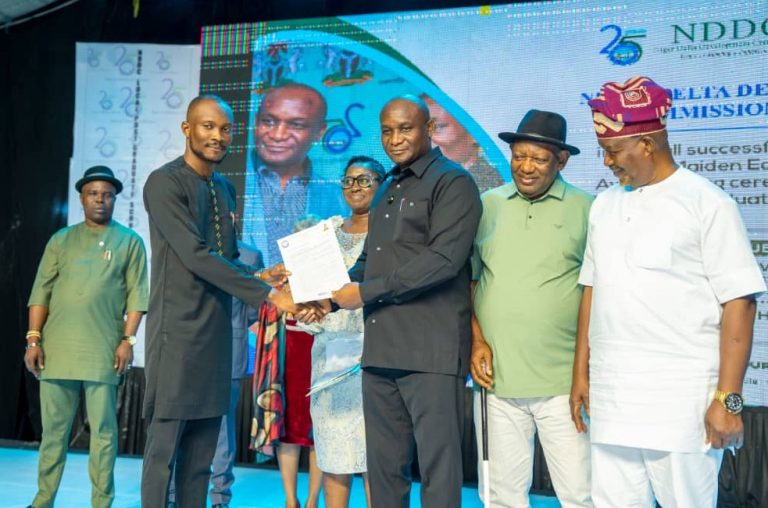
From the right: Dimaro Denyanbofa, Bayelsa State Representative on NDDC Board, (2nd right), Ifedayo Abegunde, Executive Director Corporate Services (2nd left), Angela Chukwudifu, Director Education.
The award highlighted Bassey’s ability to translate governance principles into systems that protect people and create lasting social value —a skillset that is said to have defined her professional journey.
Awarded the NDDC scholarship in 2023, Bassey is said to have pursued a Master’s degree in Intellectual Property and Technology Law at the University of Illinois, Urbana-Champaign, USA. Since completing her studies, she is said to have earned globally recognised certifications in artificial intelligence governance and privacy practice, solidifying her expertise in privacy-by-design, AI risk assessment, and digital policy formulation.
Her work is said to have played a pivotal role in shaping national-scale digital infrastructure, benefiting millions of users. By integrating privacy safeguards and operational standards into large identity and security systems, her interventions are said to have significantly reduced cyber vulnerabilities and enhanced community-level protections.
This recognition places Bassey among a distinguished cadre of global innovators who are redefining the ethical and legal frameworks of emerging technologies.
Read also: 300 youths trained by NDDC eye crafts jobs in oil industry

For the NDDC, her achievement are said to have underscored the enduring value of its scholarship programme in cultivating world-class professionals who drive transformative change far beyond the Niger Delta region.
The Nigerian stream:
Building on stories of success like Bassey’s, the NDDC is said to have expanded its scholarship programmes to include postgraduate studies in Nigerian universities. On October 8, 2025, the Commission presented award letters to 600 successful candidates for its 2025/2026 Local Post Graduate Scholarship Programme.
Presenting the scholarship letters to the successful candidates during the award ceremony in Port Harcourt, Samuel Ogbuku, the NDDC Managing Director, stated that the scholarship programme was an initiative designed to enhance human capital development in the Niger Delta region.
Ogbuku described the scholarship scheme as an essential component of the NDDC scheme of work, noting that education was the most powerful weapon for changing the fortunes of the Niger Delta region.
He observed that previous beneficiaries of the scholarship programme set enviable standards for subsequent groups, stating: “It is remarkable that 32 of our scholars graduated with distinction in Coventry University this year.”
Ogbuku advised the NDDC scholars to avoid distractions to excel in their studies, reminding them that they owed the Niger Delta a duty to succeed.
He declared, “You are the torchbearers of transformation. Your education is not just for you but for the millions who look up to you for hope. As you pursue your postgraduate studies, remember that every lecture you attend, every paper you write, and every solution you provide is a step towards transforming our communities.”
In his remarks, George Uzonwanne, the NDDC Director of Education, Health and Social Services, disclosed that out of 46,240 applicants, only 600 were selected through a transparent electronic examination process. He said, “I congratulate the successful candidates who applied and went through a seamless selection process.”
Uzonwanne stated: “Through initiatives like the NDDC Local Scholarship Programme, we are investing in the minds that will shape the Niger Delta’s tomorrow. By equipping our youth with advanced knowledge in fields like engineering, environmental sciences, technology, humanities, and management sciences, we empower them to tackle our region’s unique challenges.”
The Director explained that the Foreign Post-Graduate Scholarship Scheme was meant to equip Niger Delta youths with relevant training and skills for effective participation in the local content programme of the Federal Government.
He added, “The objective is to equip our people to compete favourably with others in terms of employment and entrepreneurship in the region.”
He noted that emphasis was placed on science disciplines because of a noticeable deficiency in the oil industry, which made it challenging to employ young graduates from the region in that critical sector.
According to him, previously, the oil and gas industry had discriminated against fresh graduates, dismissing them as not possessing the requisite qualifications. “We also need to encourage our youths to show interest in engineering for the sake of our projects. We need qualified engineers who can manage our projects just as in agriculture, environmental science, and other science-related courses.”
Uzonwanne stressed that the foreign scholarship scheme was designed to expose the graduates to other developed environments outside the country. “So far, we have been proved right as those who benefited from the programme in the previous years have justified the need for the advanced training programme,” he said.
The Director recalled the outstanding performance of one of the beneficiaries who studied in the United Kingdom. He said that Francisca Chiedu, the star NDDC scholar of that year, was elected President of the University of the United Kingdom Student Union.
That feat, he said, demonstrated that Nigerian youths could lead innovative changes within and outside the country. “Her success was indeed a victory for the NDDC. It is a testimony of the capability of the new generation of Nigerians to be the change they seek and champion worthy causes”.
Transparent process yields first-class results:
Uzonwanne expressed optimism that the transparent process for selecting beneficiaries of the scholarship scheme would continue to yield first-class performers. “It will guarantee the Niger Delta region and Nigeria at large the likes of Francisca Chiedu, the Information Engineering and Network Management student at Robert Gordon University, Aberdeen, who brought glory to NDDC, the region, and nation.”
Angela Chukwudifu, the NDDC Director of Education, observed that the new scholarship programme emphasised on local education to ensure that beneficiaries remained connected to the Niger Delta’s challenges and opportunities, fostering a sense of ownership and responsibility.
She stated: “Through initiatives like the NDDC Local Scholarship Programme, we are investing in the minds that will shape the Niger Delta’s tomorrow. By equipping our youth with advanced knowledge in fields like engineering, environmental sciences, technology, humanities and management sciences, we empower them to tackle our region’s unique challenges.”
The best performing scholarship candidate, Reginald Omubo-Pepple, thanked the NDDC for allowing them to enhance their education. He pledged that the beneficiaries would do their best to be good ambassadors for the region and subsequently contribute to the development of the Niger Delta.
Sharing the sentiments of Omubo-Pepple, another beneficiary from Abia State, Brian Okafor, promised that the new set of scholars would follow the foot steps of those before them in striving for excellence.
Those who set the standards for NDDC scholars include Ubong Peters, an NDDC scholar in Australia, who was celebrated for winning the university’s three-minute thesis competition.
Apart from Peters, “Augustine Osarogiagbon of Memorial University is so brilliant he completed his PhD in less than the stipulated time and was offered a dual PhD programme with two graduate assistants to work with and a post-doctoral fellowship lined up.
Among the stars is Charles Igwe whose exceptional contributions in Construction Engineering at Concordia University, Canada, made headlines. Igwe’s unique design saved the Montreal Area Municipality over $1 billion. He achieved this feat by redesigning the TURCOT interchange road construction project, which cost $3.67 billion.
Lenin Francis, who benefited from the foreign scholarship programme and earned a Master’s degree in petroleum engineering, suggested that NDDC should also extend the scholarship to other undergraduate students and increase the number of beneficiaries.
Francis, from Bayelsa State, agreed that the programme was a good capacity-builder that would equip the youth to join in developing the Niger Delta. “I pray that the NDDC will continue with this laudable programme, which has helped many youths in the region,” he said.
He said that the foreign scholarship was a boost not just for the beneficiaries but for the entire Niger Delta, as it would enable the youths to develop themselves and acquire technical expertise, which would ultimately benefit the people of the region.
According to him, the NDDC made the right decision to build the capacity of the youths, rather than focusing only on infrastructure. “After all, human resources are more important than physical infrastructure.”