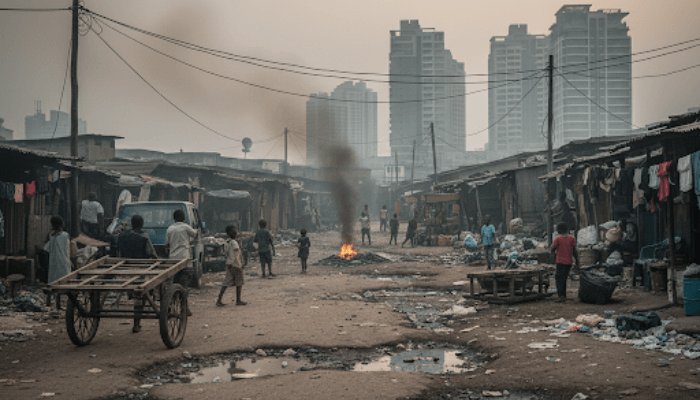
Nigeria’s policymakers have reason for cautious optimism. Headline inflation has eased from a rebased 34.8 percent in December 2024 to 21.9 percent by July 2025. Foreign reserves stand at a three-year high of $40.1bn, while the IMF forecasts output growth of 3.4 percent this year. The Central Bank of Nigeria (CBN) is even more bullish at 4.2 percent. On paper, the economy appears to be stabilising. On the ground, however, the picture is far less reassuring.
The real debate is no longer about whether the economy is growing; it is about who feels it. For many Nigerians, the so-called recovery ends at the pages of economic reports. You can’t eat GDP, as the saying goes. When inflation falls on paper but bread doubles in price, the numbers begin to sound like another language.
“The deeper question is why macroeconomic progress so rarely translates into welfare gains. Nigeria’s growth model rewards capital, not labour.”
The headline data suggest an economy recovering from the shocks of 2024. Yet the recovery is shallow and exclusionary. Growth is concentrated in oil, finance, and telecommunications, sectors that generate revenue but few jobs. While core inflation has moderated, food and transport still consume more than half of an average household’s income.

Per capita income continues to fall, from $877 in 2024 to $835 this year, underscoring how aggregate growth has failed to outpace population expansion. The much-heralded rise in reserves also masks fragility: net reserves, at about $23bn, barely cover a few months of imports. Meanwhile, debt servicing absorbs nearly half of federal revenue, leaving little room for investment in health, education, or infrastructure.
Read also: Tinubu’s reforms are restoring economic stability, investor confidence, says Tuggar
Officials urge patience, arguing that reforms take time to yield results. Nigerians have heard this before. Two decades of “stabilisation first, welfare later” have delivered neither. Structural weaknesses, fiscal inefficiency, overreliance on oil, and chronic underinvestment in power and manufacturing remain unaddressed. They continue to erode the social contract and widen the gulf between statistical stability and daily hardship.
Small businesses, which employ more than 80 percent of the workforce, are bearing the brunt. Interest rates above 25 percent, currency volatility, and unreliable electricity have forced thousands to close. The Nigerian Economic Summit Group estimates that nearly 30 percent of MSMEs will shut down between 2024 and 2025. The government’s ₦4tn electricity refinancing plan must therefore translate into improved power supply, not merely accounting adjustments.
Food insecurity remains acute. The UN’s Food and Agriculture Organisation projects that 33 million Nigerians will face high levels of hunger this year. While the CBN attributes falling inflation to tighter monetary policy, that discipline has come at a social cost: eroding real wages, higher unemployment, and diminished purchasing power.

The deeper question is why macroeconomic progress so rarely translates into welfare gains. Nigeria’s growth model rewards capital, not labour. Unlike peers such as Kenya or Indonesia, which have paired fiscal discipline with SME credit and export diversification, Nigeria relies heavily on oil and financial flows to sustain output. The result is an economy that grows in spreadsheets but contracts in welfare.
To correct the course, the government must move from managing indicators to managing outcomes. Three priorities are clear. First, fiscal reform should be anchored in transparency and efficiency. Reducing debt servicing, broadening the non-oil tax base, and curbing leakages would free fiscal space for capital investment.
Second, credit and energy reforms must target productive sectors. MSMEs cannot thrive in a system that rewards speculation over production. Affordable financing and reliable electricity are the minimal conditions for inclusive growth.
Read also: Beyond statistics: Why Nigerians still feel the pinch despite signs of economic stability
Third, social protection must move beyond ad hoc palliatives. A credible national safety net, linked to verifiable data and funded through fiscal discipline, is vital to cushion the poorest against inflationary shocks.
These are not novel ideas, but Nigeria’s policy challenge has always been consistency. Each administration announces reform, only to retreat under political pressure. True stability cannot be defined by a temporary easing of inflation; it must rest on the resilience of households and enterprises.
Policymakers will insist that “fundamentals are improving.” Yet Nigerians cannot live on fundamentals. When a market trader pays triple for food while reading of falling inflation, she is justified in her scepticism. Economic stability must be measured not by PowerPoint metrics but by purchasing power, job creation, and social security.
If Nigeria’s leaders can align macroeconomic prudence with household welfare, 2025 could mark the beginning of a genuine recovery. If not, the country will remain trapped in a statistical mirage, growing on paper while its citizens fall further behind.