|
Getting your Trinity Audio player ready...
|
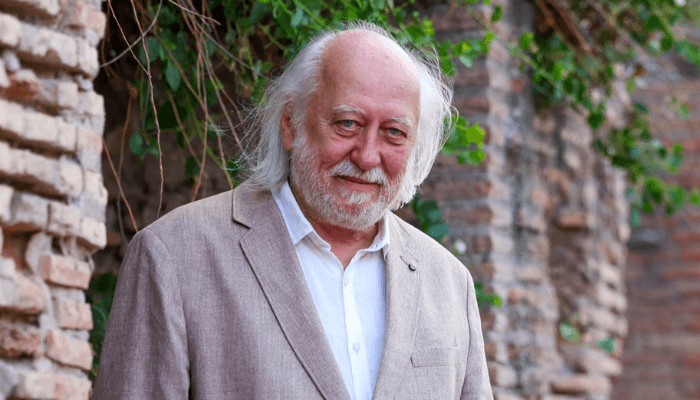
László Krasznahorkai a Hungarian novelist and screenwriter has been awarded the 2025 Nobel Prize in Literature, the Royal Swedish Academy of Sciences announced on Thursday.
The Swedish Academy praised Krasznahorkai “for his compelling and visionary oeuvre that, in the midst of apocalyptic terror, reaffirms the power of art.” The award, worth 11 million Swedish crowns (about $1.2 million), is one of the world’s most prestigious literary honours.
Read also:Chemistry Nobel prize 2025 awarded to trio for groundbreaking work on metal-organic frameworks
Krasznahorkai, born in 1954 in Gyula, Hungary, is best known for his haunting, intricate novels that explore the collapse of meaning and the endurance of humanity amid despair. His works are often described as demanding but profoundly rewarding, characterised by long, unbroken sentences and a philosophical intensity that borders on the surreal.

The author once said his writing sought to “examine reality to the point of madness” – a reflection of his lifelong preoccupation with chaos, beauty, and moral decay. The late American writer Susan Sontag once called him “the contemporary master of the apocalypse,” a description that has followed him throughout his career.
Read also: South Korean writer Han Kang grabs the 2024 Nobel Prize in Literature
Krasznahorkai grew up in the shadow of the Soviet occupation and the failed 1956 Hungarian Revolution, events that shaped much of his outlook. “I was born in a predicament and a country where a person accursed with a heightened aesthetic and moral sensitivity like me simply cannot survive,” he once said.
Although only a few of his works have been translated into English, they have earned a cult following in literary circles. The critic James Wood famously remarked that Krasznahorkai’s novels “get passed around like rare currency.” His best-known works include Satantango, The Melancholy of Resistance, and War and War – novels that depict bleak, often absurd worlds filled with flawed, searching characters.
The Nobel Committee said his writing, marked by “absurdism and grotesque excess,” demonstrates how art can illuminate the darkest corners of existence.

Read also: Nobel Prize in Physics 2025 awarded to trio for quantum mechanics discoveries
The Nobel Prize in Literature, established through the 1895 will of Swedish industrialist Alfred Nobel, has been awarded since 1901 to writers whose work has had an outstanding impact on the literary world.
Past recipients include French poet Sully Prudhomme, the first winner in 1901; American novelist William Faulkner in 1949; Britain’s wartime leader Winston Churchill in 1953; Turkish novelist Orhan Pamuk in 2006; and Norwegian writer Jon Fosse in 2023.
Last year’s laureate was South Korean author Han Kang, recognised “for her intense poetic prose that confronts historical traumas and exposes the fragility of human life.” Han became the first South Korean and the 18th woman to win the literature prize.
For Krasznahorkai, whose novels are set in crumbling Central European towns haunted by uncertainty, the award is a recognition of a writer who has made despair luminous — and who, even amid darkness, insists on the endurance of art.