



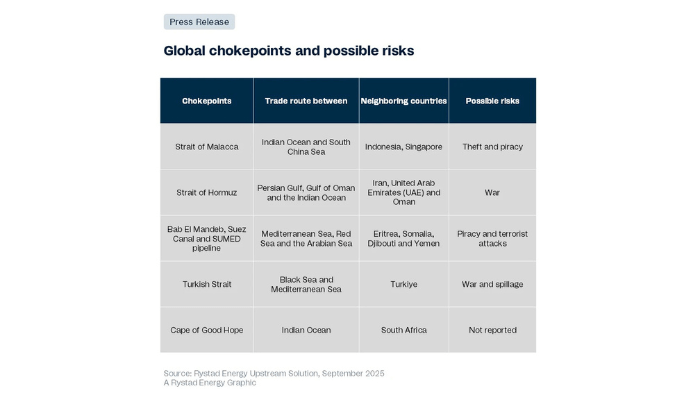
Escalating geopolitical tensions, piracy, and environmental threats are putting the world’s most vital maritime oil and gas routes under severe strain, posing a growing danger to global energy security.
Rystad Energy’s latest analysis, the world’s five key maritime chokepoints, narrow sea routes critical to the global flow of crude oil and liquefied natural gas (LNG), are becoming increasingly unstable.
In 2023, these chokepoints carried an estimated 71.3 million barrels per day (bpd) of oil and petroleum products and 26 billion cubic feet per day (Bcfd) of LNG. By 2024, the figures had fallen to 65 million bpd and 24.8 Bcfd, respectively, reflecting the impact of conflict and insecurity on global trade routes.
While part of the decline is due to temporary disruptions such as Houthi rebel attacks near Yemen and tensions between Iran and Israel, Rystad noted a deeper structural shift as vessels and cargoes are increasingly rerouted via the Cape of Good Hope and alternative pipelines.

The US, with its growing domestic production, remains less exposed than Asia and Europe, which rely heavily on the Strait of Hormuz and the Strait of Malacca for transport, leaving China acutely vulnerable.
“We have identified the five chokepoints most at risk, assessed the threats they face and outlined the far-reaching consequences for global energy markets,” said Mrinal Bhardwaj, Senior Analyst, Upstream Research, Rystad Energy.
“Any disruption at these chokepoints could shatter supply chains, trigger sharp spikes in energy prices and inflict severe economic damage worldwide.”
Read also: Renaissance unveils continental strategy at Africa Energy Week
He added that insurance premiums and freight rates have already surged in response to the instability, warning that a full closure of any chokepoint could lead to extreme price volatility and test the resilience of global supply chains.

About three-fourths of the world’s oil trade passes through maritime chokepoints, with one-fourth via the Strait of Malacca and one-fifth through the Strait of Hormuz.
Strait of Malacca: Asia’s Energy Lifeline
The Strait of Malacca is the world’s largest trade chokepoint, handling approximately 24 million bpd of oil and gas. This narrow passage between the Indian Ocean and the Pacific Ocean is a critical corridor for transporting most of the Middle Eastern crude oil and liquefied natural gas (LNG) to Asia, including major consumers China and Japan.
China accounts for the largest share of crude and condensate imports through this route, representing 50 percent of the total volume, while Saudi Arabia is the leading exporter, contributing with 25 percent of the share.
Since the pandemic, oil and gas flow through the Strait had increased by 2.1 million bpd as of 2024. Although the route is known for piracy and theft, no major incidents have been reported this year.
Strait of Hormuz: The World’s Most Critical Chokepoint
The Strait of Hormuz, situated between Iran to the north and Oman and the United Arab Emirates to the south, is particularly vital. Approximately one-fifth of the world’s maritime oil and condensate trade, along with nearly half of the Middle East’s daily oil and condensate production around 14 million bpd, passes through this narrow waterway to major Asian markets such as China and India.
To be more precise, about half of Saudi Arabia and the UAE’s daily oil and condensate exports, and roughly one-fourth of China’s daily oil and condensate demand, are shipped through the strait. It is also a key route for LNG, with about one-fifth of globally traded LNG volumes passing through it.
Qatar exports about two-thirds of its daily gas production, roughly 16.3 Bcfd, through the strait to countries including China, India and South Korea. In the past five years, China’s LNG imports via the Strait of Hormuz have increased by approximately 2.5 times, reaching 2.7 Bcfd.
“The strategic importance of the Strait of Hormuz was underscored during the recent Iran-Israel conflict, when Iran’s parliament proposed a bill to close it, although the plan was reportedly deferred,” said Bhardwaj.
According to him, if the strait were to be closed, it could disrupt nearly half of Middle Eastern oil exports, severely impacting global oil and gas transportation. “This would likely lead to a sharp increase in global oil prices and raise energy import costs for dependent nations, affecting the entire oil and gas supply chain.”
To reduce such risks, countries in the region have developed alternative oil transport routes. These include Saudi Arabia’s East West Crude Pipeline, which has a capacity of 5 million bpd, the UAE’s Abu Dhabi Crude Oil Pipeline, with capacity of 1.8 million bpd, and Iran’s Goreh Jask pipeline, which provides an additional export route bypassing the Strait of Hormuz.
Read also: Lagos licences new electricity distribution firms to replace Eko, Ikeja DisCos
Suez Canal and Bab el-Mandeb: Red Sea Instability
The Bab el-Mandeb Strait has become the Middle East’s second major chokepoint and another potential threat to the stability of global oil and gas trade.
The narrow waterway connects the Red Sea with the Gulf of Aden and the Arabian Sea, serving as a critical route for ships transiting between the Suez Canal and the Indian Ocean.
Egypt’s Suez Canal, along with the 2.5 million bpd SUMED pipeline, link the Red Sea to the Mediterranean, forming a vital corridor for global energy flows.
Before a wave of Houthi attacks targeting commercial vessels and tankers in late 2023, the Bab el-Mandeb Strait accounted for around 12 percent of global seaborne oil trade.
However, the surge in attacks in December 2023 caused daily shipping volumes through the Strait to drop by nearly 50 percent within just six months. Traffic has remained below normal levels ever since.
A potential full closure of the strait would force vessels originating in the Gulf of Aden to bypass the Suez Canal entirely, redirecting them around the Cape of Good Hope. This detour significantly increases voyage times and freight costs, adding further pressure to already strained global energy supply chains.
Turkish Straits: Europe’s Strategic Crossroads
The Turkish Straits, a narrow and strategically critical maritime route connecting the Mediterranean Sea and the Black Sea, are key to global energy transportation.
Comprising the Bosporus and Dardanelles, the Turkish Straits handle around 3.5 million bpd of crude oil and 0.5 Bcfd of LNG, or about 5 percent of global maritime oil trade. The route is critical for transporting Russian and Caspian oil to both European and Asian markets.
Transit volumes fell during the Russia-Ukraine conflict but recovered to 3.4 million bpd in 2023. Still, the narrow waterways face risks from congestion, accidents, and political interference. Alternative routes include the Baku–Tbilisi–Ceyhan and Iraq–Turkiye pipelines.
Cape of Good Hope
At the southern tip of Africa, the Cape of Good Hope has re-emerged as a key bypass route amid Red Sea tensions. Once handling around 6 million bpd, traffic surged 50 percent to 8.7 million bpd in 2024 as shippers avoided the Suez Canal.
Around 40 percent of oil via the Cape now goes to China, with about one-third coming from the US and a quarter from South America. Middle Eastern producers like Saudi Arabia and Iraq have also diverted exports to Europe through this route.
Despite longer journeys and higher costs, traders see the Cape as one of the world’s safest maritime routes, higlighting its growing role in ensuring energy security.





