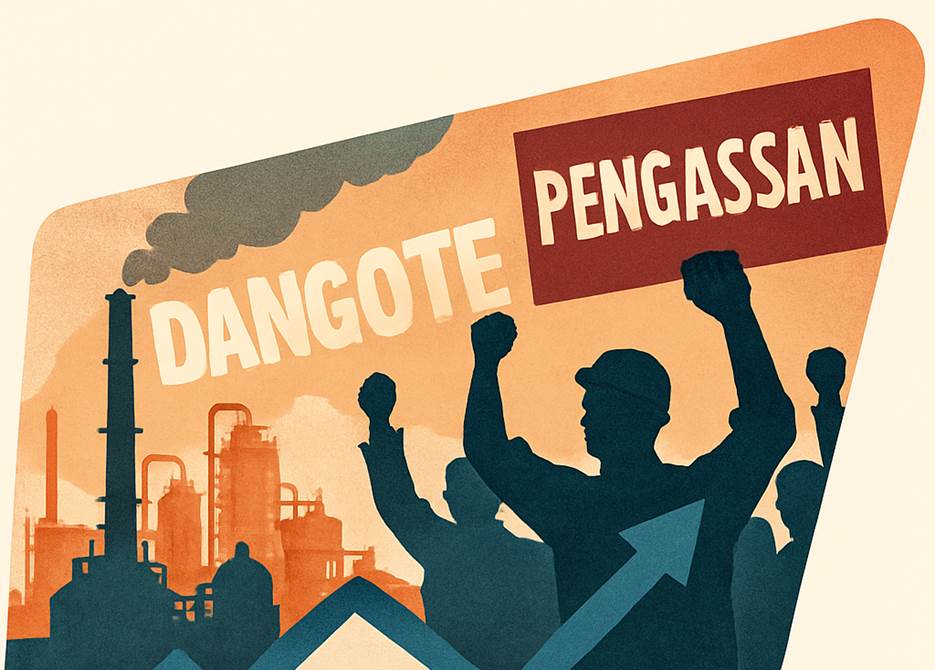
The standoff between Dangote and Nigeria’s oil union, PENGASSAN, could jeopardise recent gains from painful reforms that are yet to reach the vulnerable. Nigeria’s reform economy is edging toward a take-off stage.
Key indicators are turning positive trends. Inflation has slowed for the fifth consecutive month to 20.12 percent, the naira has steadied, foreign reserves are rising, and non-oil exports are expanding. These are the macro signals President Bola Tinubu has been banking on, the kind that align with Walt Rostow’s growth model, where economies move from recovery into sustained expansion.
But just as these green shoots appear, turbulence is building at the heart of Nigeria’s energy sector. A dispute between the Petroleum and Natural Gas Senior Staff Association of Nigeria (PENGASSAN) and the 650,000-barrel-a-day Dangote Refinery risks undermining fragile stability. Analysts warn that mishandling the conflict could amount to economic sabotage, derailing the momentum of reforms that are only beginning to take hold.
The fault line

At the centre of the clash are 800 refinery workers who joined PENGASSAN but were affected by a company reorganisation. The union sees this as intimidation, while Dangote insists it is part of an internal restructuring.
Peter Esele, a former president of the Trade Union Congress (TUC), has urged dialogue, stressing that while workers’ rights to unionise must be respected, Dangote’s fears of being held hostage by organised labour are not misplaced.
Nuhu Toro, the current TUC Secretary-General, took a firmer stance, condemning the dismissals as unconstitutional and demanding reinstatement. “We expect an assurance from Dangote that such actions will not be repeated,” he said.
The government is scrambling to contain the fallout. Nkeiruka Onyejeocha, Minister of State for Labour has scheduled talks in Abuja, appealing for calm and urging PENGASSAN to suspend strike plans. The union has already directed members in firms such as TotalEnergies and Chevron to cut crude supply to the refinery until the dismissed workers are reinstated.
Why it matters

The stakes go far beyond industrial relations. A disruption in crude deliveries could stall Dangote’s operations and unsettle Nigeria’s oil exports, which average about 1.5 million barrels a day.
The refinery has quickly become central to Nigeria’s energy balance, meeting as much as half of gasoline demand and reducing costly imports. Any stoppage would tighten global gasoline markets, where futures have already reacted to news of the dispute.
From a macroeconomic perspective, the refinery is more than a corporate project: it is an anchor of Nigeria’s balance-of-payments strategy. By cutting fuel imports, it eases pressure on foreign reserves and stabilises the naira. By refining at scale, it lowers fiscal exposure to volatile import subsidies. And by supplying regional markets, it positions Nigeria as a net exporter of value-added petroleum products.
A prolonged shutdown would unravel these gains, dent investor confidence, and complicate fiscal and monetary planning. This is why analysts are increasingly framing the dispute not as an isolated labour spat but as a systemic economic risk.
The economics of conflict
Faruq Quadri, an economic analyst, notes that the crisis highlights Nigeria’s “dual challenge” of reform: delivering macro stability while managing micro-level frictions.
“When the headline numbers are moving in the right direction, inflation easing, currency stabilising, reserves improving, you cannot afford disruptions in critical sectors like energy. The refinery dispute, if unresolved, risks translating labour grievances into systemic shocks.”
Quadri argues that the episode reflects the thin line between growth and fragility. “A 650,000-barrel refinery is not just a factory. It is tied to Nigeria’s external accounts, inflation path, and even food prices through transport costs. The wrong signal to investors could raise the cost of capital and undermine the reform story.”
Olugbenga Olaoye, Energy economist, told BusinessDay that unionism in Nigeria’s oil sector often puts access to essential commodities under strain. “That creates unnecessary hikes in fuel prices that ripple through transport fares, food costs, and other basic goods and could reverse the easing inflation trend and jeopardise reform gains.
Over the years, unions such as PENGASSAN have appeared inevitable and untouchable, but at this level, unionism undermines national stability. Dangote should be allowed to operate without disruption.”
Government’s test
For Abuja, the dispute is a test of regulatory capacity. The Labour Ministry has been criticised for weak mediation, while unions accuse the state of failing to defend workers’ rights. Dangote, meanwhile, accuses labour of overreach, warning that disruptions threaten “the economic recovery and energy security of Nigeria.”
The deeper question is whether Nigeria can balance private capital and organised labour in a way that sustains growth. “Investors need predictability,” Quadri observes, “but so do workers. If either side feels exposed, the economy pays the price.”
Outlook
For a reforming economy trying to stabilise, the timing could not be worse. Another internal shock could shake investor confidence just as Nigeria seeks to attract capital inflows to fund growth.
The resolution of the Dangote–PENGASSAN dispute will therefore resonate far beyond the refinery gates. It will signal whether Nigeria can manage the difficult politics of reform while keeping its economic trajectory intact.