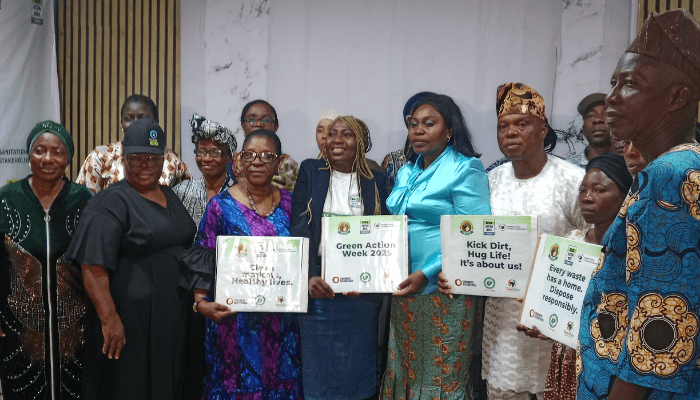
Stakeholders at a one-day forum have called for proper sanitation in traditional markets in Lagos state, emphasising that poor sanitation leads to illness, food waste, and economic loss.
Speaking at the forum organised in Lagos by Healthy Living and Women Empowerment Initiative (HELWEI) to mark Green Action Week 2025, the stakeholders who include community leaders in Alimosho Local Government Area of the State; educationist, markets leaders among others opined that proper sanitation protects food, health and livelihoods.
According to them, market space can be kept safe and hygienic by adopting cleaner practices and supporting regular sanitation.
Also speaking at the event which came under the theme, “Community dialogue: Sensitisation/awareness creation of food safety, sanitation, hygiene and nutrition among market and community stakeholders’’, Sussan Holdrooke-Agbenla explained that unsafe food due to poor sanitation in market space could lead to Illness, lost income and malnutrition.

Quoting a recent report, Holdrooke-Agbenla who is a lecture at the Federal University of Agriculture Abeokuta said : “ 600 million people are affected with unsafe food, that is 1 in 10 people in the world fall ill after eating contaminated food and 420 000 die every year.
“Foodborne diseases inhibit socioeconomic development by straining health care systems and harming national economies, tourism, and trade.”
However, she called on market authorities to provide clean water, waste disposal, and regular inspections.
A representative of the Lagos State Ministry of Environment, Aderemi Falaye who spoke on “Community-led total sanitation and hygiene as a tool to food safety and environment protection in traditional markets in Alimosho LGA’’, said that hygiene is everyone’s responsibility and added that people can build hygienic culture by washing of hands before handling food and after using the rest room.
Similarly, Bose Ironsi who spoke on, “Community–led sanitation and hygiene as a tool to food safety and environmental protection in traditional markets’’, affirmed that community-led sanitation and hygiene empowers communities to collectively improve their hygiene practices and infrastructure.

To address contamination sources in traditional markets, Ironsi who is the Executive Director, Women’s Right and Health Project (WRAHP) encouraged
collective behaviour change and social awakening to stop open defecation and improve waste management which according to her, reduces the presence of pathogens in food and the surrounding environment.
Enumerating challenges in traditional markets, she said they include; poor waste disposal; dirty drains, flies and rodents and; little awareness of hygiene practices.
‘’When our markets are clean, food stay fresh; children grow healthy and strong, there would be less sickness like cholera, typhoid among others.’’
Speaking earlier, Executive director, Healthy Living and Women Empowerment Initiative, Eberechukwu Okey-Onyema, described the market space as critical to achieving optimum health and the SDGs.
“The issue of Water Sanitation and Hygiene and the market space is a key concern to me because we all shop in the market and when you visit some of the markets in the state, you will be struggling not to match dirt particles’’ Onyema added.
On the idea behind the involvement of community and market leaders in the dialogue, she said “we believe that the community members have also a role to play, if there is a change to achieve, it has to start from the grassroots’’.
Highlighting the theme of Green Action Week 2025, ‘’sharing community,’’ HELWEI boss said: “sharing community is a collective efforts, we need to come together to achieve change be it in terms of sanitation, improvement of the environment , environment is for everybody, clean places leads to healthy life’’
While commending the organisers of the event, some of the participants who spoke in an interview during the forum, promised to educate their members on the need to ensure proper sanitation and hygiene in the market space.