…pledges allocation of 33 percent of the state budget to education
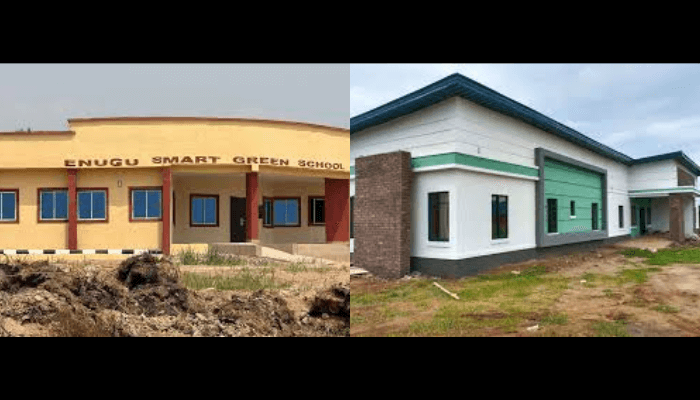
In a stride toward educational transformation, the Enugu State government recently unveiled 260 Smart-Green-Schools across the state, an initiative designed to equip learners with the skills and knowledge needed to thrive in the global economy.
Peter Mbah, the governor of Enugu State, emphasised that blending technology, sustainability, and innovation, these schools aim to redefine basic education by fostering digital literacy, critical thinking, and environmental consciousness among students from an early age.
Mbah in a statewide broadcast, described the initiative as a “covenant with the future,” designed to equip Enugu children with the knowledge and skills to compete in the global economy.

“We are no longer a state waiting to be saved, we are a state shaping the future on our own terms. Africa’s destiny rests on the minds and hearts of its youth,” he stressed.
Each of the 260 Smart Green Schools, he said, is designed as a complete learning ecosystem, featuring 25 digitally connected classrooms, ICT centres, robotics and AI labs, e-libraries, and spaces for hands-on learning.
The schools are powered by renewable energy and include smart farms where pupils learn agriculture through practice.
They also provide free uniforms, books, meals, and tablets for every child, as well as on-site clinics, water systems, and housing for teachers to ensure continuity and quality of education.
The governor urged communities in Enugu State to protect the schools and support teachers, emphasising that equipment alone cannot transform learning without committed educators.

“Smart Green Schools are not just an investment in classrooms, but in the soul of our people. A generation raised in schools of innovation will build an economy of innovation,” he said.
Besides, the governor pledges that his administration will allocate 33 percent of the state budget to education, which he describes as an investment in “the truest capital of our society, human potential.”
Speaking on the bold steps taken by Enugu State to reposition education in the southeast Nigeria, Isaiah Ogundele, an education administrator, described it as a step in the right direction.
“When schools are well equipped with necessary tools and qualified educators, the learning outcome is always top-notched. The whole world can now believe that the Enugu State government is serious not just coming up with a project and start climbing the trees from the top.
“This will be a challenge to WAEC that wanted to introduce what cannot be achieved in four years within few months,” he said.
Competence-based education panacea to Nigeria’s economic development
Experts believe that Nigeria needs to build a community of skilled workforce and equip them with all the necessary education required to excel in the global workspace.
Izu Nwachukwu, a senior lecturer, at the University of Calgary, Canada emphasised the need for competency in Nigeria’s education system when he said that the country’s current system of education lacks a competency-based approach of learning.
“The 21st-century education is competence-based, where students learn to master their chosen careers through learning by practice system,” he said.
Mbah’s administration borrowing a leaf from countries such as Rwanda, is set to equip Enugu youth with skills to be able not only to get gainful employments, but to also be able to compete at the global economy.
In 2014, Rwanda adopted competency-based modular programmes with industry participation to ensure that training curricula were aligned with labour market needs to expand opportunities for the acquisition of quality, market-relevant skills in selected economic sectors.
The government ensured that faculty members gained hands-on experience through industry attachments, enhancing the relevance of instruction and improving programme delivery.
The results were impressive with 80 percent of the beneficiaries in the short-term training under the Rapid Response Training window getting permanent jobs after completing their training.
Omowale Ogunrinde, founder of Field of Skills and Dream (FSD), highlighted that Nigerian youth need to get the type of skills industries need to be employable and that is where tech-education comes in.
“Nigerian youth waste years in universities paying so much for studies and graduate without jobs.
“We are a people who do not believe in skills acquisition, however, that’s what keeps everybody who is somebody in business,” she noted.
Human capital development is the process of enhancing and optimising the skills, knowledge, abilities, and experiences of individuals in a workforce.
The human capital development index of Nigeria is put at 0.32 percent, which simply means that a Nigerian child has only about 30 percent of his/her potential in life to compete at the global level.
Employers of labour have also lamented the dearth of skilled graduates that fit to work amid poor performance of candidates that turn up for job interviews.
The Enugu State government by this initiative is pushing to ensure the youth are empowered enough to face the contemporary global workforce.