In 2008, I was on a flight from Kaduna to Lagos when we hit some disconcerting turbulence. The plane was behaving as if it were going to fall from the sky.
All the frequent flying experiences and all the readings about turbulence not bringing down planes disappeared, and passengers flew into various forms of cacophonous prayers. In the bedlam, I noticed a man two rows ahead of me snoring so heavily it drew laughter from the panic-stricken passengers.
But as the turbulence persisted, one man at the back started banging at the window just by his seat, and it took the crew, who had to leave their seats, to go to reassure the man and stop him from what he was trying to do.
This man, scared for his life and determined to save it, was trying to break the window of a plane flying at 32,000 feet to jump out.

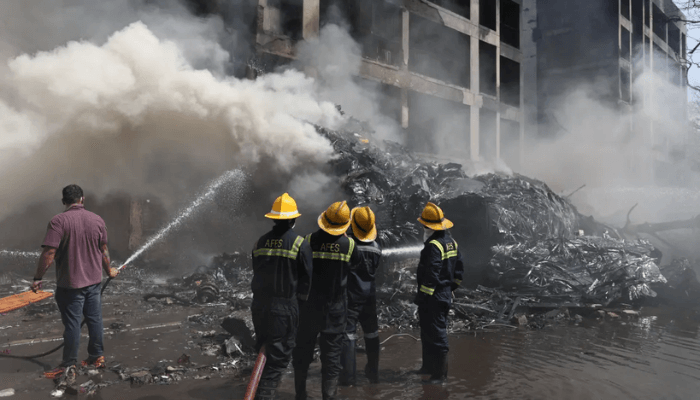
People do all sorts of weird things when overwhelmed by adrenaline, and that was how it felt watching some videos of the Afriland Towers fire that recently took place and which took the lives of some people, including employees of United Capital Ltd.
Fear-stricken occupants of the building were seen in several videos jumping through windows, several floors off the ground. Egged on by a large crowd, I saw these people make desperate efforts to save themselves from the raging inferno, and I wondered if those egging them on provided landing pads or converted their bodies to pads for those jumping from windows five floors off the ground to cushion their fall.
Fortunately, reports of fatalities from the fire did not include those who desperately jumped through the windows. Those who unfortunately lost their lives during the incident were mostly as a result of suffocation from the smoke, which quickly pervaded the building, compromising both evacuation and the air quality of the complex.
I have worked in quite a few high-rise structures in my career, and I have been exposed to a few fire and emergency training routines. One of the first things one is taught is the use of the staircase during such situations as fire and/or other evacuation emergencies. In many high-rise buildings, there are signs pointing to the staircases as emergency exits.
Those who know Afriland Towers should appreciate the existence of similar protocols, but the nature of the incident that happened made the effectiveness of those protocols difficult to put into action.

The fire, which engulfed the building, has been established to have started in the basement where the inverter batteries were located. The plumes of black smoke from the smouldering inverter room quickly found their way to the staircase and made visibility impossible for those who wanted to make a safe exit through the stairs.
Smoke is more pervasive than flood in movement, and it rapidly fills the air all through the building, severely making visibility difficult and restricting access to designated evacuation routes. Under such challenging conditions, some occupants resorted to exiting through the windows in their efforts to reach safety. The intensity of the incident and the desperation of individuals to reach safety created significant disorder and hindered effective communication.
During times of tragedy, experts emerge from everywhere with opinions and advisories on what could have been done differently. Many of these expert advisories will not remedy the adverse situation nor be effective in forestalling future occurrences. While there have been cases of indiscretions that led to incidents and fatalities, triggering blame, there are certain tragedies that demand greater circumspection before apportioning blame.
The speed of the spread of the fire at the Afriland Towers was quite fast; it made total evacuation difficult. This is why in law, there is what is called a force majeure, otherwise called an act of God, where it has to be recognised that such was an event or effect that cannot be reasonably anticipated or controlled.
It was not possible to anticipate that such an intense fire would occur from the building’s inverter battery room. Nobody could have expected such an incident to occur, with such thick plumes of smoke spreading through the major evacuation routes and at such speed that it overwhelmed the building within such a short time.
It is sad, 10 people died during the incident, and from available communications, the institution is doing its best to mitigate the effects of the sudden loss on the affected families. What makes it easier is the insurance cover on the building, which will help extend succour to the other victims who were not employees of Afriland and United Capital.
Inverter systems as alternatives to grid electricity are relatively new in Nigeria and have been adopted mostly by companies and businesses that need greater efficiency in their service offerings in the face of frequent interruptions and fluctuations from the grid supply channel.
While safety protocols were apparently not in short supply at Afriland Towers, additional learnings for this business and for all others who use inverter systems as alternatives and backup sources of power supply include the ventilation of the inverter room. Experts have advised that one always keep inverters and batteries in a well-ventilated area to prevent overheating. Avoid tight cupboards or closed spaces.
Secondly, they also advise that flammable items such as petrol, papers, curtains and other flammable materials should be kept away from the inverter rooms. 3. Proper installation has also been advised. The use of qualified technicians to handle installations is fundamental to safety, as wrong wiring or undersized cables can cause overheating and spark a fire.
Load management is also said to be critical, as overloaded inverters are a recipe for disaster. Frequent battery checks are also important. Users should make a routine habit of inspecting batteries for leaks, corrosion, or swelling.
The installation of safety gear, such as circuit breakers, fuses, and surge protectors, has also been recommended, while keeping fire extinguishers handy and the training of fire champions is a no-brainer.
Routine maintenance of the installation is also important for identifying and taking care of the presence of dust, loose connections, or weakening terminals; immediate fixing is key.
Ikem Okuhu, a journalist and PR practitioner, is the executive producer of the C-Suite Café podcast.