



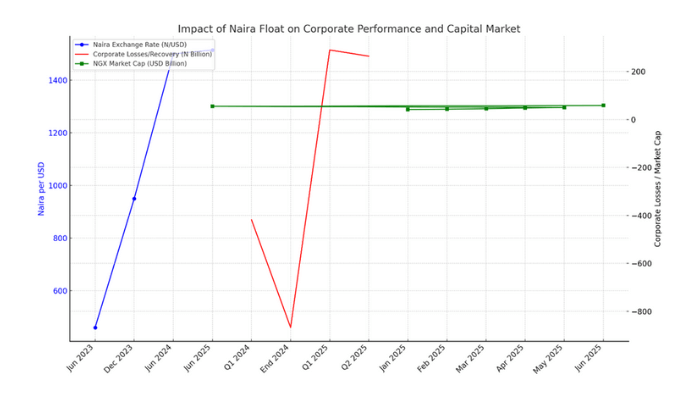
When Nigeria floated the naira in June 2023, scrapping multiple exchange rate windows, it marked one of the boldest policy shifts since the structural adjustment programme of the mid-1980s. The immediate collapse, from N460 to over N1,500 per dollar, devastated companies with dollar debts, triggered record losses, and forced firms into survival mode.
IMPI’s September 2025 report frames this phase as brutal but transformational. “The float created a corporate crisis,” it argues, “but the shock forced balance-sheet discipline and market realignment.” Debt-laden firms turned to equity, supply chains shifted toward local sourcing, and hedging and cost control became mainstream.
That corporate reset spilt into the capital market. IMPI shows how, by mid-2025, the Nigerian Exchange (NGX) was enjoying its strongest rally in nearly two decades. Valuations surged, transactions doubled, and pension funds swelled. What began as a freefall ended as a reset, painful but ultimately catalytic for both corporate strategy and market revival.
The free-fall phase

IMPI’s data captures the scale of early losses. Consumer goods giants from Nestlé Nigeria to Nigerian Breweries recorded combined losses of N418 billion in Q1 2024 alone. By year-end, listed firms had lost N867 billion, largely from foreign exchange translation and surging interest costs on dollar loans.
Import-heavy sectors were hit hardest. Breweries paid more for malt and hops, cement makers for spares, and telecoms for network equipment. Firms with foreign-denominated loans saw repayments triple in naira terms. Dividend payouts disappeared, leaving investors stranded.
IMPI notes that this “bloodbath” forced firms to abandon old habits, reliance on cheap credit and import dependency, laying the groundwork for restructuring that would later feed the capital market rebound.
Read also: Naira sustains year-to-date stability on $42bn external reserves, weekly inflows
Adjustment and resilience

By late 2024, IMPI observes, companies were no longer just absorbing losses; they were reinventing themselves. Many renegotiated foreign loans, restructured supply chains, and leaned into local inputs. Others hedged currency risk, raised equity instead of debt, or passed costs to consumers.
“These adjustments did more than restore profitability,” IMPI writes. “They reshaped corporate Nigeria.” Balance sheets became less debt-heavy, equity financing gained ground, and supply chains tilted closer to home.
By Q1 2025, the shift was evident. The seven major consumer firms that had posted N418 billion in losses a year earlier reported N289.8 billion in profits. By Q2, profits reached N264 billion. IMPI interprets this as more than a recovery: “It was a structural reset that positioned firms for sustainable growth and restored investor trust.”
Market rally
Corporate restructuring translated directly into capital market strength. As IMPI details, firms turned to equity financing, resumed dividends, and pulled investors back in.
Between January and July 2025, equity transactions on the NGX hit N6 trillion, the highest since 2007 and double 2024’s total. The All-Share Index rose 37 percent by August, unlocking N26.6 trillion in capital gains.
In dollar terms, market capitalisation expanded from $41.8 billion to $58.4 billion. Eighteen companies now boast valuations above $1 billion, including Presco and Transcorp Hotels.
IMPI frames this as the logical outcome of restructuring: “The float forced companies to become leaner and stronger, and the market rewarded them.”
The confidence game
For IMPI, stability is what turned recovery into revival. The narrow band of N1,501–N1,530 per dollar since mid-2025, supported by CBN reserves now above $41.5 billion, underpinned investor trust.
Foreign portfolio inflows, hesitant in 2023–24, are rising again. A London-based fund manager told IMPI that “the perception is that Nigeria is no longer running a dual exchange system, and that matters for credibility. Stability, even at a weaker level, is better than artificial strength.”
Read also: Slower inflation offers hope but Nigerians doubt the gains
Winners and losers
IMPI stresses that not all firms benefited equally. SMEs without hedging tools or foreign credit remain squeezed. Import-dependent retailers face higher costs without pricing power. Service firms with little export exposure are still struggling.
The winners are those who adapted quickly. Dangote and BUA Cement leveraged scale, Presco gained from export competitiveness, and telecoms offset dollar debts with naira-based revenues. Their resilience drew investors, fuelling the NGX rally.
Global parallels
IMPI places Nigeria’s float alongside Egypt’s 2016 devaluation, which initially caused pain but stabilised markets within two years. Argentina’s repeated failures, by contrast, highlight the risks of wavering commitment.
“The difference”, IMPI notes, “is that Nigeria sustained the policy despite pressure. Credibility made adjustment possible.”
Broader macro impact
For IMPI, the revival of the capital market is structural, not cyclical. By shifting firms toward equity financing, the float deepened Nigeria’s markets and aligned them more closely with global norms.
Dividend resumption, it argues, will boost household savings. Rising equity values expand pension fund assets. Higher turnover improves liquidity, drawing in new listings. Corporate tax receipts are climbing, adding fiscal space.
“Capital market depth is not just about investors,” IMPI writes. “It strengthens households, pensions, and fiscal capacity.”
Voices of dissent
Still, IMPI acknowledges dissent. Labour leaders argue that corporate recovery came at the expense of workers, with jobs cut and prices raised. Analysts caution that the NGX rally may be vulnerable if inflation rebounds or politics shift.
Fragile stability
Nigeria’s naira float was a high-stakes gamble. The initial freefall nearly broke corporate Nigeria. But as IMPI documents, the shock reshaped business models, forced new discipline, and revived the capital market.
“Painful reforms”, the report concludes, “have begun to yield dividends. But stability is fragile, recovery uneven, and public scepticism high. The promise of reform will only be fulfilled if corporate gains translate into jobs, wages, and affordable goods.”
For investors, Nigeria is back on the radar. For citizens, the judgement is still out.
Oluwatobi Ojabello, senior economic analyst at BusinessDay.





