|
Getting your Trinity Audio player ready...
|
Linda Okorie, a mass communication student from one of Nigeria’s public universities who was on an internship, was asked to type and format her news story after covering an event.
She struggled for some hours without making any headway, when the editor tried to find out why she could not use her computer system conveniently, she said, “We don’t have functional computers in our school; we’re always asked by our lecturers to engage business centres for our assignments.”
Linda’s predicament reflects the fate of many Nigerian students in public universities whose academic dreams are being stifled by obsolete and inadequate facilities.
Despite Nigeria’s ambition to elevate the standard of its university education to meet global benchmarks, the reality on the ground tells a grimmer story.

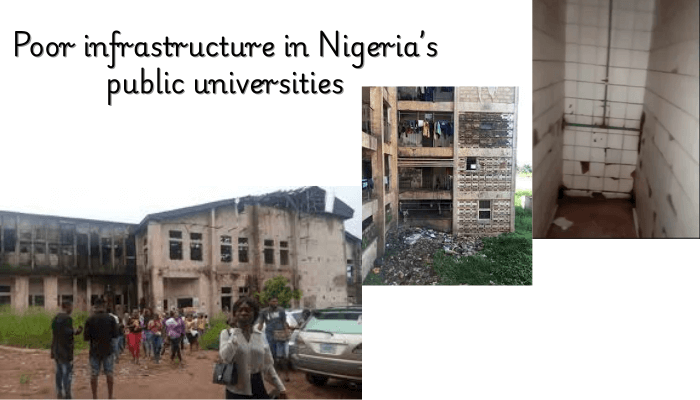
Crumbling lecture halls, outdated laboratories, overcrowded classrooms, and inadequate student accommodations are just some of the visible signs of a decaying infrastructure system that continues to undermine the country’s higher education goals.
These structural deficits, both physical and institutional, cast long shadows over efforts to improve academic quality, research output, and graduate employability, leaving students and educators caught in a system struggling to sustain itself.
So many of Nigeria’s public universities are faced with a growing crisis of decaying infrastructure beneath their supposedly admired reputation.
Read also: Nigeria tops in university numbers but trails in ranking
With crumbling lecture halls, inadequate housing, and failing utilities, the once-vibrant physical environment of Nigeria’s tertiary institutions, such as the University of Ibadan, University of Lagos, University of Nigeria, Nsukka and Nnamdi Azikiwe University, among others, is struggling to support their academic missions.

Power supply is unreliable, forcing students to rely on generators. Water scarcity is persistent, impacting hygiene and sanitation. Dilapidated roads and walkways make physical movement a challenge.
A student of the University of Ibadan, who gave his name as Bode, said his Independence Hall is not an ideal place for habitation and quality learning outcomes.
“Our facilities are broken down, the bathroom is a mess, the mattresses are bedbug-infested, and no water; besides, electricity is not constant.
“The facilities in many of our laboratories are obsolete, and good ones are not enough compared to the number of students,” he noted.
The libraries, though filled with invaluable resources, struggle with outdated facilities and space constraints for students to study.
“We are trying to provide a world-class education with third-world infrastructure,” laments another student.
A 300-level student of Political Science at the University of Lagos told BusinessDay that his learning outcomes are being affected by inadequate facilities.
“Lack of quality infrastructure slows down learning, makes research harder, and reduces overall academic performance.
“Our facilities are not very good; hostels are crowded; we have issues with quality drinking water and epileptic light supply, and our lecture halls need repairs,” he noted.
Similarly, a student in the Economics Department of the University of Lagos said her learning outcomes are affected by the lack of quality facilities.
Read also: ASUU decries poor retirement package for university lecturers
“As students of economics, we need to be taught how to practically use econometrics to solve and analyse economic issues, but due to a lack of these facilities, we are only taught theoretically,” the student said.
A postgraduate student in UNILAG also decried the negative effect of dilapidated and lack of inadequate infrastructure on his learning outcome.
“Dilapidated hostel facilities are not helping our academic quest here. How can one study in a hostel where there is no light, no water, bad doors, and bad beds?” he queried
At the Nnamdi Azikiwe University, Awka, in Anambra State, a student revealed that in some departments and hostels, the facilities are dilapidated and inadequate.
According to one of the students in the Medicine and Surgery Department, the laboratories are small compared to the number of students using them.
“We suffer from issues of overpopulation and poor ventilation. There are several unfinished buildings in the school
“Some of the infrastructure has been there for decades. The roads are bad, and it makes transportation to school difficult,” he said.
Most libraries and laboratories in public universities are decorated with old and obsolete books, not needed for 21st-century university education.
Friday Erhabor, a graduate from the Mass Communication Department at the University of Nigeria, Nsukka, over 20 years ago, wondered how students would be expected to be updated with contemporary education using outdated books.
Stakeholders believe that the need for modern hostels to ensure decent and safe accommodation, considering the number of students admitted every academic year, cannot be overemphasised.
Godwin Iguwo, an educationist, said the call for the provision of up-to-date equipment and facilities to support practical and cutting-edge learning, especially in public universities, is sacrosanct.
Nubi Achebo, director of academic planning at the Nigerian University of Technology and Management, said one of the disturbing concerns in Nigeria’s tertiary education quest is the potential compromise on quality education.
“With more universities, there’s fear of a shortage of qualified faculty members, inadequate infrastructure, and insufficient resources, ultimately affecting the quality of education,” he said.