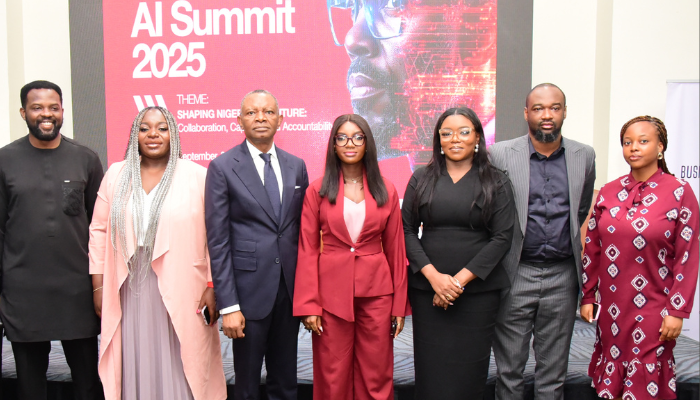
Nigeria’s path to becoming an active player in the global artificial intelligence (AI) economy hinges on collaboration, robust infrastructure, and a mindset shift, industry leaders said at the BusinessDay AI Summit 2025.
Nigeria’s AI future depends less on new institutions and more on bold decisions such as investing in infrastructure, closing the digital divide, fostering collaboration, and ensuring ethical and inclusive frameworks, they noted, at the event themed ‘Shaping Nigeria’s AI Future: Collaborations, Capacity and Accountability’.
Read also: Can Artificial Intelligence ever truly write Literature?
Charles Emembolu, founder of TechQuest STEM Academy, while speaking during a panel session, warned that while AI is already part of everyday life, Nigeria faces sovereign risks if it fails to act decisively.

“Most sectors will be affected by AI, but in Nigeria, we need to be deliberate. Innovation hubs are raising awareness not just in cities but also in rural communities. Infrastructure must come first. Collaboration is critical, but we don’t need to rebuild existing models or form new policies.
“What we need is a new mindset where ingenuity is shared as an asset. The federal government is the only actor that can make this happen at scale,” Emembolu said.
Justina Oha, executive director of Digital Equity Africa, stressed the urgent need to address Nigeria’s deep digital divide.
“If we want a fighting chance in the global AI race, we must think about powering the pipeline of digital infrastructure. Millions of Nigerians don’t have devices, and those who do struggle with expensive data. Inclusion must be reflected in the affordability of devices and connectivity. Telcos remain expensive, and we must innovate alternative models of connectivity,” she said.
On the enterprise side, Tumi Akinade, associate director of tech platforms at KPMG West Africa, noted that AI adoption starts and ends with data. “There is no artificial intelligence without data. Organisations must think carefully about data collection, integration, and governance.

“Beyond data storage, we need to consider structured datasets, scalable models, and use cases that address local needs. Policy and adoption frameworks must be sorted out internally before companies can scale,” he said.
From a legal perspective, Elizabeth Layeni, associate at Olaniwun Ajayi, argued that Nigeria has yet to establish a comprehensive legal framework for AI. “Law often plays catch-up with innovation, but regulatory sandboxes can bridge that gap.
“With sandboxes, companies deploying AI can operate within a framework that allows regulators to understand where to step in. Ethical considerations must be baked into product development from day one,” she said.
Emaediong Lawrence, associate, Wigwe & Partners, noted that equipping Nigerians with the right AI skills is fundamental, while also underscoring the role of government in leading national data collation.
Read also: Artificial Intelligence is a contradiction in terms
“Our data is fragmented. The government must take the first step, since it already has access to public data. Frameworks should then allow both public and private sectors to feed into a central data pool.
“The Nigeria Data Protection Act (NDPA) is a strong starting point, but we must protect our data to avoid selling our future, and that’s how we transition from consumers to producers of AI solutions,” she stated.