As Nigeria’s market reforms begin to show results, especially in oil & gas and manufacturing, the nation must take a crucial next step, revamping its education system and not just through curriculum padding. The gains of reform will not trickle down if citizens are not directly involved in the manufacturing processes that drive industrialisation.
Today, Nigerian industrialists outsource most of their manufacturing to foreign expertise, largely because of a dearth of local capacity. Education, which should have bridged this gap, has failed. Training graduates from ground zero is expensive, leaving industrialists with little choice but to look abroad for skilled talent.
Consider Tan Zhongming, the Chinese industrialist who transformed Sinoma into a global cement giant. He studied cement engineering at the Nanjing Institute of Chemical Technology from 1978 to 1982, honing the technical expertise that would define his legacy. Even though he had prior experience in chemical engineering, it was his focused education in cement technology that enabled him to perfect innovations China would later export worldwide.
The link between education and industrialisation is well established. In the 1960s, Mary Bowman, an American economist found that without an adult literacy rate of 70 percent – 80 percent, countries failed to industrialise. Yet, according to World Bank data, Nigeria’s adult literacy rate stood at just 63.18 percent in 2021, far below the threshold.

As Charles Robertson, former global chief economist at Renaissance Capital, argues: “Education is only the first pre-condition for economic take-off.” Without it, Nigeria’s reforms risk boosting output without creating the inclusive growth that comes from building indigenous knowledge and capacity.
Men who built their Nations
Cornelius Vanderbilt was instrumental in building the railway system in the United States and made a fortune from it. Andrew Carnegie believed steel production could transform America, and he was right. His success laid the foundation for the country’s high-rise buildings.
When Vanderbilt colluded with another railway magnate to raise freight costs on John D. Rockefeller’s oil shipments from Cleveland, he underestimated Rockefeller’s ingenuity. After fruitless negotiations, Rockefeller built his own pipeline, bypassing the costly rail system. This bold move cut his production costs, boosted profits, and threw Vanderbilt’s rail business into turmoil.
Similarly, the Association of Licensed Automobile Manufacturers (ALAM) once refused to grant Henry Ford a licence to manufacture cars for the public. At the time, automobiles already existed, but they were luxury goods reserved for the wealthy, selling for approximately $1,500. Ford envisioned a car that would cost just $900, roughly 40 percent cheaper, and be affordable for the average American.

Frustrated by delays and restrictions, he introduced mass production using the principles of division of labour and specialisation. His assembly line cut costs, improved efficiency, and brought cars within reach of ordinary households.
Threatened by his success, ALAM dragged Ford to court for producing cars without a licence and even demanded a royalty on every vehicle he sold. Ford argued that such fees would eventually raise prices and defeat his mission of making cars affordable for ordinary Americans. The judge ruled in his favour, securing his place as a pioneer of accessible mass production
These men, Vanderbilt, Carnegie, Rockefeller, and Ford, were labelled “robber barons” because of their monopolistic practices. Yet, through creativity, bold decisions, and fierce rivalry, they built industries that laid the foundation of modern America.
Nigeria’s market liberalisation yet to deliver inclusive growth
Since 1986, when Nigeria commenced its journey into economic liberalisation, government policies have only produced a few billionaires, without tying those policies to the greater good of all Nigerians. No transfer of technology, no meaningful capacity building, only a blatant policy tilt towards wealth concentration. What this has created is not builders, but what Feyi Fawehinmi, author at 1914reader, rightly calls “glorified middlemen.”
When Nigeria launched the Backwards Integration Policy (BIP) for cement in 2002, the housing deficit was about 8 million units. Yet the policy had no clear plan to close that gap. Today, the deficit has swelled to 28 million units. What it did produce, however, is a handful of billionaires, while affordable housing slipped further from the reach of ordinary Nigerians. According to BusinessDay analysis, Dangote, BUA, and Lafarge Africa saw their combined net income rise to N834.01 billion in the first six months of 2025. That’s more than triple the figures they earned in the same period last year.
As Fawehinmi notes, “What Nigeria has allowed to happen is a ridiculous situation: the innovation, the critical, value-creating process that produces society-wide benefits and constitutes the body of knowledge a nation can claim to know, has been entirely outsourced. Meanwhile, the manufacturing of billionaires has been thoroughly domesticated.” In simple language, Nigeria’s cement billionaires “did not build the technology, the machinery, or the processes” that underpin their wealth. Everything that made them billionaires was outsourced, leaving no transfer of knowledge or capacity that could multiply across the economy. This happens because government policy is not tied to such.
The opportunity cost of ignoring skills transfer
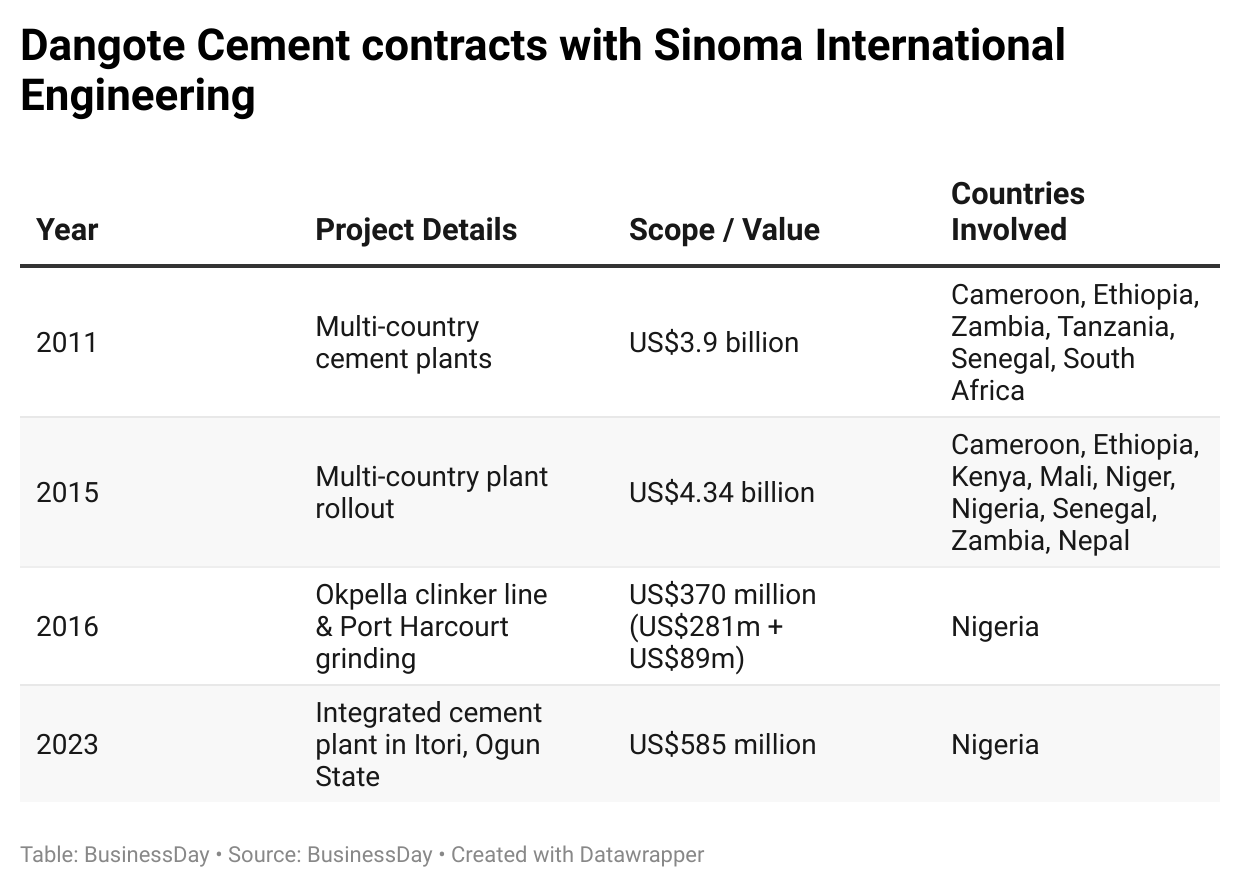
Dangote Cement has over the years signed multiple contracts with China’s Sinoma International Engineering, $3.9 billion in 2011, $4.34 billion in 2015, $370 million in 2016, and $585 million in 2023, to build cement plants across Africa, including in Cameroon, Ethiopia, Kenya, Mali, Niger, Nigeria, Senegal, and Zambia, as well as one in Nepal.
BUA Cement has followed a similar path. In 2015, it signed a $600 million contract with Sinoma to expand its Obu plant in Edo State. Five years later, in 2020, it entered a $1.05 billion deal with the same Chinese firm to build three new plants across Edo, Sokoto, and Adamawa States, each with a capacity of 3 million tonnes per annum. In 2024, Sinoma laid the foundation for another expansion in Edo (EDO4 line), and in 2025, BUA deepened this partnership with an operations and maintenance (O&M) agreement covering its Obu and Sokoto facilities.

Now imagine if the federal government had tied the Backward Integration Policy (BIP) in cement not just to boosting output, but also to bridging housing gaps, enforcing industry-wide efficiency, and mandating knowledge transfer through education reform. Nigerian engineers could, by now, build cement plants from start to finish, rather than outsourcing every major project to foreign firms. That kind of capacity would have positioned Nigeria as the exporter of cement technology across Africa, reaping billions in additional foreign exchange instead of paying it out.
The situation is not different from Nigerian Oil & Gas where the local expertise is very shallow, as many of the professionals who once worked with IOCs are either retiring or migrating abroad in search of better opportunities, leaving local firms struggling with severe shortages of skilled engineers, geoscientists, and technicians needed to sustain production.
Nigeria’s government policy agenda needs to be retweaked for knowledge transfer, and it must be on a continuous basis. Until this happens, the citizen may not truly experience shared prosperity, and the nation may not attain the status of being developed with inclusive growth.