|
Getting your Trinity Audio player ready...
|
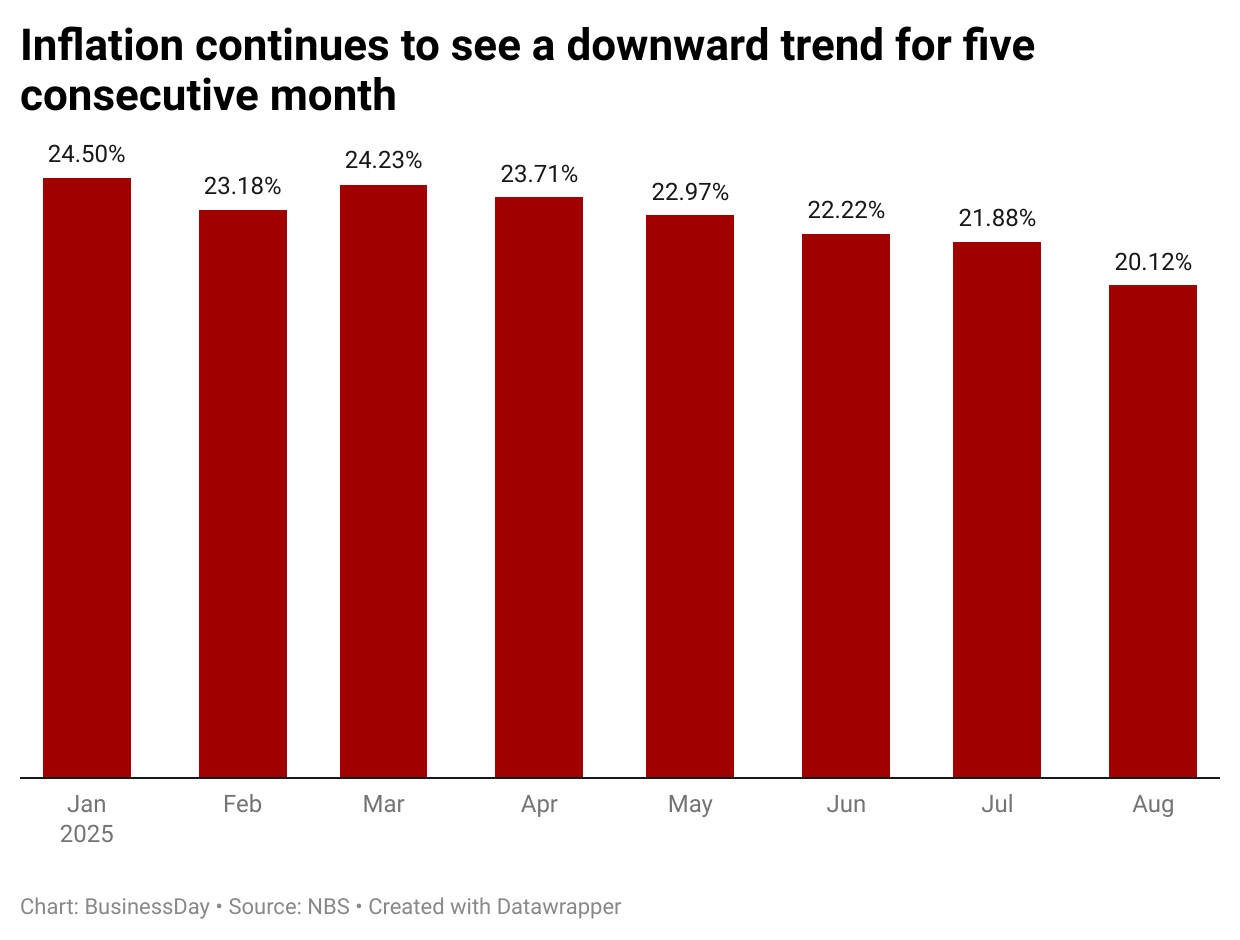
Nigeria’s headline moderated to 20.12 percent year-on-year in August, down from 21.88 percent recorded in July.
According to analysts at FBNQuest, the inflation easing in August’s inflation reading was driven by softer energy prices and ongoing stability in the FX market.
The Central Bank of Nigeria (CBN)’s sustained monetary tightening efforts have alleviated demand-side pressures, supported by a moderate expansion in credit allocation.
The naira recorded its strongest gain in seven months last week, buoyed by robust foreign reserves that saw a $4.1 billion rise between July and August. The naira closed at N1,497.46 in the official market yesterday, buoyed by ease of demand pressure and improved foreign exchange (FX) liquidity.

Similarly, both food and core inflation moderated, easing to 21.9 percent and 20.3 percent, respectively.
Read also: Nigeria’s millionaires shrink by 53% in a decade on naira fall
On a month-on-month basis, headline inflation dropped to 0.74 percent in August, compared with 1.99 percent the previous month.
Nigeria’s inflation surge between 2023 and early 2024 stemmed from FX shortages, petrol subsidy removal, security-related agricultural disruptions, and soaring logistics costs.
Food inflation

Nigeria’s food inflation eased to 21.87 percent in August 2025, representing a 15.65 percent points lower compared to 37.52 percent recorded in August 2024 and 22.74 percent reported in July 2025.
Read also: Naira hits seven-month high on $4.1bn reserves boost
According to the NBS, the decline in the annual food inflation figure is technically due to the change in the base year.
“On a month-on-month basis, food inflation rate in August 2025 was 1.65 percent, down by 1.47 percent compared to July 2025 (3.12 percent). The decrease can be attributed to the rate of decline in the average prices of rice (imported), rice (local), guinea corn flour, maize flour sold loose, guinea corn (sorghum), millet, semolina, soya milk etc,” the report stated.
Food inflation, year-on-year, was highest in Borno (36.67 percent), Kano (30.44 percent), Akwa Ibom (29.85 percent), while Zamfara (3.30 percent), Yobe (3.60 percent), and Sokoto (6.34 percent) recorded the slowest rise.
However, on a month-on-month basis, August 2025 food inflation was highest in Kaduna (9.37 percent), Katsina (9.05 percent), Akwa Ibom (7.87 percent), while Bayelsa (-9.52 percent), Sokoto (-8.92 percent), and Borno (-8.74 percent) recorded decline in the period.