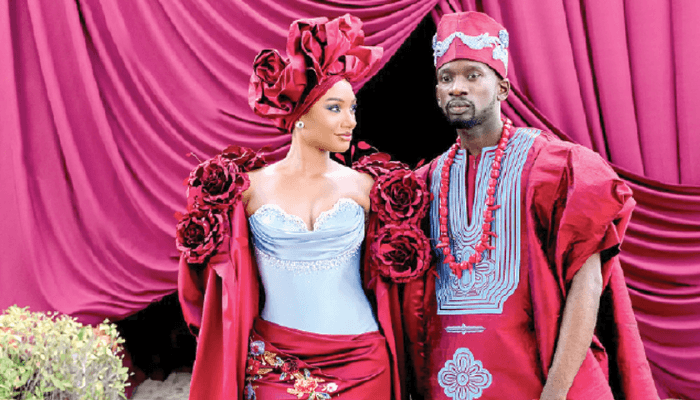
When Temi Otedola walked into the courtyard, the crowd swelled like tidewater. Her gele caught the sun; the weave of her aso-oke – handmade, jewel-toned, and unmistakably Yoruba – told a story that could not be translated by press releases alone. Beside her, Mr Eazi’s agbada draped with the quiet authority of a modern king. The ceremony was private; the signal it sent was public and loud: Nigerian luxury now speaks its own language.
That language, on this night, had a translator – Lisa Folawiyo. The designer’s hand on Temi and Mr Eazi’s garments did more than clothe a couple. It framed a deliberate act of cultural and economic branding: heritage recast as high fashion, a private ritual that doubled as a marketing moment for an industry that wants urgently to be seen as business, not merely culture.
A fashion dynasty, reimagined
Lisa Folawiyo’s work is not a sudden burst of celebrity patronage. It is genealogy. In the 1970s, Abah Folawiyo (also known as Sisis Abah) founded Labanella, a Lagos label credited with modernising Ankara and introducing refined, cosmopolitan silhouettes to West African wardrobes. That lineage is essential: Lisa did not invent the fabrics or the rituals; she honed them into a language the global luxury market recognises.

Where Labanella proved Ankara could be chic for a growing Nigerian middle class, Lisa Folawiyo has helped prove it can be collectible on international runways. The couture at Temi and Mr Eazi’s wedding was part textile, part diplomacy – an emblem of continuity from mother to daughter, and from Lagos studios to the world stage.

The wedding as national signalling
Why does a wedding matter to economists? Because fashion is information: it signals supply chains, tastes, and willingness to pay. Temi Otedola is a scion of one of Nigeria’s most visible business families; Mr Eazi is a pan-African cultural entrepreneur with business interests across entertainment and tech. When such a couple chooses Nigerian textiles and a local designer for an internationally watched event, they amplify demand narratives for local materials, skills and brands. In commodity terms, that translates to higher perceived value for aso-oke, adire, embellished Ankara and the clusters that produce them – and that is precisely the currency Nigeria’s creative economy needs.
Fashion as industry, not charity: the numbers

This is not mere optimism. Nigeria’s fashion sector already carries serious economic weight. Analysts estimate Nigeria accounts for roughly $4.7 billion of the sub-Saharan African fashion market – a figure that captures retail, design and related services and shows rapid growth despite economic headwinds.
Yet the balance sheet also contains uncomfortable truths. Textile imports have surged sharply in recent years: official data show import bills for textile and textile articles rising to N726.18 billion in 2024, a 298% increase from 2020. That leap underscores a paradox: a country with deep textile traditions and cotton potential is increasingly dependent on foreign fabrics and finished apparel.
Trade data tell a similar story at the product level: Nigeria imports significant volumes of apparel and textile products from Asia and Europe, which both supply domestic demand and undercut local manufacturing.
Why moments like this move markets
There are three channels by which a high-profile wedding becomes an industry accelerant:
Demand signalling. When elites publicly adopt local labels for prestige occasions, purchase intent ripples through aspirational cohorts.
Provenance branding. Designers like Folawiyo convert cultural authenticity into traceable luxury – a commodity buyers pay extra for.
Supply-chain pull. High visibility creates demand for higher-quality inputs and predictable volumes, which justifies investment in processing, dyeing, weaving and certification.
Lagos already has the cultural credentials: a rising roster of globally recognised designers (from Lisa Folawiyo to Kenneth Ize and Maki Oh) and recurring platforms such as Lagos Fashion Week that channel attention internationally. Yet the industry’s scale remains constrained by weak upstream linkages, limited finance and import dependence.
From heritage to hard economics – a short playbook
If Nigeria is to translate stylistic moments into industrial heft, it must act in three areas:
1. Anchor the supply chain. Invest in local textile manufacturing (ginning, spinning, weaving) and incentivise backward integration. Public-private partnerships, SAPZ-style agro-industrial models and targeted credit lines for textile SMEs would reduce import dependence and stabilise input costs.
2. Scale brands as businesses. Designers need industrial partners for production, distribution and export licensing. Support for packaging, quality certification and commercialisation (retail shelf space, export facilitation via the Nigerian Export Promotion Council and Nigerian Export-Import Bank) converts cultural capital into balance-sheet results.
3. Create prestige markets at home. Encourage government procurement, state events and corporate patronage to normalise high-end local procurement. When governors, ministers and leading corporates wear Nigeria-made luxury, it creates repeatable demand.
The currency of cultural capital
Fashion has long been a tool of national branding. Paris used couture to anchor French soft power; Italy industrialised leather into global luxury. Nigeria’s moment is to make aso-oke, adire and embellished Ankara both a cultural badge and a line item in export planning. The Temi–Mr Eazi wedding did that in fifteen minutes: it closed a circle between family legacy, cultural identity and market potential.
One wedding, many narratives
On one level, it was a private, emotional moment. On another, it was an economic nudge: an elite couple wearing Nigerian luxury on a public stage, a designer translating family legacy into a signifier of modern Nigerian sophistication, and an industry watching for profit pathways. As Lisa Folawiyo continues the trajectory started by Labanella, her work at the altar may yet prove as impactful as any runway show – because this is one time when cloth met currency, and both changed value.