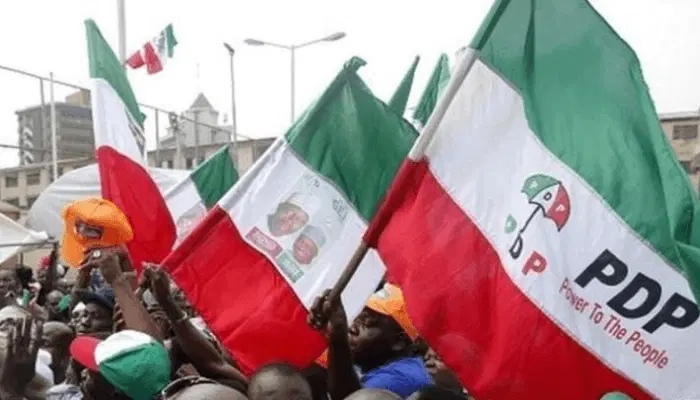
Nigeria’s main opposition, the People’s Democratic Party (PDP), once regarded as the most formidable opposition party in Lagos State has now disintegrated and becoming a shadow of itself.
In the last two decades, the party has remained a rallying point for opposition politicians in Lagos State, the commercial capital of Nigeria, with a long history of challenging the ruling Alliance for Democracy (AD), Action Congress of Nigeria (ACN) and now the All Progressives Congress (APC).
The PDP, once described as the largest in Africa, has now been reduced to nothing in Lagos State, the home state of President Bola Ahmed Tinubu.
Indeed, Lagos PDP has not known peace in the last one decade and has been enmeshed in one leadership crisis or the other, especially prior to a major election. This often affects the party’s capacity to mount any serious challenge to the ruling party in the state over the years in major elections.

Even though, few party leaders often struggle to salvage the situation leading up to major polls by persevere few chieftains to work in accord, deepening disunity, insincerity, anti-party activities and a lack of sense of purpose among its leaders often come back to hunt Lagos PDP on election day.
But the troubles facing the party in Lagos State seem to have worsened after the 2023 general election, perhaps, descending from the national to the state.
The party went into the 2023 general election engulfed in crisis, divided into factions and had its worst results in a gubernatorial election in the state since it was birthed in 1999.
After that there were complaints by party members that many influential individuals within the party worked for the ruling party’s victory in the state.
The party’s votes were not up to the number of votes from a local government.

Political analysts said it was a reminder of the party’s dwindling fortunes. The PDP failed to win a single seat in the Lagos State House of Assembly, while the APC retained dominance with 38 seats and the rising Labour Party, LP, clinched 2 seats.
The trend continued in the House of Representatives election, where the APC secured 19 seats, LP took 5, and PDP again walked away empty-handed.
Read also: LP, PDP, ADC, others working to field best candidates in 2027- LP spokesman
The result of the election showed that Babajide Sanwo-Olu (APC) polled 762,134 votes, Gbadebo Rhodes-Vivour of Labour Party got 312,329 votes and Abdul-Azeez Adediran (Jandor, PDP) came far behind with 62,449 votes.
For the first time in two decades, the PDP did not even place second.
Instead, it placed a distant third, trailing the Labour Party by a massive margin of nearly 250,000 votes, unlike in 2019 where PDP’s candidate Jimi Agbaje polled 206,141 behind Sanwo-Olu.
This sharp contrast to previous elections, where the PDP routinely placed second behind the APC, was both historic and humiliating.
The handwriting was on the wall when Abdul-Azeez Olajide Adediran Jandor, PDP’s much-publicized 2023 gubernatorial candidate, returned to the APC.
Jandor, who once left the APC in protest, cited internal sabotage and a lack of commitment from PDP leadership during the election as reasons for his return.
His exit signaled to many party faithful that there was no future left in PDP, at least not in Lagos. The vacuum left behind was quickly filled by silence, confusion and infighting.
While PDP struggled with internal divisions and court-imposed paralysis, a new force emerged.
The Labour Party, previously a non-factor in Lagos politics, surged forward on the back of Peter Obi’s presidential campaign and the viral ‘Obidient Movement.’
Energised by youths, tech-savvy professionals and first-time voters, LP stepped into the space PDP had vacated.
Just like similar crisis bedevilling the PDP at the national level, the crisis in Lagos has continued. Ironically, with the next general election cycle inching closer, the PDP’s prospects in Lagos look increasingly blink.
In recent months, many party members and chieftains have dumped the party for the new opposition coalition which fused into the African Democratic Party (ADC).
Political watchers say the party has no clear leadership structure, no policy direction and has lost most of its experienced political tacticians to the APC and the ADC.
“Those people who know me, know I am a very principled man, anything I do I want to do it and give my all. I have defended PDP enough and I am not willing to continue. There is a lot of indiscipline in the party; people are doing anti-party activity and nobody is talking about it, it gives us a lot of concerns,” Tunji Shelle, a former Lagos PDP chairman, who recently defected to the ADC, said in an interview on Inside Politics on BDTelevision last week.
Shelle, pointed out that his defection would not be a surprise to those close to him, because he had tried to bring sanity to the Lagos PDP without success.
According to him, PDP has its internal mechanism of resolving these issues, but unfortunately for a long time; it has not been achieved.
“Somebody is sitting there, detecting the pace, he is the one that can choose the PDP’s chairman for you today, choose chairman for you in the future and he thinks he is in control of the party. If he wants to leave the party, let him leave honourably. Let him go and join the APC.
“Let him focus on your job in the FCT, but rather he is influencing things in the party and drawing the PDP back and I had to take my destiny in my hand and leave for the ADC”.
Similarly, among the defectors in recent months was Hakeem Amode, the party’s former publicity secretary, who left along with several top party leaders, to the ruling APC. He stated that it was obvious the party has lost its bearing in the state.
Amode said the decision to leave the PDP followed deep reflection and consultations. He described the move as a significant turning point for himself and other long-standing party members.
“It is with a profound sense of responsibility that we make this decision. The PDP, as it stands today in Lagos, is riddled with internal crises, lack of cohesion, and leadership challenges.
“After years of active participation with both wins and setbacks it became necessary to reassess our political trajectory. We believe this move is essential for serving the people more effectively and making meaningful contributions to governance”, Amode had said.
Sources within the party told BusinessDay that more Lagos PDP members would join the ADC in the coming months, noting that there were even members in the state executive committee that were sympathetic to Atiku Abubakar’s presidential bid in 2027.
“It does not seem there is any hope for 2027, there is no sign things would change either compared to what we had in 2023 that is why you see many members leaving to the ADC and others.
“I can tell you there are some members in the state exco, who will work for Atiku in 2027. Some people at the top don’t want peace for this party and they are bent on things remaining like this”, a source stated.
However, a chieftain of the party who spoke on the condition of anonymity blamed the ruling APC for the crisis in Lagos PDP, noting that the APC, under the leadership, has done everything possible to frustrate the opposition out of relevance.
The sources stated that much of the party’s crisis is instigated by the ruling party and members lured to the APC.
According to him, they’ve captured not just political structures, but institutions, the democratic space, and even the people’s confidence.
“They are gradually turning Nigeria into a one-party state. If not, how do you explain a sitting governor from another political party campaigning for him while the citizens suffer?
“Opposition voices are being suppressed. Tinubu knows his popularity in Lagos is dwindling. If truly free and fair elections are held, he’ll lose Lagos again. It’s a shame,” the source said.