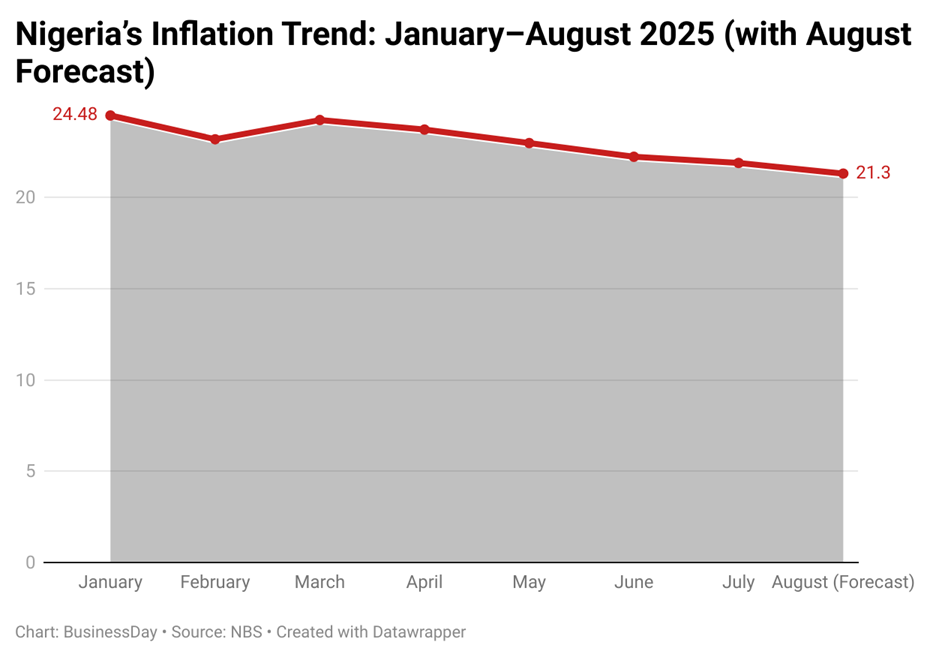
For the first time in years, Nigeria is recording a sustained slowdown in inflation, raising hopes that economic sentiment may finally be shifting in favour of stability. Headline inflation eased for a fourth consecutive month in July, falling to 21.88 percent from 22.22 percent in June.
Analysts at Access Bank expect the August figure, due later this month, to drop further to about 21.3 percent. If realised, it would mark the fifth month of disinflation and signal the most durable retreat in prices in over a decade.
For households squeezed by years of rising costs and stagnant wages, the numbers offer little immediate comfort. Food and transport remain punishingly expensive. But the easing trend gives policymakers a rare opportunity to consolidate stability before political pressures mount ahead of the 2027 elections.
Drivers of the slowdown
Several factors are working in Nigeria’s favour. The naira has held steady, trading around N1,533 per dollar in July, supported by stronger foreign portfolio inflows and reserves of $41.3bn, the highest in three years. A more stable currency has helped anchor import costs, especially for fuel and key staples.
Food inflation, once the main driver of overall prices, has slowed sharply. At 22.7 percent in July, it is far below the near-40 percent pace of a year earlier. Improved domestic supply of beans, maize and rice, coupled with softer global prices for cereals and vegetable oils, have eased pressures.
The ramp-up of the Dangote refinery has further reduced demand for imported fuel, removing one of the economy’s biggest foreign exchange strains.
Tighter monetary policy has reinforced these tailwinds. Yields on longer-dated government paper have climbed, reflecting both tighter liquidity conditions and strong investor demand at auctions. The oversubscription of recent bond and OMO sales highlights confidence in the central bank’s restrictive stance, which has helped anchor expectations.
Risks to momentum
The decline in inflation remains fragile. Election years in Nigeria have historically loosened fiscal discipline, with spending increases stoking demand and undermining price stability. If that cycle repeats in 2026, the recent gains could quickly unravel.
External risks also loom. A spike in oil prices, weaker portfolio inflows, or global food supply shocks could reignite pressure on the naira and drive costs higher. Domestically, insecurity in farming regions and poor transport infrastructure continue to threaten food supply, the most sensitive part of the inflation basket.
Outlook
Analysts see three possible paths. A baseline, assuming policy stays tight and reserves remain strong, could see inflation fall to 17 percent–19 percent by the end of 2025.
A worst-case scenario, shaped by election spending and external shocks, would keep inflation between 20 and 23 per cent. A best case, with strong harvests and benign global prices, could push it down faster, to 15 percent–17 percent.
Credibility test
For citizens, inflation is not a macroeconomic trend but a daily struggle. “Even with a pay rise, what I bring home still cannot feed my children,” said a Lagos teacher. “Until food and transport costs drop, these numbers mean little.”
For policymakers, the test is whether the current easing builds credibility. If falling prices translate into falling hardship, confidence will grow. If not, the risk is that the reprieve proves temporary, leaving reforms once again judged as economically correct but socially irrelevant.