



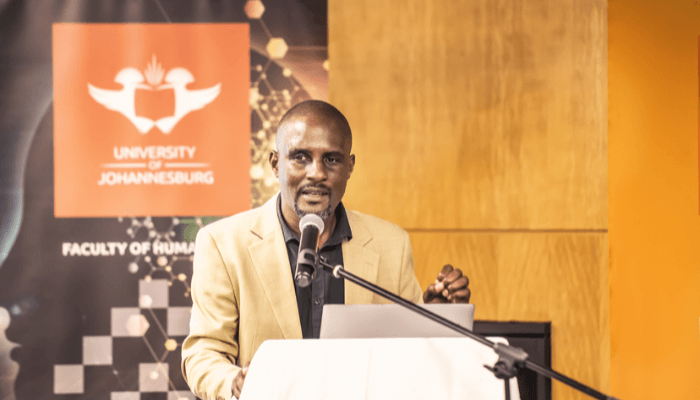
The global order is undergoing seismic shifts, with Africa caught in the middle of emerging rivalries between old and rising powers.
This was delivered in a keynote address by Admire Mare, associate professor in the department of communication and media at the University of Johannesburg, South Africa, examining nationalism, technology, and Africa’s role in shaping the future.
Mare drew his teaching from Fareed Zakaria’s 2009 book The Post-American World and the Rise of the Rest, which predicted the decline of U.S. dominance and the emergence of multiple centres of power.
“The old order is dying, but the new cannot be born,” he said, describing a world where the United States, China, Russia, Turkey, and Gulf nations are competing for influence while Africa struggles to define its position.

He pointed to South Africa’s strained relations with Washington over its ties to BRICS as an example of how smaller nations are punished for asserting independence. The U.S. dollar’s dominance, he argued, is directly threatened by alternative trade currencies being considered by BRICS states, explaining why America is pushing back.
The battle for global technological supremacy was another theme. While U.S. firms dominate global apps, China has built domestic alternatives for nearly every platform. Africa, by contrast, remains “a net downloader, not an uploader,” consuming global technologies while supplying raw materials that fuel them. The rise of AI firms like China’s DeepSeek, he noted, has rattled American confidence in its own technological superiority.
On Africa’s internal challenges, the speaker was blunt: democracy is failing to deliver dividends for ordinary citizens. Frustration with entrenched leaders has fueled admiration for figures like Niger’s Ibrahim Traoré, whose rise is seen by some as a return to strongman politics reminiscent of Kwame Nkrumah. “When people look to coups as a way of solving problems, we must ask ourselves—where did democracy go wrong?” he said.
He also highlighted the Democratic Republic of Congo as a stark example of how resource wars are overlooked in global media discourse. While Ukraine and Gaza dominate headlines, the conflicts in Central Africa—where critical minerals for AI and electronics are extracted—receive far less attention.
The role of the media, he insisted, is central to Africa’s future. “We cannot rely on CNN to tell our stories. Our media must dig deeper, unpack issues, and amplify African voices,” he said, criticising the tendency of local outlets to only quote politicians rather than ordinary people.

Ultimately, the address framed Africa’s biggest tragedy as its lack of a unified agenda. “The rest of the world has an agenda for Africa. Africa has no agenda for the rest of the world,” he lamented, calling for stronger continental positions on global issues.





