Nigeria’s inflation outlook: A turning tide amid policy coordination
By Dr. Oluyemi Adeosun
Nigeria’s economic narrative in 2025 is being gradually reshaped—not by dramatic breakthroughs, but by the deliberate recalibration of a complex economy finding its footing. The country’s inflation trajectory, long a barometer of both macroeconomic credibility and household welfare, is finally beginning to bend in the right direction. While the scars of past volatility remain evident, the green shoots of stability are increasingly visible and convincing.


The Current Landscape: Cautious Optimism
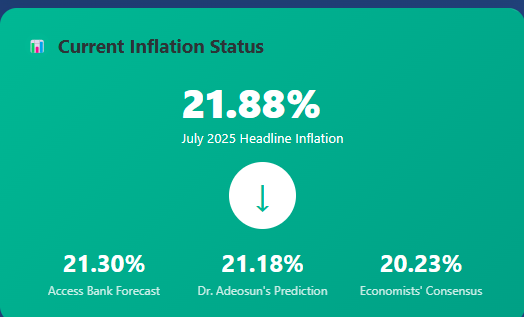
In July 2025, headline inflation eased for the fourth consecutive month to 21.88%, continuing a disinflationary trend that began in the second quarter. Our independent forecast for August 2025 suggests a further decline to 21.18%—marginally below Access Bank’s projection of 21.30%. This difference, though seemingly modest, reflects deeper analytical considerations of three concurrent forces reshaping Nigeria’s price dynamics: food market normalization, exchange rate stability, and improving investor sentiment. The BusinessDay Board of Economists survey provides additional insight into market expectations. Among 18 respondents, nine economists—representing 50%—forecast that August 2025 inflation would fall below 20%, with seasonal harvest effects cited as a critical driver. Only four economists (22.2%) expect inflation to remain at July’s level of 21.88%. The weighted consensus points to a headline inflation rate of approximately 20.23%, suggesting expert sentiment is more optimistic than both institutional forecasts and our model-based estimates.Should this view materialize, it would mark the sharpest disinflationary move in over 18 months—a strong endorsement of Nigeria’s evolving policy framework.

Food Price Revolution: The Primary Driver
Nigeria’s inflation surge between 2023 and early 2024 stemmed from a perfect storm: foreign exchange shortages, petrol subsidy removal, security-related agricultural disruptions, and soaring logistics costs. Today, that storm is passing, with food prices leading the retreat. The most striking development has been the collapse in food inflation from 39.53% in July 2024 to 22.74% a year later. While base effects and statistical rebasing contribute significantly to this decline, underlying fundamentals are genuinely improving. Prices of major staples—rice, maize flour, sorghum, millet, and vegetable oil—have all softened considerably. Supply chains are recovering post-harvest, input costs have stabilized, and a better-than-expected rainy season has boosted agricultural output. This food price normalization is critical for Nigeria, where food accounts for a disproportionate share of household expenditure, particularly among lower-income groups. The sustained decline suggests that supply-side interventions and seasonal patterns are finally overwhelming the demand-pull factors that drove prices higher in previous years.


Currency Stability: The Unsung Hero
For an import-dependent economy like Nigeria, exchange rate stability represents more than psychological comfort—it delivers material disinflationary benefits. The naira’s recent performance, appreciating 0.83% year-to-date against the US dollar and holding steady around ₦1,533.62/$, has substantially reduced imported inflation pressures. This newfound stability rests on structural foundations. Foreign portfolio inflows have strengthened, lifting external reserves to $41.26 billion—the highest level in three years. Simultaneously, fuel import demand is declining as local refining capacity, notably the Dangote Refinery, gradually comes online. Nigeria’s foreign exchange position is thus improving on both supply and demand sides. Investor confidence is evident in capital market flows. Equity market inflows rose from ₦139.31 billion in June to ₦145.95 billion in July, reflecting growing faith in Nigeria’s macroeconomic trajectory. Bond market oversubscription for both Open Market Operations bills and Federal Government bonds demonstrates rising appetite for naira assets, particularly at the long end of the yield curve.
Monetary Policy: The Central Bank’s Quiet Victory
Central banking, when executed effectively, often operates in the shadows—no headlines, no populist applause, just steady progress toward price stability. The Central Bank of Nigeria’s unwavering commitment to tight monetary policy through sustained high interest rates is yielding dividends. The 364-day Treasury Bill yield has climbed to 17.44% in August, with investors increasingly confident that inflation may have peaked. More importantly, the CBN’s credibility—severely damaged during years of foreign exchange controls and opaque policy decisions—is being methodically rebuilt. The inverted yield curve and sustained investor appetite for longer-dated securities signal market expectations of declining inflation, validating the central bank’s hawkish stance. Policy coordination, long absent from Nigeria’s economic management, is also being restored. Recent joint summits involving the Ministry of Finance, the CBN, and the Federal Inland Revenue Service demonstrate a unified approach to macroeconomic challenges—perhaps the most underreported success story of 2025.
Forward-Looking Indicators: Reading the Economic Tea Leaves
The disinflationary trend extends beyond statistical base effects. Nigeria’s effective tariff exposure remains among the world’s lowest at just 0.2%, primarily due to oil and gas export exemptions. This has helped shield the economy from global trade tensions while preserving export revenues. Capital market behavior provides forward-looking insights. Investors are no longer pricing significant inflation risk into their decisions. Bid-to-cover ratios in OMO auctions have soared, particularly for tenors beyond 245 days, while the Debt Management Office’s new issuances have all been oversubscribed. This appetite for naira-denominated instruments reflects genuine confidence, not merely yield-chasing behavior. The newly launched Renewed Hope Development Plan (2026-2030), embedded within the broader Nigeria Agenda 2050, reinforces this optimism. By prioritizing structural transformation, infrastructure investment, and macroeconomic stability, the plan provides a credible medium-term framework for achieving the ambitious goal of a $1 trillion economy.
Persistent Vulnerabilities: Tempering Expectations
Despite encouraging trends, Nigeria remains structurally fragile. Inflation at 21.18%, while declining, still ranks among Africa’s highest. Fiscal space remains constrained, public debt servicing costs are elevated, and the tax-to-GDP ratio hovers at just over 10%. A drought, oil price collapse, or renewed insecurity in food-producing regions could quickly reverse recent gains.
Food price volatility represents a particular vulnerability. Post-harvest relief may prove temporary if structural issues—post-harvest losses, low mechanization levels, and rural insecurity—remain unaddressed. Transport and logistics costs also remain sticky, particularly given high diesel prices and underdeveloped intermodal infrastructure. Policy slippage poses another risk. With political pressures mounting, the temptation to abandon fiscal discipline for short-term populism is ever-present. The recent unity between fiscal and monetary authorities must be sustained through institutional reforms, not merely coordinated rhetoric.
Conclusion: A Tenuous but Promising Turning Point
The broad contours of Nigeria’s inflation story are shifting positively. The convergence of declining headline and core inflation, currency stability, and stronger foreign exchange buffers is creating a more stable platform for economic planning and private sector confidence. While 21.18% inflation remains elevated, the trajectory and underlying drivers offer genuine cause for optimism. Success in maintaining this disinflationary path requires sustained discipline: avoiding populist fiscal shocks, improving agricultural logistics, deepening financial markets, and keeping the CBN focused on its inflation-targeting mandate. If Nigeria can stay this course, 2026 could witness inflation falling into the high teens or even lower. Ultimately, the most transformative economic stories are written not in dramatic headlines but through disciplined policy execution. Nigeria’s inflation trajectory in August 2025 exemplifies this principle—a testament to the power of steady, coordinated course correction in complex economic systems. The turning tide, while still tentative, appears increasingly sustainable.